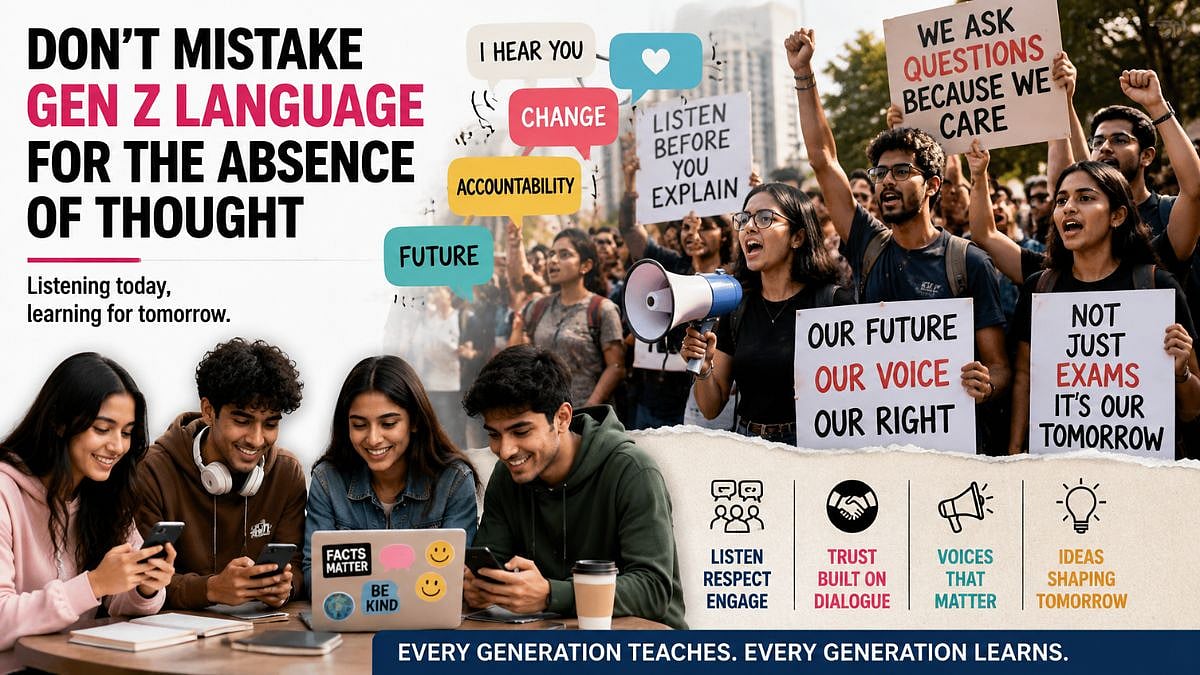
A few days ago, a professional acquaintance cancelled a meeting at the last minute to join the student protests in Mumbai. He has no children. Yet, what struck me was not his decision to stand with the students but his quiet admission that he wished he had possessed their courage much earlier in life. Watching them, he mentioned, was less about supporting a movement than about rediscovering the confidence to ask difficult questions.
Most of us instinctively believe that wisdom flows only in one direction, from the older generation to the younger. We speak of mentoring, coaching and guiding the young. The recent student protests, regardless of where one stands politically, are a reminder that every generation occasionally becomes both the teacher and the taught.
Every protest eventually becomes political. Democracies are designed that way. Yet, if we allow politics alone to define what we have witnessed, we risk overlooking something much larger. The significance of these events may not lie in who won a political contest but in what an entire generation has been trying to tell the rest of us about trust, communication, accountability and the future they hope to inherit.
The Cost Of OldGensplaining
We are familiar with the word mansplaining. Perhaps it is time to coin another expression: ‘OldGensplaining’.
It should describe the tendency of older generations to explain away the anxieties of younger people before taking the trouble to understand them. It is the confidence that experience automatically produces better judgement, that age entitles us to speak first and listen later.
OldGensplaining is not confined to families. Parents do it to children. Professors do it to students. CEOs do it to young employees. Boards do it to first-generation entrepreneurs. Governments, occasionally, do it to citizens. We forget that the very generation once dismissed as impatient eventually becomes the generation that changes society.
In a nation whose demographic centre of gravity is among the youngest in the world, anyone above thirty-five, including me, is living on borrowed relevance. Experience no longer guarantees influence. Every generation must earn its place again by remaining curious, adaptable and willing to learn.
Beyond Exams And Employment
Reducing student protests to examinations alone misses the larger picture. Employment is only one anxiety. Livelihood, affordability, social mobility and confidence in tomorrow have merged into a broader question that quietly troubles many young Indians: will tomorrow reward today’s effort? Whether that perception is universally accurate matters less than recognising that it exists.
Whether every perception is objectively correct is almost beside the point. Institutions are ultimately judged not only by the policies they produce but also by the confidence they inspire. Trust cannot be legislated into existence, nor can it be defended through explanations alone. It is earned when citizens believe that institutions are willing to listen before they begin to justify themselves.
There is another lesson hidden in these protests, one about communication itself. We celebrate India’s rise as a creator economy, proudly counting influencers, digital entrepreneurs and millions of content creators. Ironically, right after the student protests, we had the cringe post boasting about record views on Instagram Reels, missing the point that younger voices had just won.
Yet, that is precisely the next lesson—one of grace. Increasingly, leadership across any sphere will be measured by the humility of its responses. Sometimes the strongest institutional act is not another explanation but a sincere apology. Sometimes it is a heartfelt thank you. Sometimes it is simply saying, “I hear you”.
Those three words acknowledge dignity before disagreement. They restore trust before they settle debate. In every sphere of life, whether in government, business, universities or families, that grace has become a leadership competency, a rare one, not surprisingly.
Understanding Gen Z’s Language
While we celebrate becoming one of the world’s largest creator economies, creators understand something institutions often overlook. Content travels because context gives it meaning. A thirty-second video becomes powerful only because thousands already understand the story surrounding it. Gen Z instinctively builds both together.
We have spent years mocking Gen Z’s emojis, memes, abbreviations and social media habits as signs of shrinking attention spans. Perhaps we have been studying the wrong phenomenon. Every generation develops its own vocabulary. Memes are not simply jokes. Emojis are not emotional shortcuts. Digital humour is often a compressed form of commentary. We mistake a different language for the absence of thought because we continue to judge digital natives through analogue assumptions.
Gen Z understands this instinctively. They do not merely communicate; they document, interpret, remix and amplify. Their memes are often arguments in disguise. Their humour carries criticism. Their videos become public records. Their smartphones have turned every participant into a witness and every witness into a publisher.
Older generations grew up believing communication meant broadcasting. Institutions spoke and citizens received. Gen Z sees communication as participation. Every protester is also a documentarian. Every bystander is potentially a publisher. Every smartphone is simultaneously a camera, an archive and a distribution platform.
Questions Strengthen Democracy
The protests also carry an important lesson in accountability. Previous generations often accepted that authority deserved deference simply because it occupied high office. Gen Z appears less persuaded by hierarchy alone. Respect remains important, but it has become increasingly reciprocal. Questions are no longer viewed as acts of disobedience. They are expressions of citizenship. Institutions should resist the temptation to mistake scrutiny for hostility. Democracies become stronger when citizens care enough to demand answers rather than retreat into indifference.
India’s greatest demographic advantage is not merely that it has one of the world’s youngest populations; it is, hopefully, that every generation still has the opportunity to learn from the next. Perhaps the highest form of experience is not having all the answers; it is recognising when the youngest among us have begun asking better questions. For reminding us of that timeless truth, our generation owes India’s young something remarkably simple, and remarkably overdue: our gratitude.
Dr Srinath Sridharan is a policy researcher and corporate adviser. X: @ssmumbai

