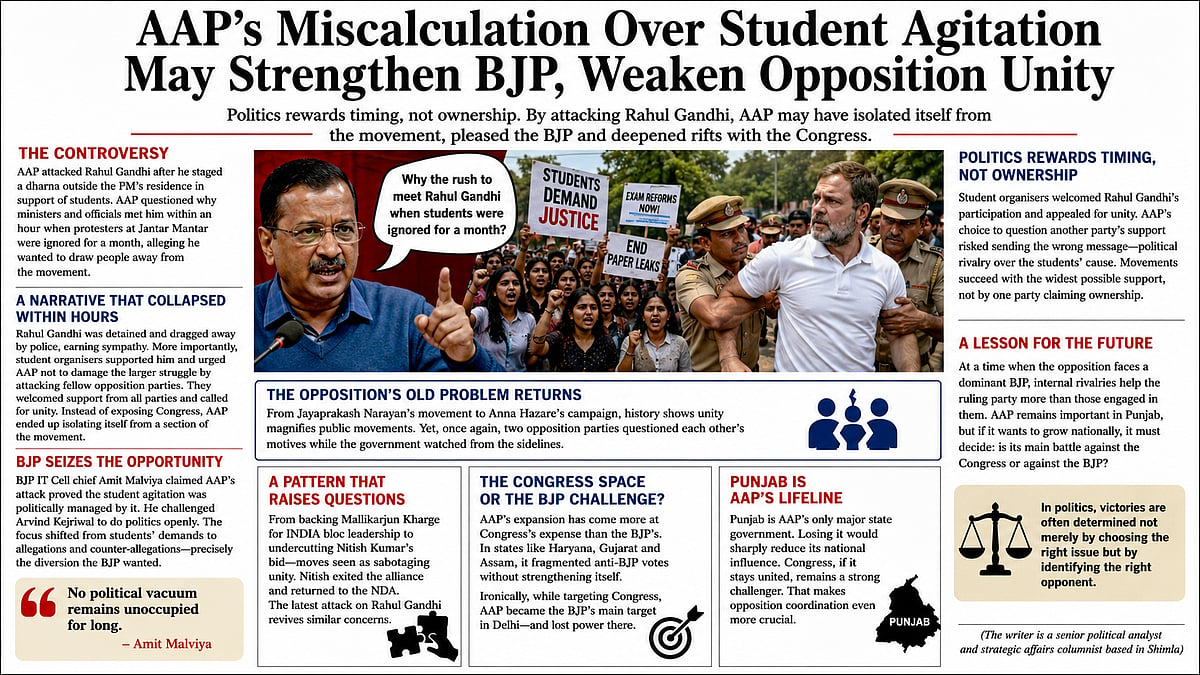
Politics often punishes misreading the public mood more severely than making an ideological mistake. The latest controversy surrounding the nationwide student agitation appears to have done exactly that for the Aam Aadmi Party (AAP). What was perhaps intended as an attempt to expose Congress's political opportunism has instead left AAP facing criticism from sections of the protest movement, discomfort among opposition parties and fresh attacks from the BJP. The episode has revived an old question: Is AAP's determination to occupy the Congress space inadvertently helping the BJP while weakening opposition unity?
The controversy erupted after Leader of the Opposition; Rahul Gandhi staged a dharna outside the Prime Minister's residence in support of the students' demands. Instead of welcoming another major opposition party joining the agitation, AAP leaders launched a sharp attack. They questioned why, according to them, two Union Ministers and senior officials responded to Rahul Gandhi within an hour when the government had ignored the month-long agitation at Jantar Mantar. They further alleged that Rahul Gandhi was more interested in drawing people away from the students' movement than strengthening it.
Politically, however, the attack produced precisely the opposite result.
A Narrative That Collapsed Within Hours
Within hours of Rahul Gandhi's protest, he was detained and forcibly dragged by the police, generating considerable political sympathy. More significantly, the organisers of the student movement publicly supported Rahul Gandhi and appealed to AAP not to damage the larger struggle by attacking fellow opposition parties. Their message was unambiguous: the movement welcomed support from every political party willing to stand with the students and saw no merit in opposition infighting.
The reaction left AAP on the defensive. Instead of exposing Congress, it appeared to have isolated itself from a section of the movement whose support it had hoped to retain.
Many protesters subsequently argued that if Rahul Gandhi's intervention could bring national attention to their demands, every opposition party should intensify rather than dilute the pressure on the Modi government. They urged AAP to launch equally aggressive campaigns instead of questioning another opposition party's participation. For a movement seeking wider political backing, unity mattered far more than political ownership.
BJP Seizes the Opportunity
No political vacuum remains unoccupied for long.
BJP IT Cell chief, Amit Malviya quickly claimed that AAP's criticism of Rahul Gandhi amounted to an admission that the supposedly independent student agitation was actually being politically managed by AAP. Challenging Arvind Kejriwal to conduct politics openly instead of allegedly hiding behind student organisations, Malviya attempted to turn AAP's own argument against it.
Whether one accepts the BJP's interpretation or not, the political damage was evident. Instead of the national debate remaining focused on examination reforms and accountability, attention shifted towards allegations, counter-allegations and questions over which opposition party was attempting to claim leadership of the movement.
The BJP could scarcely have asked for a more convenient diversion.
The Opposition's Old Problem Returns
The episode has once again exposed the chronic weakness of India's opposition politics—its inability to remain united even when confronting a common adversary.
Governments become politically vulnerable when opposition parties converge around a common issue. From Jayaprakash Narayan's movement in the 1970s to Anna Hazare's anti-corruption campaign, history shows that broad-based political support often magnifies public movements.
Instead, the present agitation witnessed two opposition parties questioning each other's motives while the government watched from the sidelines.
For many observers, AAP's response appeared less like a defence of the students' movement and more like another chapter in its prolonged rivalry with the Congress.
A Pattern That Raises Questions
The latest controversy is not an isolated incident. It fits into a broader political pattern that has increasingly shaped AAP's relationship with the Congress.
It may be recalled that during a crucial INDIA alliance meeting, Arvind Kejriwal and former West Bengal Chief Minister Mamata Banerjee unexpectedly proposed Congress president, Mallikarjun Kharge for the alliance's top leadership position which was evidence of evidence of sabotaging the unity. The move reportedly surprised even senior Congress leaders. Many political observers interpreted it as effectively undercutting then Bihar Chief Minister, Nitish Kumar's bid to become the alliance's convenor. Nitish Kumar subsequently exited the INDIA bloc and returned to the NDA, dealing a serious blow to opposition unity from which the alliance never fully recovered.
Whether intentional or otherwise, the latest attack on Rahul Gandhi has revived similar concerns that AAP's political calculations frequently end up widening divisions within the opposition rather than narrowing them.
The Congress Space or the BJP Challenge?
Since its inception, AAP has attempted to position itself as the principal alternative to both the BJP and the Congress. In practice, however, much of its political expansion has come at the expense of the Congress rather than the BJP.
The party's electoral strategy in states such as Haryana,Gujarat and Assam, despite having a limited organisational presence, has long attracted criticism from opposition leaders who argue that it fragmented anti-BJP votes without substantially strengthening AAP itself.
Whether that criticism is entirely justified remains debatable. Yet the perception has persisted and has complicated relations between the two opposition parties.
Ironically, while AAP concentrated considerable political energy in challenging the Congress nationally, it eventually became the principal target of the BJP in Delhi. The liquor policy investigations, arrests of senior leaders and the BJP's subsequent electoral victory in Delhi fundamentally altered AAP's political landscape.
The party today confronts a political reality very different from the one it envisaged a decade ago.
Punjab Has Become AAP's Political Lifeline
The political stakes are now considerably higher.
Punjab remains AAP's only major state government. Retaining power there is critical not only for governance but also for preserving its claim as a national political entiity. Losing Punjab would significantly diminish its influence in national politics and raise uncomfortable questions about its future trajectory.
Congress, despite persistent factionalism, remains one of the strongest challengers in Punjab. If it manages to contain internal divisions, it possesses both the organisational strength and historical support base to mount a formidable challenge against AAP.
That reality makes opposition coordination even more important. Yet the latest controversy has only deepened distrust between the two parties.
Politics Rewards Timing, Not Ownership
The central issue before the country remains the grievances of students, not the competition between opposition parties.
Movements rarely succeed because one political party claims ownership over them. They succeed when they attract the broadest possible social and political support. The organisers themselves made that point clear when they welcomed Rahul Gandhi's participation and appealed for opposition unity.
By appearing to question another opposition party's support instead of expanding the movement's reach, AAP risked sending a message that political rivalry had taken precedence over the students' cause.
That perception, rather than any immediate electoral consequence, may prove the party's biggest political setback.
A Lesson for the Future
It would be premature to conclude that this episode alone will redefine opposition politics. Public memory is often short and political narratives evolve rapidly. Yet it has provided an important lesson.
At a time when the opposition faces the challenge of confronting a politically dominant BJP, internal rivalries often yield greater dividends for the ruling party than for those engaged in them.
AAP undoubtedly remains an important political force in Punjab. But if it wishes to expand nationally, it may have to decide whether its principal political battle is against the Congress or against the BJP.
The student agitation has exposed that dilemma more starkly than any election campaign. In politics, victories are often determined not merely by choosing the right issue but by identifying the right opponent. Whether AAP has learnt that lesson remains to be seen.
(The writer is a senior political analyst and strategic affairs columnist based in Shimla)

