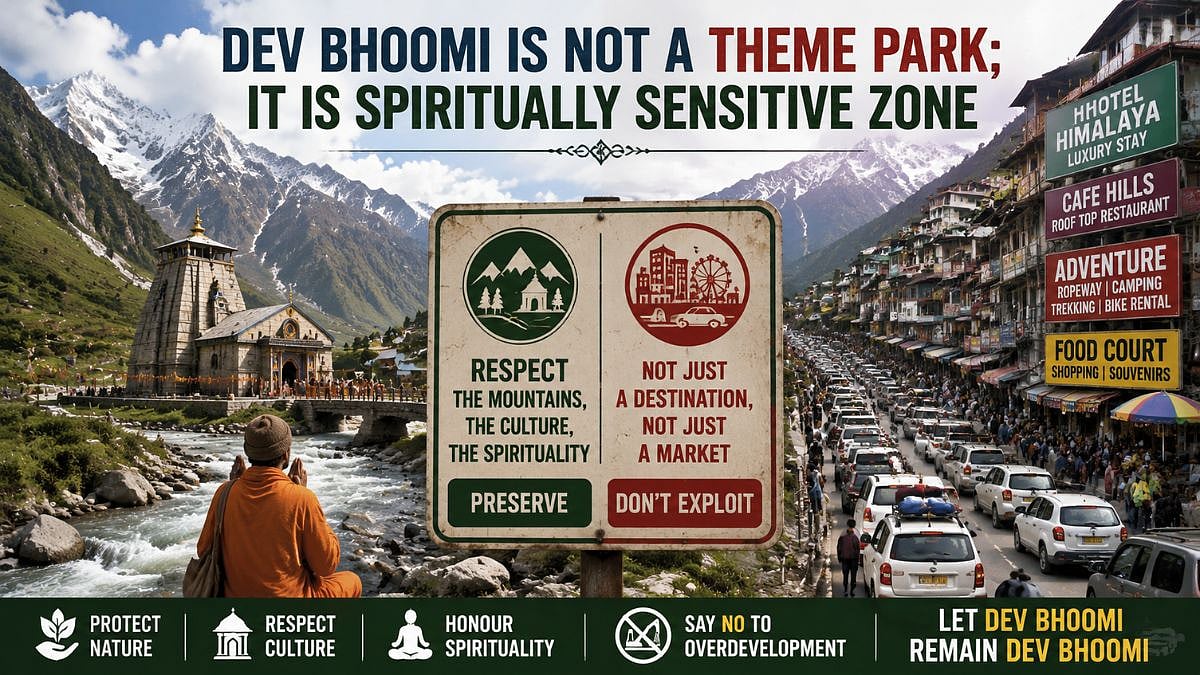
Uttarakhand's greatest failure in its focused tourism approach is not inadequate roads, insufficient hotels, poor promotion, or even weak infrastructure; it is the state's inability to understand what it is destroying. The government appears determined to measure success by tourist arrivals, hotel occupancy, vehicle counts and revenue.
Yet, the very destinations that attract people to Uttarakhand are being compromised in the pursuit of those numbers. This is not merely a tourism-related issue; it is an ecological issue. A cultural issue. A spiritual issue. And increasingly, a survival issue.
We all proudly call Uttarakhand 'Dev Bhoomi'. Millions undertake the Char Dham Yatra, visiting Kedarnath, Badrinath, Hemkund Sahib, Purnagiri, Jageshwar and countless other sacred sites. But Dev Bhoomi was never intended to become a high-volume tourism marketplace where spirituality competes with commercialisation.
At the same time, we must acknowledge that Uttarakhand is far more than a pilgrimage destination. Its mountains, rivers, glaciers, forests, wildlife, trekking routes, villages, cuisine and traditions attract visitors from across the world.
Fragile Mountains Under Pressure
This has been an opportunity. This diversity should have compelled the government to create a sophisticated and sustainable tourism framework. Instead, the response has been predictable and simplistic. More visitors arrive. More hotels are approved. Traffic increases. More roads are widened. Crowds grow. More shops emerge. Every challenge is answered with more construction. As if concrete were a tourism policy.
But the Himalayas are not cities waiting to be urbanised. They are among the youngest and most fragile mountain systems on the planet. Every mountain slope has a carrying capacity, and we all know it. Every valley has ecological limits. Every pilgrimage route has cultural limits. Every sacred destination has spiritual limits.
And Uttarakhand is steadily breaching them all. The consequences are already visible. Cloudbursts appear more frequent and destructive. Landslides regularly cut off entire regions. Rivers behave more unpredictably. Traditional water sources are disappearing. Heat patterns are changing. Weather windows are becoming increasingly uncertain. Villages continue to witness migration and cultural erosion.
Not every event can be blamed on tourism. But it would be equally irresponsible to pretend that relentless construction, hill-cutting, unchecked commercialisation, exploding visitor numbers and pressure on fragile ecosystems play no role.
Protecting Culture And Ecology
Mountains remember every mistake. Unfortunately, they often present the bill decades later. The most disturbing impact, however, is not geological; it is cultural.
Many destinations are slowly becoming generic tourist centres that could exist anywhere in India. Local architecture is disappearing. Traditional building styles are being abandoned. Sacred spaces increasingly resemble commercial bazaars. Places once defined by simplicity now compete to offer urban comforts. The very character that made these destinations special is being diluted.
A pilgrimage is not meant to feel effortless. A mountain village is not meant to resemble a city. A sacred destination is not meant to function like a shopping mall. Not every shrine requires a corridor. Not every peak requires a ropeway. Not every meadow requires a food court. Not every scenic point requires commercial development.
Some places deserve protection from development itself.
Need For Sustainable Tourism
The government is far behind. It has been discussing and planning solutions for the past decade, when it should be looking at the future.
The government must immediately establish scientifically determined carrying capacities for all major destinations and enforce them through visitor caps, timed entry systems, mandatory registrations and seasonal restrictions.
It must create a unified accreditation framework for hotels, homestays, taxi operators, guides and tourism businesses. And on treks for porters, a prepaid system. It must establish a tourism police force and fast-track tourism complaints.
Most importantly, it must impose strict restrictions on fresh commercial development around ecologically and spiritually sensitive zones. You don't need more than what already exists. Some areas should simply be declared off-limits to future construction. Revenue cannot remain the primary measure of success.
The real question is not how many tourists Uttarakhand can attract. The real question is whether Uttarakhand will still be recognisably Uttarakhand 20 years from now. Because once a mountain loses its forests, its traditions, its silence, its spirituality and its identity, there is no reconstruction project that can bring them back.
Dev Bhoomi is not a theme park. And if Uttarakhand continues down its present path, future generations may inherit the roads, hotels and commercial complexes but lose the sanctity of the mountains that inspired them in the first place.
Sanjeev Kotnala is a brand and marketing consultant, writer, coach and mentor.

