Every morning I open the paper with a sense of dread. How many rapes? How many cases of molestation in the last 24 hours? This morning was no different—a 25-year-old man was arrested for raping and blackmailing a minor in Delhi’s South Avenue area, which is adjacent to Rashtrapati Bhawan, one of our most protected VIP stretches.
Recent Cases In Delhi
Last month, the capital reported four minors being molested in fourteen days. The most serious was when three men, posing as policemen, sexually assaulted a 17-year-old girl at the Aastha Kunj Park near Kalkaji Temple. The level of criminality can be understood from the fact that although the police went on to arrest the three accused, one of them was apprehended only after an exchange of fire.
Every hour, nearly 51 First Information Reports (FIRs) related to crimes against women are being registered across India. Where are the safety, dignity and freedom that have been promised to us by our present woman Chief Minister, who had pledged to make Delhi safe and crime-free?
According to the latest National Crime Records Bureau, 445,256 cases of crimes against women were registered this year. This represents a 4% increase compared to the previous year. As a result, the national average now stands at approximately 51 FIRs every hour (crimes against women), with a crime rate of 66.4 cases per one lakh female population.
Underreporting Of Crimes
However, these figures represent only the cases that are officially reported. Many incidents never reach the police because survivors often fear social stigma, family pressure, financial dependence, or lengthy legal proceedings. The minor living in the South Avenue area was raped last year from April to October. Too scared to inform her parents, she did not disclose the horror she underwent during these months. On turning 18, her parents got her married, but the accused shared a video of her in a compromising position with her husband, resulting in a matrimonial dispute. It was then that she approached the police to inform them of how her neighbour had been sexually assaulting her for over six months but, fearing social stigma, she did not inform her parents.
September has overall been a dreadful month. Thirteen rapes in 30 days. On September 10, a 17-year-old girl in Swaroop Nagar was sexually assaulted and later killed; police arrested four people, including three juveniles. On September 17, a Class VI girl was allegedly lured into a tailoring shop in Sadar Bazar and sexually assaulted by a 56-year-old shopkeeper. On September 21, a seven-year-old girl was allegedly sexually assaulted in the Desh Bandhu Gupta Road area. In Saket, a 21-year-old woman alleged that two motorcycle-borne men chased and harassed her near the Panchsheel Park metro station. On September 23, two Delhi University students alleged that four men in an SUV stalked and harassed them near the Hakikat Park in Mukherjee Nagar.
Crime Rates Across States
Women in some states are at greater risk. The states with the highest crime rate are Haryana, Telangana, Uttar Pradesh, Madhya Pradesh and Rajasthan. But Delhi enjoys the dubious distinction of reporting the highest number of crimes against women with little succour in sight.
Following the horrific Nirbhaya tragedy of 2012, women here had hoped the situation would improve, but their hopes stand shattered. Many of these crimes occur in homes. According to the NCRB data, cruelty by a husband or his relatives accounts for more than 133,000 reported cases, representing nearly 31% of all crimes against women across India. According to the National Family Health Survey-5, nearly 32% of ever-married women aged 18–49 have experienced physical, emotional or sexual violence by their husbands at some point in their lives. Furthermore, 6.1% reported experiencing sexual violence.
Growing Online Abuse
The most frightening aspect of this growing violence is that it is increasingly being registered as online abuse. A recent Asia-Pacific survey found that even women parliamentarians are not spared, and around 76% of them have experienced threats through social media platforms.
Dr Ranjana Kumari, heading the Centre for Social Research, maintains, “We have become an increasingly violent society where people are willing to kill each other over parking lots. Sexual violence has to be understood in this overall push that is being given to masculinity without realising its negative fallout.”
Dr Y. Rajesh, who heads SPYM and has spent decades working with juveniles and in running de-addiction centres, believes, “Mental health has become a major issue with people spending more time in the virtual world than in talking to each other. When there is no dialogue taking place within families and children are being subjected to much pressure, what outlet do they have? Parents are struggling to survive and are finding it difficult to make ends meet. Families do not know how to combat this pressure.”
Need For Long-Term Prevention
The whole emphasis should be on coming up with long-term prevention strategies and improving victim support services. Stronger community participation is required to reduce violence in our society.
The problem of increasing violence is also linked to increasing numbers of younger women stepping out of their homes to study, work, and participate in social events. Journalist activist Sujata Madhok believes “the old norm that public spaces belong only for men no longer holds true. The greater participation of women is not acceptable to many men, and that is also responsible for making women more vulnerable.”
Calls For Greater Safety
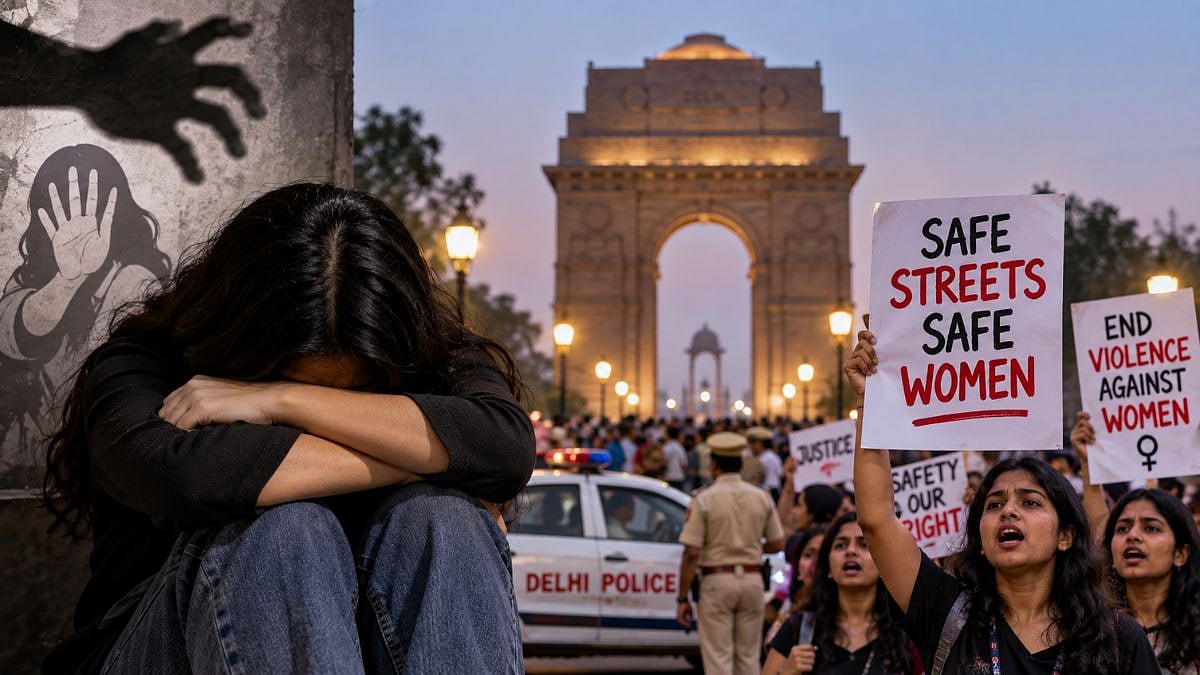
Hundreds of students took to the streets of Delhi last month, demanding greater safety for women. Some of the slogans women raised related to how “women are being told to stay indoors and not go out at night, to cover themselves, and to protect ourselves. When will society tell men in our country not to rape?” Under pressure, the Supreme Court has pushed for greater accountability, blaming law enforcement agencies for this epidemic.
The Delhi Police are doing audits of all parks in the city and also ensuring CCTV cameras are constantly monitored. Our public spaces must be made more secure. Parents, schools, and RWAs need to conduct regular campaigns emphasising that a woman’s integrity cannot be violated.
Rashme Sehgal is an author and an independent journalist.

