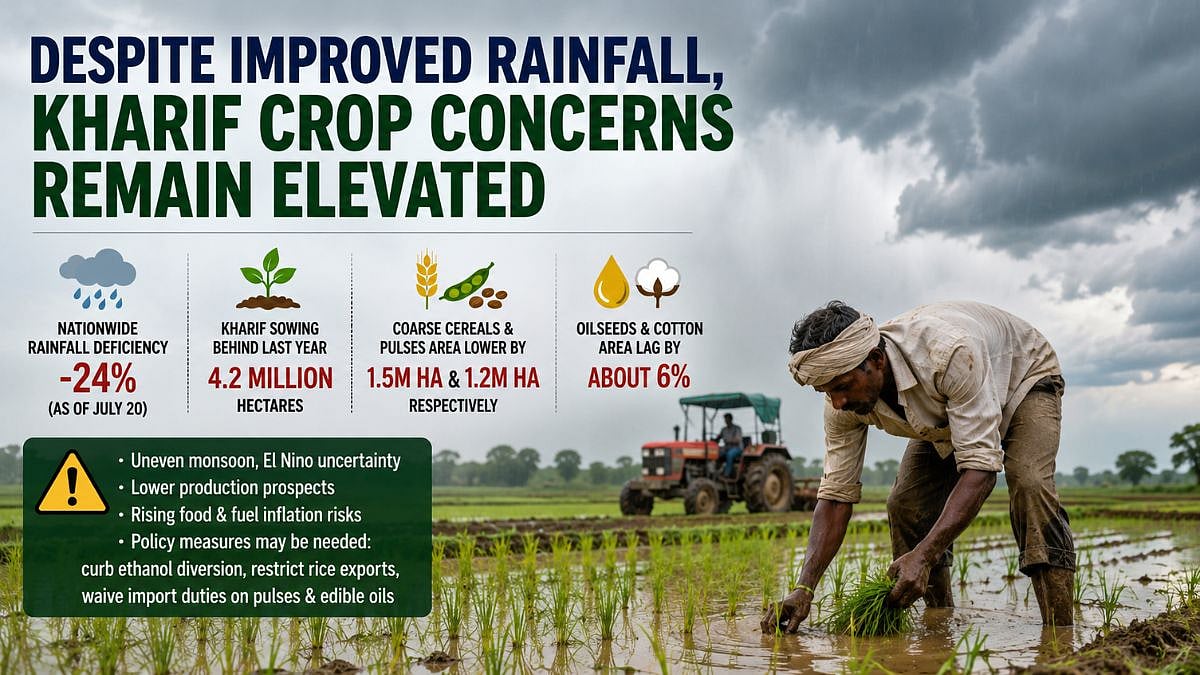
With significant rainfall activity over most parts of the country since July 1, there is hope that we may have escaped widespread drought. Yet, concerns abound.
As of July 20, the nationwide rainfall deficiency stands at 24%. Out of the 36 meteorological subdivisions, as many as 23 subdivisions, located mainly in the west, northwest, east, northeast and central parts of the country, have recorded a 25% to 50% deficiency. Rajasthan, Punjab, Haryana, Bihar and Jharkhand, and parts of Madhya Pradesh, Maharashtra, Andhra Pradesh and Karnataka are affected. In other words, the spatial distribution of the southwest monsoon has been uneven after seven weeks into the season.
Sowing Lags Behind
The latest report of the Central Weather Watch Group shows that the progress of area coverage for Kharif crops continues to lag last year's level. Across crops, the overall decline in planted area was 4.2 million hectares as of July 19. Acreage for coarse cereals and pulses is still lower than it was at this time last year by 1.5 million hectares and 1.2 million hectares, respectively. Oilseeds and cotton, too, lag in planted area by about 6%.
With the delayed onset and tardy progress of the southwest monsoon, the planting window is now closed. Any further planting is subject to weather risk even for short-duration crops like moong, maize and bajra.
The weekly sowing report from the Union Ministry of Agriculture is a compilation of reports filed by state governments. Usually, there is a lag in data collection and dissemination. By early August, one may be able to gather a reasonably good idea about the planted area and, by implication, the crop prospects.
Weather Uncertainty Persists
It is becoming increasingly clear that the spatial distribution of rainfall for the rest of this month and for the whole of August will be crucial. At the same time, it is not clear whether El Niño would strengthen further and reduce the quantum of precipitation in August. With these uncertainties, it would be premature—indeed speculative—to talk about harvest prospects at this point in time.
It is worth remembering that monsoon-dependent agriculture usually does not spring major surprises. That said, the country has to brace for lower production of rice, coarse cereals, pulses, oilseeds and cotton. The harvest size may be lower than not just the target but also last Kharif's levels. Looming production shortfalls, tightening supply-demand fundamentals and food inflation cannot be wished away.
Inflation Risks Increase
The situation is exacerbated by renewed hostilities in the Persian Gulf region. While the so-called "truce" was always fragile and uncertain, military action in the last few days has once again drawn attention to the closure of passage through the critical Strait of Hormuz. With the recurrence of supply chain disruption even before normalisation was achieved, energy prices have again spiked. Brent is above $90 a barrel.
The combination of climate and geopolitics means that New Delhi must get ready to address the looming food inflation and fuel inflation. It is going to be a daunting challenge. It is a matter of solace that we have adequate buffer stocks of rice and wheat, but that is not everything. Traditionally, September to November are festival months when demand for food spikes.
Depending on how the situation unfolds in the next six weeks, New Delhi may be forced to review its food policy and renewable energy policy. The diversion of feedstock, such as sugarcane, maize and rice, for ethanol may have to be curtailed. Non-Basmati rice exports may be restricted to ensure domestic availability.
Larger imports of vegetable oils, pulses and cotton are, of course, a given. Customs duty on unrefined vegetable oils (10% ad valorem at present) and specified pulses may be waived for the time being. New Delhi has its task cut out.
G. Chandrashekhar is a senior journalist, policy commentator and commodity markets specialist. The views expressed are personal.

