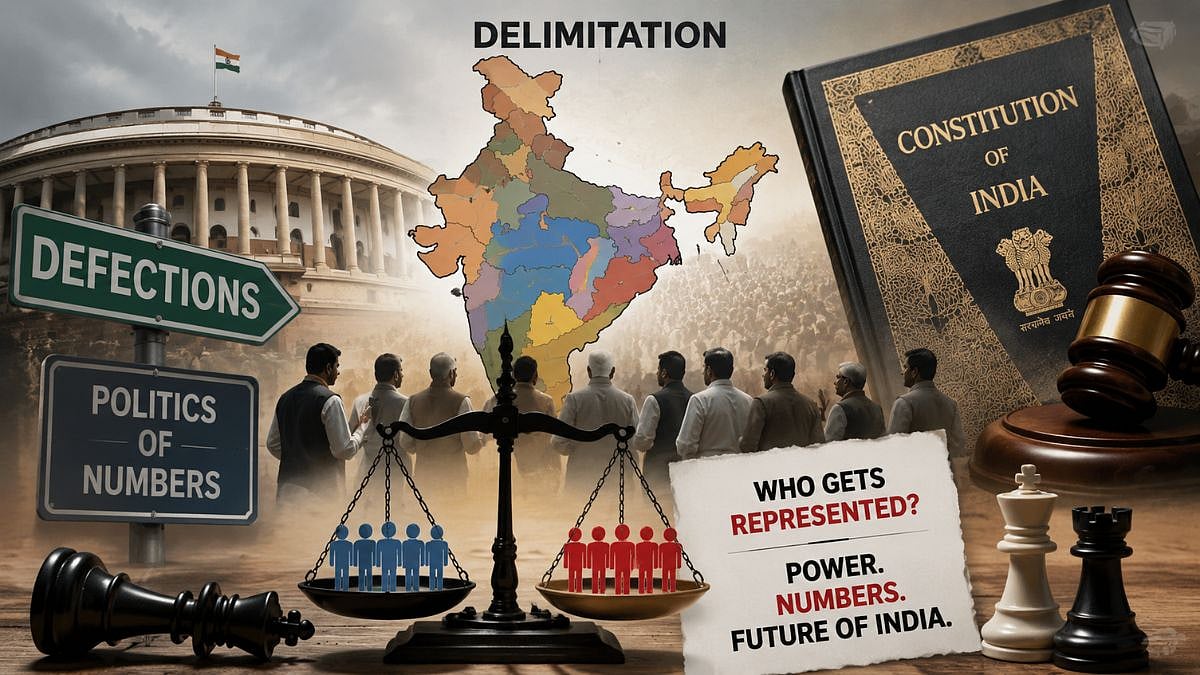
Congress has raised a serious political charge. It says the BJP is working to engineer defections in opposition parties so that it can eventually secure the two-thirds majority needed for major constitutional changes, including the possible passage of a delimitation-related law and, perhaps, a larger shift in the way India is governed. It is a charge that should not be dismissed lightly. In a democracy, numbers matter, and when numbers begin to look like an instrument for constitutional change, suspicion is bound to follow.
But suspicion is not proof, and political alarm is not the same thing as constitutional debate. The danger in the present discussion is that the issue may get reduced to slogans and counter-slogans, while the real questions are left untouched. If India is to discuss delimitation, federal balance, or even the possibility of a presidential system, it must do so openly, honestly and with a full public mandate. Anything less would be unfair to the Constitution itself.
Numbers And Constitutional Change
The BJP has one point in its favour, which cannot be ignored. Its record on constitutional amendments is not excessive when compared with the Congress era. In fact, if one goes by the figures available, Congress governments amended the Constitution 67 times, while BJP governments did so 21 times. The total number of amendments stands at 106.
Atal Bihari Vajpayee's government accounted for 14 amendments, and the Modi government for seven. On the Congress side, Jawaharlal Nehru's government amended it 18 times; Lal Bahadur Shastri's, once; Indira Gandhi's governments, 23 times in two tenures put together; Rajiv Gandhi's government, 12 times; P. V. Narasimha Rao's, 10 times; and Manmohan Singh's government, five times.
These numbers matter because they tell us something important. The BJP cannot easily be painted as a party that has habitually tampered with the Constitution for short-term political gain. That is a useful correction to make in a debate where one side is often accused of harbouring secret constitutional designs. At the same time, a modest record of amendments does not automatically end the controversy. A party may amend the Constitution fewer times and still be willing to pursue a major institutional change if the political arithmetic allows it.
Federal Balance And Delimitation
That is why the present controversy needs to be understood in the larger constitutional context. Delimitation is not just a matter of redrawing constituencies on paper. It has direct political consequences. It affects representation, regional balance, and the future weight of different parts of the country in Parliament. If it is handled carelessly, it can deepen the feeling that some regions are being punished for having controlled population growth better than others.
The presidential system is an even bigger question. It is not a small reform that can be tossed around in passing. It changes the character of the executive, the nature of accountability, and the relationship between the legislature and the government. Under the present parliamentary system, the Prime Minister and the Council of Ministers remain accountable to Parliament. Under a presidential system, the executive gets a different kind of mandate and a different kind of independence. Both systems have merits and limitations. But no serious constitutional change of this nature can be decided by rumours, trial balloons or political suspicion.
The Congress charge, therefore, must be seen in two parts. First, it is a political warning that defections should not be allowed to become a route to constitutional engineering. That warning is valid and deserves attention. Second, it is also an attempt to frame the BJP as a party that may be planning a deeper shift in India's constitutional structure. That claim needs stronger evidence before it can be treated as fact.
Need For Public Debate
The BJP would do well to respond clearly and not leave room for needless speculation. If it is not contemplating any move towards a presidential system, it should say so in plain terms. If delimitation is to be taken up, it should be discussed through proper institutional channels, with full consultation and with the federal concerns of the states in mind. Silence or ambiguity only feeds mistrust. In a charged political atmosphere, even an unfinished thought can be turned into a full conspiracy theory.
At the same time, the Opposition must also be careful not to weaken its own case by exaggeration. Every major constitutional discussion cannot be presented as a plot. India has a long history of constitutional amendments made by governments of different political shades. Some were necessary, some were controversial, and some were clearly driven by political motives. The answer to that history is not panic but democratic scrutiny.
That is the real issue. The Constitution should not become a battlefield for one-upmanship between parties. Nor should it be treated as a private instrument of the ruling party. If India is to think about delimitation or any change in the form of government, the debate must be rooted in transparency and public consent. No party should try to smuggle in a constitutional makeover through defections.
So, Congress may have a point when it warns about the misuse of political numbers. But the larger test will be whether any government, now or in the future, is willing to place a major constitutional proposal before the people with honesty and clarity.
Ajay Jha is a senior journalist, author and political commentator.

