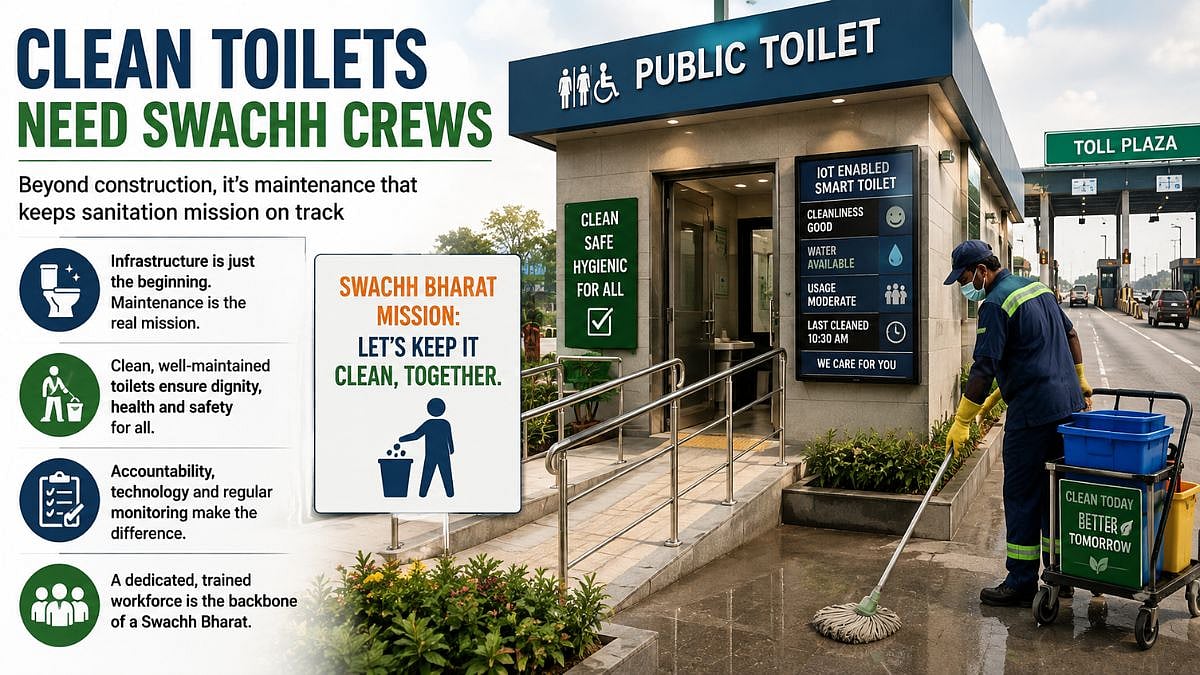
Just when fading urban sanitation under the Swachh Bharat Mission is prompting cities to come up with new initiatives, such as in Mumbai’s Dharavi, the National Highways Authority of India (NHAI) has launched an initiative to put up modernised toilets near toll plazas. It is no secret that the shiny public toilets installed in many cities under the SBM’s urban component over the years have been quietly dismantled and, in many cases, replaced by old-style facilities put up by local bodies.
The absence of accessible urinals, a major lacuna for service professionals and gig workers who are out in the field throughout the day, has turned the clock back on sanitation. Secluded corners and parked vehicles provide the privacy many people look for along quiet streets when they cannot find urinals; women suffer badly.
This is a poor outcome for a flagship programme with a staggering expenditure of Rs 18,543 crore, being the Union government’s share released over 11 years until 2024-25 for SBM-Urban works across the country. Although the SBM claims the presence of 37,766 public toilets, there is little clarity on how many remain viable today and are in active use.
Against this background, the NHAI plans to invest afresh in modern toilets equipped with Internet of Things (IoT) monitoring systems at toll plazas. A sanitation standards upgrade and outcome-based maintenance, aided by user feedback, are promised to highway users. This is certainly promising, but the intent is often laid low by poor execution in public projects.
Maintenance Must Be The Priority
Public sanitation is hobbled by a variety of factors, beginning with the absence of a dedicated maintenance apparatus responsible for the state of toilets. In some cases, toilets become politically contentious, and there is even an expectation of bribes among locally influential politicians to allow them to be installed.
Toilets on highways may fare better, isolated as they are, but the NHAI talks about standardised, indigenously developed designs for both the renovation of existing toilets and the construction of new ones. Unfortunately, the current state of many public facilities does not inspire confidence.
What is more, India has run several advanced pilot projects for international technologies to reinvent the toilet, which promise to reduce or eliminate flushing, separate liquid and solid waste automatically, and use high-temperature decomposition, or pyrolysis, to manage large volumes of faecal sludge. Such experiments, started a decade ago, do not appear to have produced dramatic, scalable results to transform sanitation.
The question that poses itself is whether the SBM failed to insist on a stakeholder for maintenance in every city and town, focusing instead on creating more visible structures. A positive toilet culture is hard to achieve in communities where the responsibility to clean up is enmeshed in entrenched caste politics.
A secular apparatus that works like a company, using modern tools, uniformed personnel and political will, could overcome that barrier in cities and on highways.

