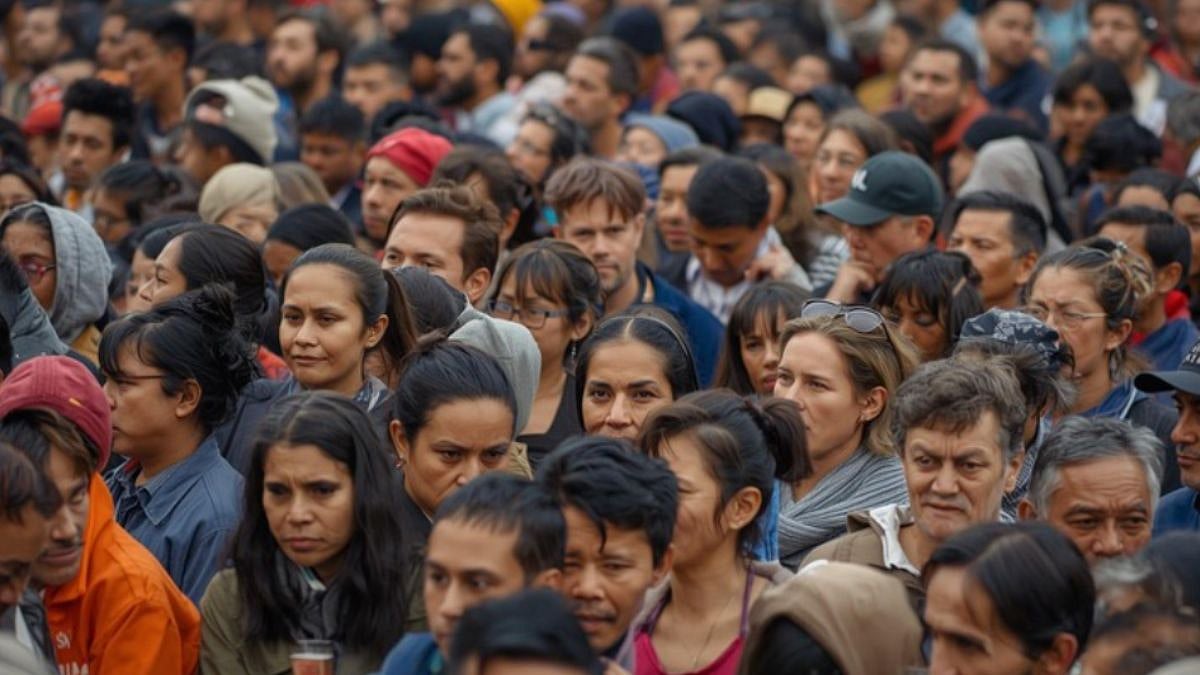
History has a strange way of surprising persons as well as nations. Today China is forced to offer incentives like free childbirth expenses to be implemented in 2026. Why? Its population has been decreasing with an alarming rate, forcing policy makers to think of incentives to produce more babies. Part of these freebees is the new offer which will cover all out-of-pocket expenses related to childbirth in the year 2026. These expenses include prenatal checkups.
The moves comes as China grapples with ever-decreasing population. Now China keeps company with another Asian giant Japan which too suffering from the same phenomenon. China’s population dropped for the first time in decades in the year 2022 and the slide continued throughout 2024. Not only this, the demographers predict that this trend will continue in the days ahead alarming the Chinese authorities to react with new policy of incentives.

In 1980 when Deng took over he realized that his new economic policy [Get Rich, it is glorious’] will not work unless he has similar new approach to China’s ever-increasing population. Let us look at some statistics. In 1950, China’s population was 54. 40 crores. In 1960 it became 65.48 crore and in 1970 it touched 82.23 crore. Same figure jumped to 98.12 crore in 1980 when Deng took over. It simply means the system now had to feed, look after double the population. Deng, the pragmatic that he was, immediately launched what became famous as ‘one child policy’.
This policy had wide-ranging social, cultural, economic and demographic effects. The controversial one-child policy found a mention in country’s constitution in 1982. Implementation of this policy was supervised by specialized committees. More often than not, women were forced to use contraception, abort children and undergo sterilization. Not only this, families who violated this policy faced large amount of fines and other penalties. On the positive side, it saw a greater work force participation by women who otherwise would have been occupied with childbearing. The Chinese Communist Party [CCP] grabbed the credit and claimed that this programme contributed to country’s tremendous economic progress as it had less mouths to feed, thanks to its one-child policy. The CCP then claimed it managed to prevent 400 million Chinese from being born.

In the West, however, there were critics of this programme who contested this claim on various grounds. Many argued that the 400 million claim is false. It was based on the old flawed assumption put forward by Malthus that births increase in geometrical progression. This was rejected first by Marx and then by Mao as bourgeois propaganda. Modern critics compared China’s population growth with other countries which were demographically similar in the 1960s. Countries like Thailand or Brazil did not experience Malthus geometric progression of birth. In all these countries birth rate declined with economic growth. It could have happened in China, one-child policy notwithstanding.
Then there were human rights issue involved in one-child policy which China ignored. The picture began to change in the 21st century. By 2015, China raised the earlier limit of one child to two children. It was an indirect admission of the policy U-turn. Even then scholars argued that this U-turn is just symbolic and nothing substantial will come out of this. By the time second decade of 21st century dawned, China realized that something more drastic need to be resorted to. In May 2021 it announced ‘three children policy’. And in two months i.e by July 2021 it removed ALL the limits. Many factors were behind this fall in birth rates. Rapid urbanization, high cost of childcare and education, job uncertainty and slowing down of Chinese economy too were responsible. Many youngsters decided not to get married and start a family.

All this resulted into crisis of a different kind. China now faces an ageing population and shrinking workforce. This forced China to go for a policy reversal which was announced in July 2021. And yet in 2025 Beijing realized that ending of the one child rule, the birth rates haven’t rebounded as was hoped. It is now feared that the culture of small families has perhaps struck deep roots. Hence came the next level of incentives about all childbirth expenses to be borne by the state. It must be noted that what is announced now is a national policy as some provinces like Jilin, Jiangsu and Shandong have already unveiled policies to make child-birth almost free of charge.
The less number of young population was and is putting tremendous pressure on China’s economy as a fewer young workers had to support growing number of elderly population. Add to this the pension burden which creates ‘life-cycle surplus’ gap. It spells an important implication of consumption exceeding production. In social sector, the one-child policy created marriage-market difficulties. Now that all restrictions on population growth has been removed and incentives for more children have been announced, it would be interesting to see how Chinese respond to this.

