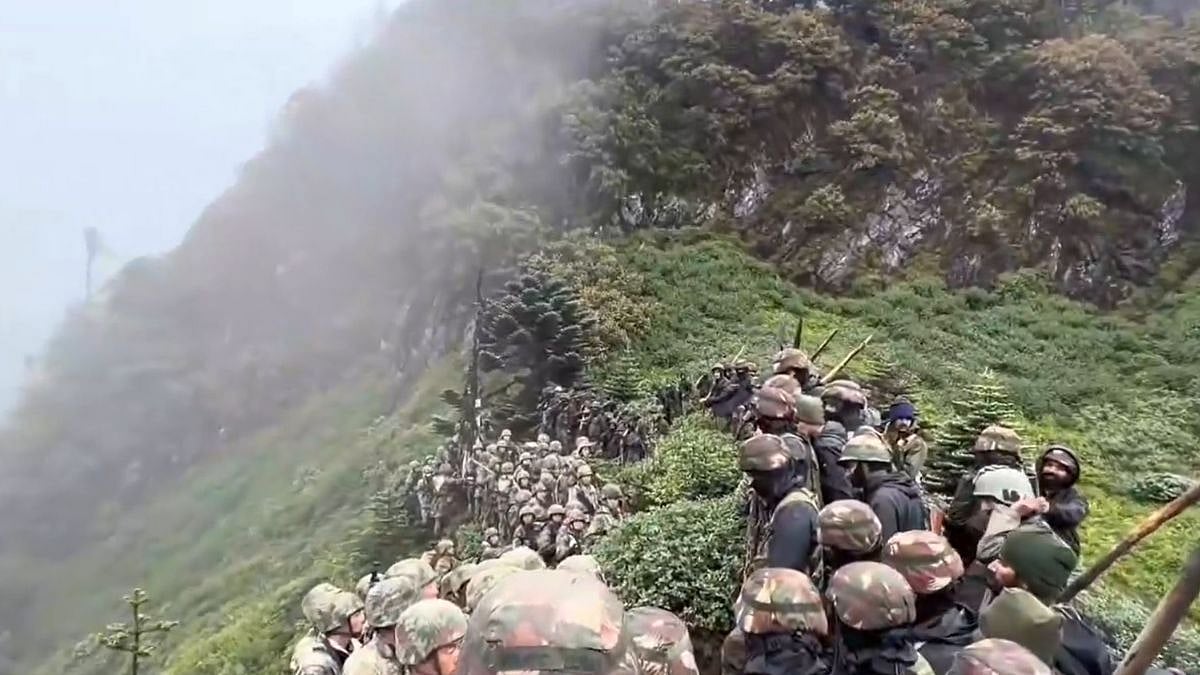
Less than one-and-a-half months after Xi Jinping visited India for the BRICS Summit, speaking against the backdrop of efforts to stabilise relations between Asia’s two largest nations, Chinese and Indian troops were reported to be facing off at several locations along the disputed Himalayan frontier in Arunachal Pradesh.
The encounters, according to Shatrujeet Kapur, director general of the Indo-Tibetan Border Police (ITBP), were continuing even as he praised the newly introduced commando platoons for their performance in confrontational situations.
Beijing’s response offered little indication that it intended to change its position. China’s foreign ministry spokesperson, Guo Jiakun, said on Monday that Beijing had consistently abided by bilateral agreements and understandings, conducting routine patrols and management activities to safeguard its territorial sovereignty and maintain border stability.
The language was at its diplomatic best, but the fact remains that this is not the first, nor possibly the last, time that India and China will face off in the ‘High Himalayas’. China presents its patrols as legitimate exercises of sovereignty, while India regards certain Chinese movements as attempts to alter the situation on the ground.
Since neither side has ever managed to mutually delineate the entire Line of Actual Control (LAC), despite umpteen rounds of talks, and both sides have fundamentally different ideas about where their respective territories begin and end, the dispute is one which will always be ready to erupt every once in a while.
Arunachal Pradesh At The Centre Of Tensions
However, the latest friction has also acquired a different edge and significance. Chinese commentators have taken this opportunity to seize on India's proposed 11,200-megawatt Siang Dam in Arunachal Pradesh to revive Beijing's territorial claims, arguing that the state's rivers and natural resources are strategically important to China.
The convergence of border patrols, water infrastructure and nationalist commentary suggests that Arunachal Pradesh is becoming a more prominent arena in the broader competition between the two countries.
Arunachal Pradesh occupies an unusual place in China's territorial imagination, as this is where the 6th Dalai Lama came from, and Beijing, of course, holds that Tibet and any territory which has the faintest connection with Lhasa is its by right.
Beijing calls the region Zangnan, or South Tibet, and rejects the McMahon Line, the boundary agreed upon in 1914 between British India and the Tibetan government. India regards that line as the basis of its boundary in the eastern sector and considers Arunachal Pradesh an integral part of the country.
Reports from the Taksing area of Upper Subansiri district have focused on encounters near Asaphila and Longju, where the two sides' perceptions of the LAC differ. Indian military sources have also indicated that patrolling has been intensified in response to increased Chinese activity.
Available reports do not establish that China has taken control of the locations in question. Nor does a face-off automatically constitute a territorial advance. But recurring encounters can still impose costs by requiring greater deployments and diverting military resources while increasing the risk of an accidental escalation.
For Beijing, persistent activity in disputed areas can keep its territorial claims visible without requiring the political and military commitment of a full-scale confrontation.
Lessons From The 1962 War
The history of the eastern Himalayas explains why even relatively limited incidents carry an importance disproportionate to their immediate military consequences.
On October 23, 1962, Chinese forces encircled Tawang after overwhelming Indian positions around Thagla Ridge and Bumla Pass. Indian troops had been deployed in difficult terrain against a better-prepared and numerically superior adversary.
There is no evidence in the current reports that Beijing is preparing to repeat its 1962 offensive. The circumstances are different; the Indian military is better equipped, and the two nuclear-armed states operate within a much more complex regional and international environment.
Both Beijing and New Delhi have been building roads and tunnels to connect their borders in the eastern Himalayas better with the hinterland. This means that measures India considers necessary to defend its territory may be presented by China as evidence of Indian expansionism, while Chinese deployments described as routine patrols or constructions of fortified villages and missile silos may be viewed in New Delhi as attempts to establish a new status quo.
Sumdorong Chu Offers A Precedent
The precedent that may be more immediately relevant to today's situation is the 1986–87 confrontation at Sumdorong Chu.
The high-altitude valley, west of Bumla and close to the Bhutan frontier, had been used by Indian troops as a seasonal camping ground. In 1986, Chinese troops occupied Wangdung, a pasture south of the valley that India regarded as lying on its side of the boundary.
India responded by deploying additional troops and artillery. The confrontation developed into a serious military stand-off, raising fears of another war in the eastern Himalayas.
Yet, the crisis did not culminate in combat. Military and diplomatic engagement gradually reduced tensions, creating the conditions for Rajiv Gandhi's historic visit to China in 1988. Deng Xiaoping used the encounter to signal that the two countries could move beyond their historical antagonisms even while the boundary remained unresolved.
The episode revealed the importance of reciprocal restraint, credible military preparedness and political leadership capable of distinguishing a tactical confrontation from the larger relationship.
Military And Economic Asymmetries
However, the circumstances today are far more complicated for both sides. On the one hand, China's economic and military capabilities have expanded enormously. According to World Bank statistics, while China had a GDP of $19.5 trillion in 2025, India had a GDP of $3.96 trillion. In terms of defence spending, China is again a colossus, spending $336 billion compared to India's $92.1 billion, as per the SIPRI Military Expenditure Database 2025.
On the other hand, each nation depends far more on the other than ever before. The two giants traded goods and services worth $155 billion in 2025, and that figure is expected to be surpassed this year. The two nations need to cooperate to ensure that the sea lanes of the Persian and Red Seas, from where both nations import their energy needs, remain open and that the world functions according to certain norms and rules to ensure that their respective rise remains free of conflict.
For both nations, a prolonged Himalayan confrontation would absorb military resources, complicate regional diplomacy and make it more difficult for Beijing to manage its competition with Washington. Economic engagement with India also has potential benefits, even amid disputes over trade, technology and strategic dependence.
However, Beijing may see no contradiction between pursuing diplomatic stability and maintaining its territorial claims. It can seek improved relations in trade and multilateral forums, while insisting that the boundary question remains unresolved on Chinese terms.
That is where New Delhi has to start rethinking its calculus of defence and diplomacy all over again. Does it have to repeat Sumdorong Chu every time there is a transgression, or can it use geopolitical arguments to force China to the negotiating table for that elusive boundary pact which has baffled diplomats from the viceregal era to the 21st century?
The writer is Editor, United News of India.
To get details on exclusive and budget-friendly property deals in Mumbai & surrounding regions, do visit: https://budgetproperties.in/

