Chai shops are known to be the barometers of what people are thinking. Earlier this year, I was sitting in a well-attended chai shop in a central part of Dehra Dun where I found a motley crowd of around ten people drinking chai and handwriting a petition to be emailed to the Prime Minister. I asked to read it. They were demanding the release of Sonam Wangchuk, who had been detained in a jail in Jodhpur under the National Security Act.
Wangchuk was finally released on March 14, 2026, but it has not stopped him from continuing to speak out against the centre. In November this year, he was once again moved from a protest site and placed under house arrest in Leh. His most immediate demand is the release of the judicial inquiry report into the September 24, 2025, violence in which firing by security personnel resulted in the death of four people. In all, 87 people had been identified as taking part in these protests, out of which 81 had been arrested and subjected to criminal proceedings. The Ladakh Administration has approved the withdrawal of cases against 20 of the accused, but Wangchuk demanded what would happen to the remaining cases.
The conflict between Ladakh’s civil society and the centre has entered a more complicated phase. Negotiations have stalled even as the centre has gone ahead with sweeping restrictions on local governance bodies, all the while refusing discussions on constitutional safeguards—such as statehood and protection under the Sixth Schedule—for the region.
Ladakhis are simple and loyal people with a population of around four lakhs. The centre’s refusal to allay their fears is leading to growing hostility against the government and its policies. This seems to be the case across all our border states. We share a 15,106.7 km-long land border with seven countries—China, Pakistan, Bangladesh, Myanmar, Nepal, Bhutan, and Afghanistan—and a coastline of 7,516.6 km, including the island territories. How can we hope to keep the country safe when our government is inept in handling the sentiments of the people living in our border areas?
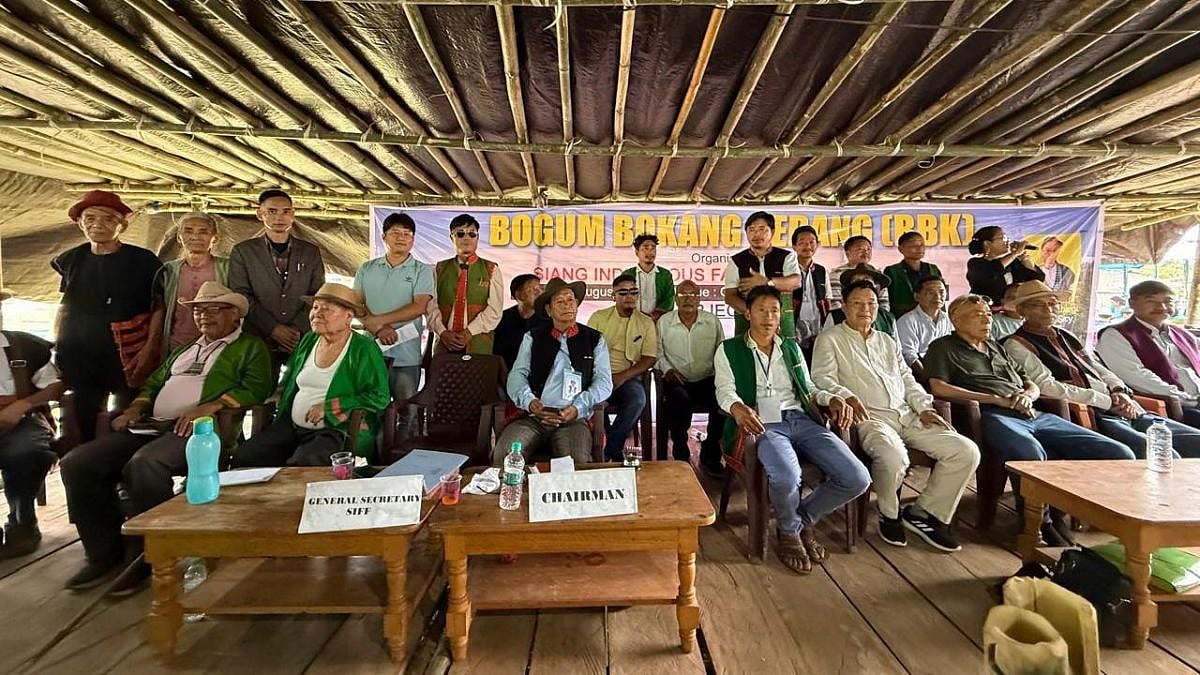
The centre’s lack of foresight has now spread to Arunachal Pradesh. The proposed Siang Upper Multipurpose Project (SUMP) in AP has triggered growing opposition from indigenous communities, putting the BJP government led by Chief Minister Pema Khandu under pressure. The government insists that this 11,200 MW SUMP, with a proposed capacity three times that of the Three Gorges Dam, is a strategic and national security requirement. Indigenous communities are not convinced, as it will submerge 27 ancestral villages and displace 1.5 lakh people, comprising nearly 11 per cent of the population of the region.
Offering financial compensation does not take away from the apprehension that they will become landless, as is happening with tribal communities across India. The other fear expressed by geoscientists, including Dr CP Rajendran, is that building a conventional gravity dam with a reservoir capacity of 9.2 billion cubic metres of water in Seismic Zone 6 could result (in case of an earthquake) in the earth underneath it sliding or liquefying, causing the dam to tip forward. Tensions in the region may have reduced somewhat, following the release of four anti-dam activists, but the local communities remain incensed with these developments and are in no mood to relent. Given that China treats Arunachal Pradesh as its own territory, calling it a part of south Tibet, handling this area requires both sensitivity and patience.
Manipur is another state where the situation has gone from bad to worse. The ethnic violence, which started three years ago, has created a divide between the Meiteis and the Kuki-Zo people and claimed nearly 300 lives.
Two years into the conflict, the Prime Minister loftily announced a Rs 8,500 crore package for the state, but it has not helped scale down the violence, which continues unabated. The Meiteis do not want to see their state split into two. The Kuki-Zo believe the violence, which erupted on May 3, 2023, has created an irreconcilable divide between the Meiteis and them. They are demanding a separate UT with their own legislature.
Both Nagaland and Mizoram are also facing fresh problems. The conflict with the Nagas is over 60 years old, and despite promises of rapprochement, the area is experiencing renewed political instability and ethnic violence. While Home Minister Amit Shah keeps harping about ‘ghuspetiyas’, he has been unable to stop the Manipur government from providing shelter to over 30,000 Chinese refugees from Myanmar on grounds of ethnic ties and humanitarian considerations.
Despite the tall claims of Operation Sindoor, there has been little letting off on cross-border terrorism across J&K. In November 2026, the J&K police attached land in the Reasi district belonging to five individuals who have been described as Pakistan-based handlers linked to a 2024 case. Terrorists continue to strike in J&K, and, in an equally dangerous development, since February this year, seven Punjab police personnel have been shot dead in the border districts of Gurdaspur, Amritsar, and Tarn Taran.
Instead of strengthening the hands of Chief Minister Omar Abdullah by granting statehood to J&K and of Punjab CM Bhagwant Singh Mann, the centre has shown no forward movement on the issue of statehood. Now with elections round the corner in Punjab, Mann’s government is being targeted by the centre on a 24x7 basis.
Chai shops may appear innocuous, but the people hobnobbing there represent the pulse of the nation. Given our troublesome borders, the people living in our border regions need to be shown tact and forbearance. The ordinary citizen is only too aware, over cups of chai, that our internal security policy needs urgent recalibration.
Rashme Sehgal is an author and an independent journalist.

