I did not grow up in a house of books. There were no overflowing shelves, no ritual of bedtime stories, no quiet insistence that reading was a habit to be cultivated. What I had instead was something far less curated, and perhaps far more formative: the daily newspaper.
It arrived without ceremony, and I read it without instruction. Ink-stained fingers, folded pages, headlines half-understood; this was my education. And somewhere in that routine, almost by accident, on the last page of the Afternoon Dispatch and Courier, I found a voice that would stay with me far longer than any syllabus ever could.
What I did not know then was that this voice had begun its journey decades earlier, on the last page of this very paper, within the Free Press Journal’s supplement, Bulletin. It was here that Behram Contractor first wrote Round and About, in a newsroom he shared with a young Bal Thackeray. The column would go on to travel with him, from the Bulletin to the Times of India, later to Mid-Day, and finally to the Afternoon Dispatch and Courier, where I would encounter it years later.
Wherever he went, the readership followed. Behram “Busybee” Contractor did not command attention in the way most columnists try to. He did not shout, provoke, or posture. He observed.
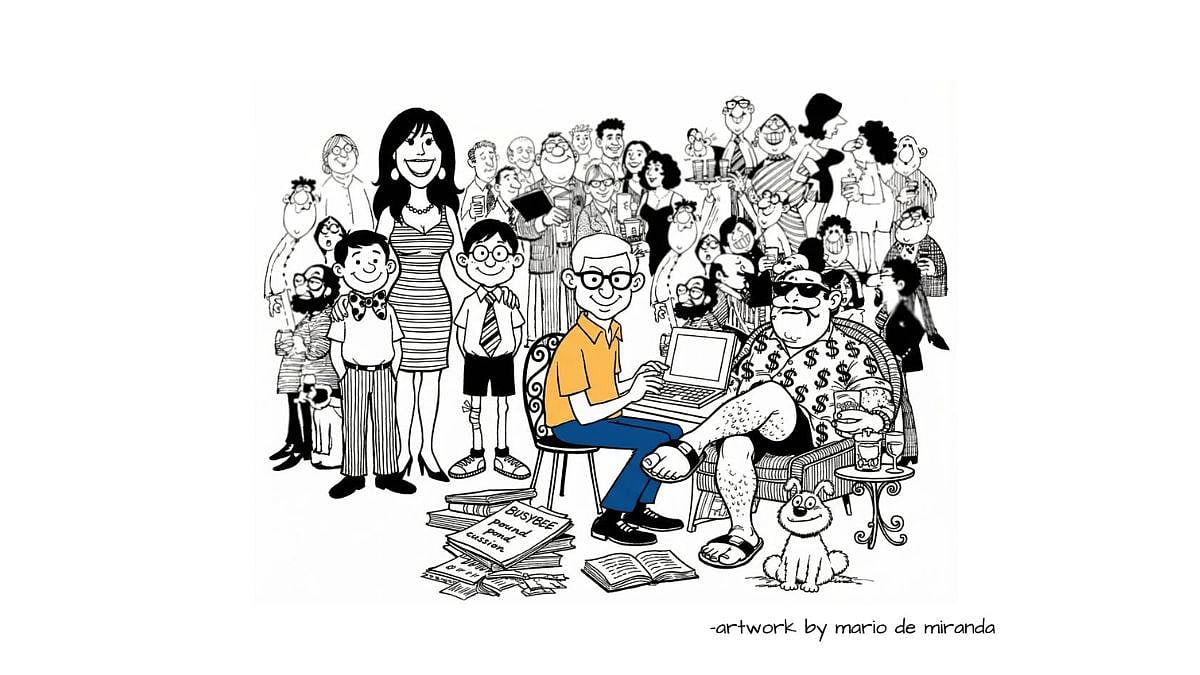
He wrote in a way that made the writer almost invisible, and the city impossible to ignore. Instead of centring himself, he built a world that readers returned to, through characters that felt both familiar and enduring. There was Bolshoi the boxer, his version of the common man, as sharply observed in prose as R. K. Laxman was in line; the ever-present wife, the two sons, and the fabulous friend on the 21st floor. They were not just literary devices, but extensions of the city itself, ways of making sense of its contradictions with humour, distance, and affection.
His Bombay lived in the everyday, in the taxi driver, the Irani café, the quiet absurdities of bureaucracy, the intimacy of neighbourhoods, the peculiar humour that only this city understands. He wrote about food before food writing was a category, about people before “human interest” became a journalistic device.
And in doing so, he built something increasingly rare: trust.
Twenty-five years after his passing, that trust remains intact. In many ways, the city he wrote about no longer exists in the same form. The scale has shifted, the pace has accelerated, and the spaces that once defined everyday life have been replaced or rebranded. But what persists is the need to make sense of it, to find continuity in change, to locate meaning in movement.
Behram “Busybee” Contractor reportedly believed that memory fades quickly, that people are forgotten sooner than we imagine. The irony, of course, is that his own work refuses to fade, not because it demands to be remembered, but because it continues to feel relevant.
And perhaps that is the truest measure of his legacy: that long after the column ended, Bombay, in many ways, still reads like him.
Ankieta Kothari is the founder of The Bombay Blueprint, a public platform chronicling Mumbai’s architecture, heritage, and evolving urban landscape.

