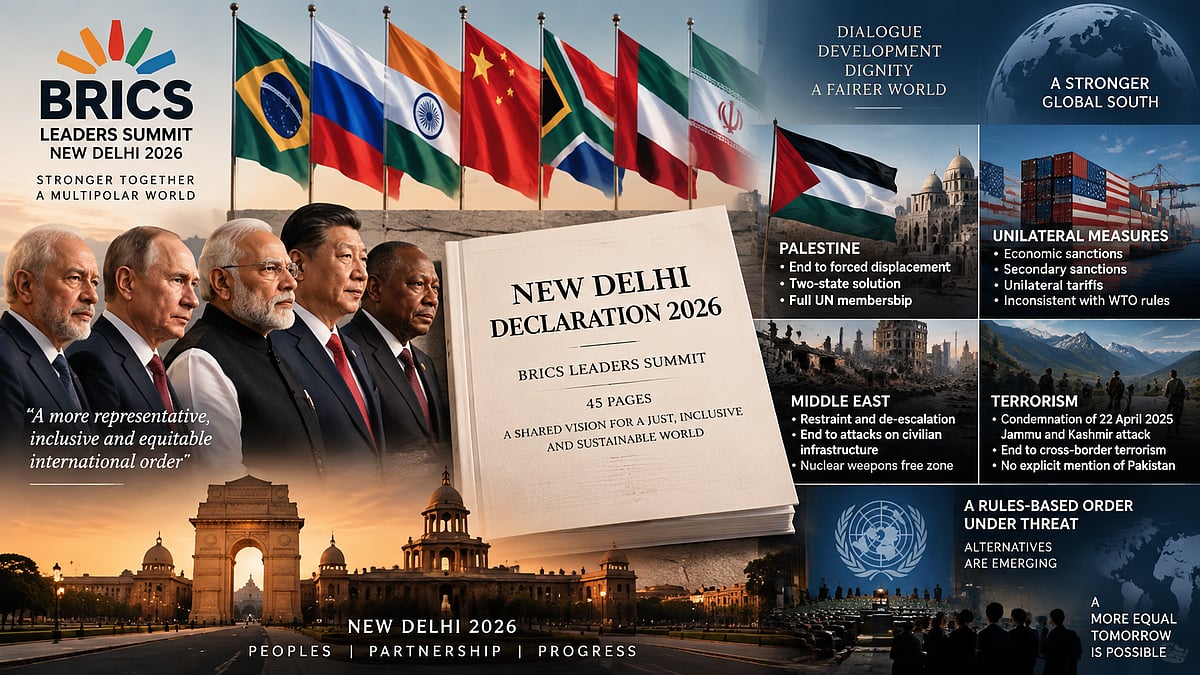
Careful draftsmanship couched in carefully generalised language was the view of many commentators as the 45-page long New Delhi Declaration 2026 – the longest of all BRICS declarations – was passed over the weekend at the BRICS Leaders Summit. The content which one commentator described as “boring” did however make some points that the Western world will definitely take note of.
While de-dollarization, the pet peeve of President Trump, was not mentioned, phrases such as “unilateral coercive measures” in the form of “economic sanctions and secondary sanctions” and the “rise of unilateral tariff and non-tariff measures which distort trade and are inconsistent with WTO rules" showed member nations were prepared to call out the US without mentioning it by name. The tone was set by President Putin, who at the BRICS Business Forum spoke about “old leaders.” Though he did not once mention the US, everyone knew whom the Russian president was referring to.
The focus of the Declaration was on Palestine, where it went further than anyone expected. While analysts had expected some mention in support of the Palestinian people, it went well beyond that. Expressing its firm opposition to the “forced displacement, temporary or permanent, under any pretext, of any of the Palestinian population from the Occupied Palestinian Territory,” the declaration then went on to endorse a two-state solution and Palestine’s full membership to the UN. Currently, Palestine is a non-member observer state, which means it cannot vote on resolutions in the UNGA.
The timing is significant given world leaders are expected to speak in the UNGA’s high-level debate in New York which will go on from September 22-28. It also went on to endorse the two-state solution Palestinian state based on the 1967 borders something which much of the world has supported but by codifying it in a formal joint document BRICS member nations made it clear that this was the view of much of the Global South something that will be noticed by both Washington and Tel Aviv.
While the focus has been placed on what was mentioned, attention needs to be focussed on what was not. Reference to Ukraine and the Ukraine war was missing, something that was inevitable given Russia was missing the signatories. Mention of China’s BRI and the New Development Bank was missing most probably due to Indian concerns. This is precedent for this, though. The G20 Declaration passed in India in 2023 did not include a reference to Russia, and the recently held SCO summit did not include India’s name among the countries that supported the BRI.
Coming to the Iran-UAE divide the Declaration sought to address the concerns of both nations by drafting neutral language. Expressing concerns over the continued “escalation of tensions in Middle East/West Asia” the Declaration called for “exercising maximum restraint, as well as avoiding actions that could further aggravate the situation.”
The Declaration also called for an end to “the deliberate attacks on civilian infrastructure and peaceful nuclear facilities under full safeguards of the International Atomic Energy Agency (IAEA),” and went on to suggest that a Special Nuclear Weapons Free zones be set up in the Middle East. This careful drafting was necessary given the talks held between Iranian President Masoud Pezeshkian and Crown Prince Sheikh Khaled bin Mohamed bin Zayed Al Nahyan on the sidelines of the summit on September 12 and the announced but now postponed Iran-Oman meeting with Gulf nations on Monday.
Coming to India, New Delhi did manage to include a paragraph through a formulation that has now become standard in bilateral and international documents. While member-nations condemned “in the strongest terms the terrorist attack in Jammu and Kashmir on 22 April 2025,” and “strong condemnation of any acts of terrorism as criminal and unjustifiable,” Pakistan was not explicitly mentioned something that New Delhi has been agitating for. Cross-border movement of terrorists, terrorism financing and safe havens were mentioned in general terms suggesting China’s bid to protect Islamabad may have had a role to play here.
Mixed reactions have greeted the New Delhi Declaration. Some commentators argue the cautious and general wording has made BRICS irrelevant as an organisation in dealing with the number of civil conflicts affecting the world today. Such comments need to be placed in context. BRICS is a new organisation whose members have disparate interests. It does not have the history of NATO or the G7, whose members are more strategically aligned in terms of interests. The joint declaration does, however, serve as a reminder to the West that the rules-based order is under threat and that slowly but surely alternatives are beginning to emerge.

