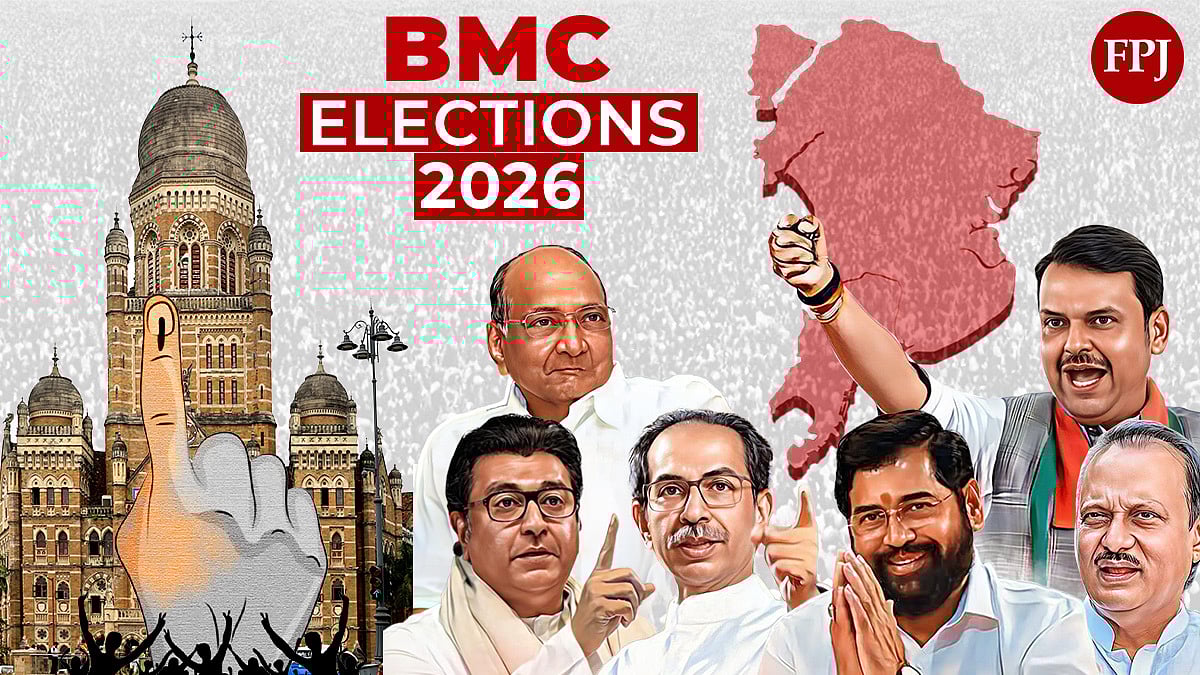
Nearly a decade after the last civic poll in 2017, the Brihanmumbai Municipal Corporation (BMC) election is finally scheduled for January 15. The prolonged delay was the result of litigation over OBC reservation and the redrawing of ward boundaries to reflect population changes. Repeated postponements meant that the BMC functioned without an elected civic body and mayor, while state government-appointed administrators ran the city for four years.
This is set to change after a fortnight, amid Maharashtra’s dramatic political fragmentation following the split of the Shiv Sena in June 2022 and the NCP a year later, developments that also had a significant impact on the 2024 Lok Sabha and Assembly elections.
Why Mumbai remains the centre of attention
Civic polls for 28 other cities in Maharashtra are also scheduled for January 15. However, the spotlight is firmly on Mumbai. As Asia’s richest civic body, the sheer size of the BMC’s budget makes the election crucial for every political party. The poll also attracts national- and state-level attention, as it is widely seen as a barometer of public mood and political equations in Maharashtra.
For over three decades, the BMC has been controlled by the Shiv Sena. The split in the party and the emergence of new political alliances have turned this election into a crucial test to determine which faction is the “real” Sena and who gets to represent the voice of Marathi people.
High-stakes battle amid political fragmentation
Who will control India’s richest civic body remains uncertain, given the muddled state of Maharashtra politics, marked by unusual alliances and shifting loyalties. The outcome is crucial not only for the ruling alliances but also for individual parties, particularly the two factions of the Shiv Sena—the Eknath Shinde-led Sena and the Uddhav Balasaheb Thackeray-led Sena.
While the election is important for the BJP, which has long sought to win the BMC on its own and came close in 2017, it is equally a prestige battle between the two Sena factions.
A direct contest takes shape
The election is shaping up largely as a direct contest between the BJP–Shinde alliance and the Uddhav–Raj Thackeray reunion. Shinde is positioned as the bridge between the BJP’s Hindutva narrative and the Sena’s traditional “Bhoomi Putra” sentiment.
When the Sena split in 2022, Shinde had numerical strength while Uddhav retained public sympathy. In the 2024 Lok Sabha elections, Uddhav’s Sena, as part of the Maha Vikas Aghadi, won three of Mumbai’s six seats, and the alliance performed well across the state. However, the Assembly elections held six months later told a very different story, with the MVA suffering its worst defeat and the Mahayuti alliance registering a resounding victory. The Mahayuti also performed strongly in recent local body polls.
Thackeray cousins reunite on Marathi identity
Against this backdrop, the reunion of estranged cousins Uddhav and Raj Thackeray on the plank of Marathi identity and language is being viewed as a crucial emotional factor that could resonate with Marathi voters. For both leaders, the alliance is seen as vital for political survival and relevance in a metropolis that has been the Shiv Sena’s home ground since 1968, when it first contested the BMC election.
Although the Sena emerged as a formidable force in Mumbai, it has never secured an outright majority in the BMC and has relied on strategic alliances to form the civic body.
Limits of identity politics in a cosmopolitan city
Between 1985, when it fell just short of a majority, and 2017—except for the 1992 election—the Sena was the single largest party in the BMC. Even during its peak in the 1990s, it never crossed the majority mark. This underscores the limits of identity-based “son-of-the-soil” politics in a cosmopolitan city with a large migrant population.
The BJP, meanwhile, was never a dominant force in Mumbai’s electoral politics. Its alliance with the Sena enabled the saffron parties to jointly control the BMC. This arrangement lasted until the BJP expanded its footprint on the Hindutva plank, prompting the Sena to realise the risk of being overshadowed by its ally.
From alliance to rivalry
For a regional, identity-based party like the Sena, diluting its core Bhoomi Putra ideology by aggressively embracing Hindutva proved costly. While it helped the BJP expand its influence in Maharashtra, it delivered limited gains for the Sena.
After coming to power at the Centre in 2014, the BJP gained momentum in Maharashtra, reflected in the 2014 Assembly elections and the 2017 BMC polls, where it won 82 seats—its best performance in two decades. This success was attributed to an aggressive campaign focused on transparency and development, explicitly targeting the Shiv Sena, despite both being allies in the state government at the time.
Existential test for the Thackerays
The breakdown of the Sena–BJP alliance in 2017 disrupted the long-standing saffron coalition in Maharashtra. Subsequent splits in the Sena and the NCP deepened political fragmentation, transforming once-cohesive vote banks into rival factions claiming legitimacy, legacy, and grassroots support.
The BJP has since moved from the fringes to a central role in Mumbai’s politics. Although the contest is multipolar, the BMC election represents a defining battle between the Thackeray cousins and the BJP–Shinde alliance, for whom wresting control of the civic body from the Thackerays is a major objective.
For the Thackerays and their parties, grappling with questions of relevance and survival, the election is an existential test to protect their vote base. This is why they have framed the contest as a fight not just for their parties, but for Mumbai and its Marathi identity.
Civic issues versus identity politics
As the election approaches, the campaign narrative appears to be shifting away from civic issues—dug-up roads, garbage heaps, open drains, traffic congestion, crumbling infrastructure, poor health services, and declining public transport—towards a sharper political binary: Marathi pride versus Hindu identity.
Whether Marathi pride will prevail over Hindutva remains to be seen.
The writer is a senior independent Mumbai-based journalist. He tweets at @ali_chougule.

