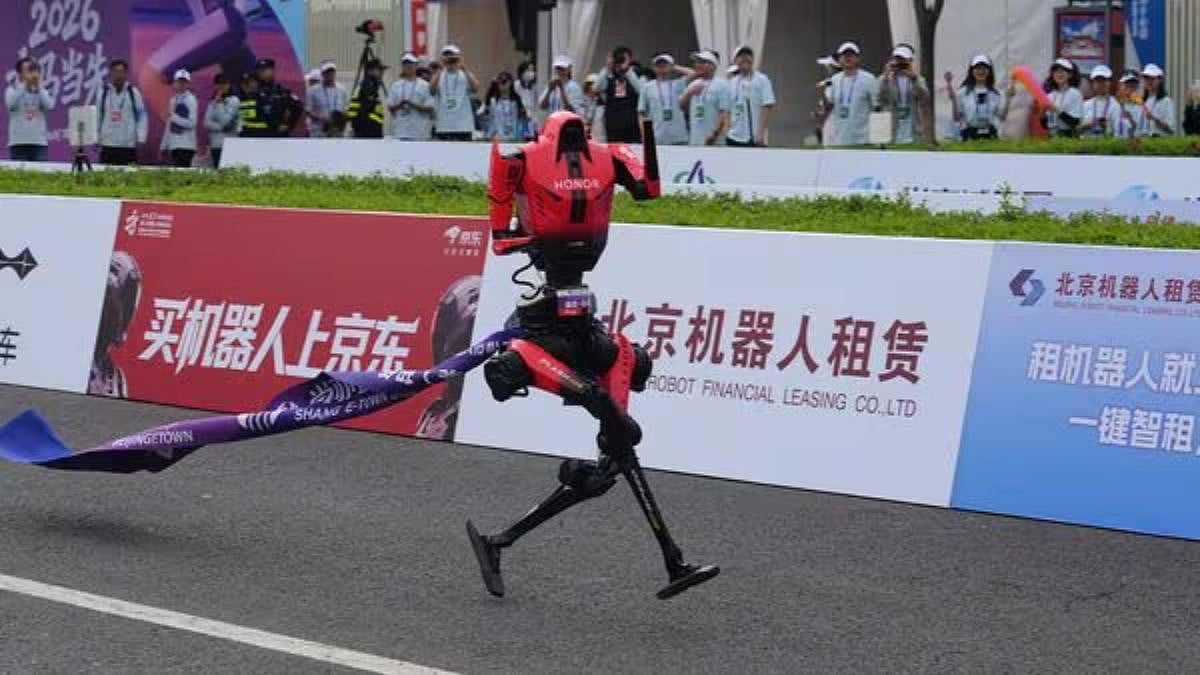
For decades, the half marathon has been a measuring stick of human endurance, a 13.1-mile (21.08 kilometre) testament to the limits of heart and lung and muscles.
But on a crisp Sunday in the Beijing E-Town district, those limits were not just tested; in one year, it has become the previous era. Flash/Lightning, an unguided humanoid developed by Shenzhen Honor Smart Technology—an offshoot of the telecommunications giant Huawei—crossed the finish line in a blistering 50 minutes and 26 seconds.
The performance did more than just win a race; it shattered the human world record of 57 minutes and 20 seconds, set just last month in Lisbon by Uganda’s distance-running phenom Jacob Kiplimo.
While Kiplimo’s feat was hailed as a pinnacle of human achievement, "Flash" finished nearly seven minutes faster, moving with a tireless, predatory efficiency that silenced the stadium.
Rapid advances in robotics performance
Next year Flash’s descendant will be even quicker. Imagine that. The spectacle marked what analysts are calling the "2026 Tipping Point". Just twelve months ago, the leading humanoid at this same event lumbered to a finish in over two hours.
The transition from a clunky, mechanical gait to this record-breaking stride underscores a rapid movement in China’s robotics sector, where hardware and software are now being mated with unprecedented precision and spectacular results.
By integrating smartphone-derived liquid cooling with foundation models for autonomous navigation, engineers have solved the "overheat and crash" dilemma that plagued earlier prototypes.
From science fiction to industrial reality
This unstoppable march of science was presaged long ago by the architects of speculative fiction. Isaac Asimov envisioned the "functional humanoid" that would eventually walk our streets; Karel Čapek foresaw the economic displacement of the human worker; and Robert Heinlein predicted the dextrous mechanical companion.
Today, their "imagined" futures have arrived as industrial reality. As the robot Cutie (QT1) famously remarks in Asimov’s I, Robot: "I, on the other hand, am a finished product...I am composed of strong metal, am continuously conscious, and can stand extremes of environment easily."
Implications for industry and workforce
The implications have inevitable spillover effects into broader human and industrial arenas. If a machine can navigate a racecourse at such speeds, it can navigate a chaotic hospital ward or a high-speed logistics hub. Cars already roam the roads without drivers. We are witnessing the birth of the General Purpose Tool—a machine that steps into the world we built for ourselves.
Rising concerns over economic impact
This mechanical triumph, however, casts a long shadow. For countries like India, which maintain a massive industrial workforce tied to manual labour, this is a matter to ponder deeply.
As AI and robotics steadily march from the laboratory to the pavement, the competitive advantage of human labour is being challenged by a tireless, silicon-based alternative. The finish line for Flash/Lightning is merely the starting line for a new era of global economic anxiety.

