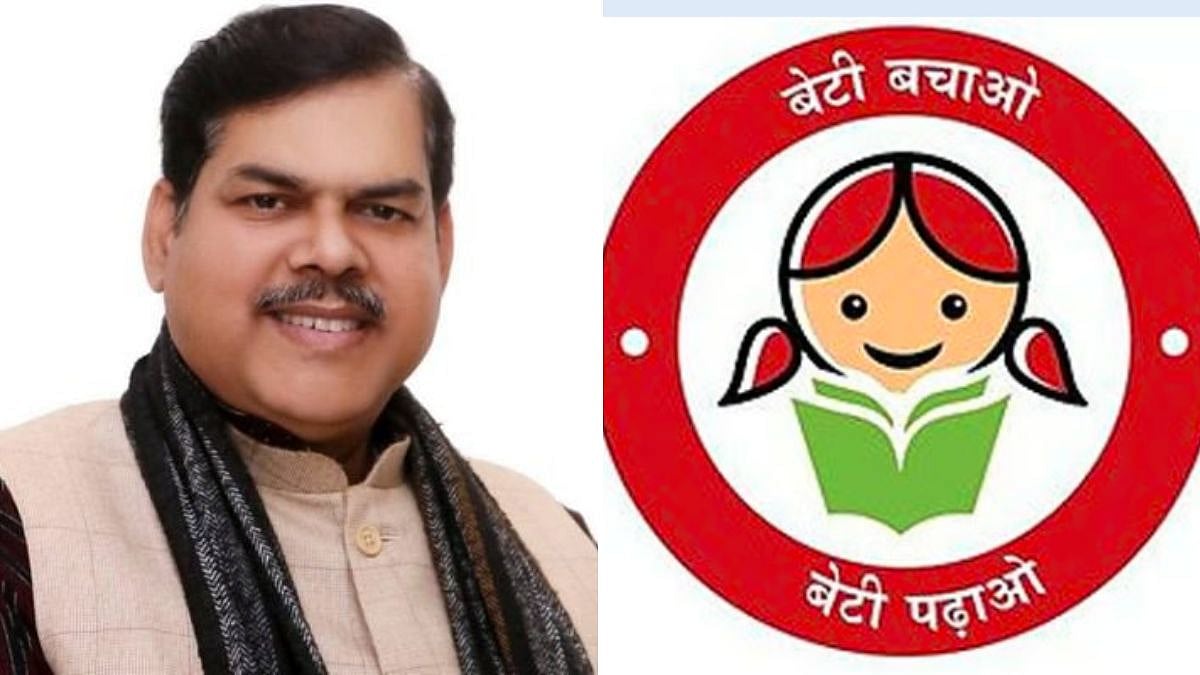
Few things are more wretchedly ironic than Bihar’s education minister Mithilesh Tiwari questioning the need for girls to be educated. In a video, the minister and BJP MLA from Baikunthpur in the Gopalganj district, who holds BA (Honours) degree in economics and was a teacher before becoming a politician, lauded the value of girls being within the four walls of their homes because “our daughters in our homes are our Shakti, the foundation of our prosperity…what is the need for education?” In an ideal polity, Tiwari would have been benched or certainly stripped of his portfolio after the reprehensible remarks, but in New India, where accountability is at a discount and majoritarian-traditional attitudes mean brownie points for politicians, Tiwari will likely be applauded, perhaps even hailed as an exemplar of the strong Hindu man. His remarks are clearly dissonant with the famous ‘Beti Bachao, Beti Padhao’ slogan given by Prime Minister Narendra Modi.
Tiwari’s disgusting remarks cannot be seen as a mere controversy that will soon blow over; they come from a place of immense power, authority, and influence. This lends them an air of legitimacy and invests them with the power to impact the lives of girls and women who have fought long and hard to be educated and the exhausting work by non-government organisations to get girls enrolled into schools and prevent dropouts. Both groups have long understood the fundamental value of educating girls and the promise it offers of a better life and more agency and autonomy even within the conservative and patriarchal family structure. Every international and national institution which has studied the subject recommends that educating girls can transform families, communities, economies, and countries. Tiwari seems to be blissfully ignorant of the mapped benefits of education in all societies but especially in India’s backward places, including his constituency.
Bihar continues to be at the bottom of several gender indices, including girls’ education, particularly in higher education, against the national narrative of improvement in girls’ enrolment and dropout rates; it ranks second highest for out-of-school girls in India. Tiwari’s constitutional responsibility is to ensure that more girls are in classrooms, from primary schools to colleges. When he questioned the very need for their education, he not only failed all those who have done decades of work to improve the metric but also his constitutional duty. In the past decades, the number of 15 and 16-year-old girls not enrolled in schools across Bihar fell from 28.2 per cent in 2006 to 6.7 per cent in 2022. The Nitish Kumar-led government promoted girls’ education by introducing bicycles to ease commuting and ensure attendance and offered ‘poshak yojana’ money for uniforms. Instead of building on these by providing better education infrastructure, including functional toilets and menstrual care, which have proved successful in retaining girls in schools, Tiwari walked two steps back. There’s little to separate his views from those of the Taliban, unfortunately.

