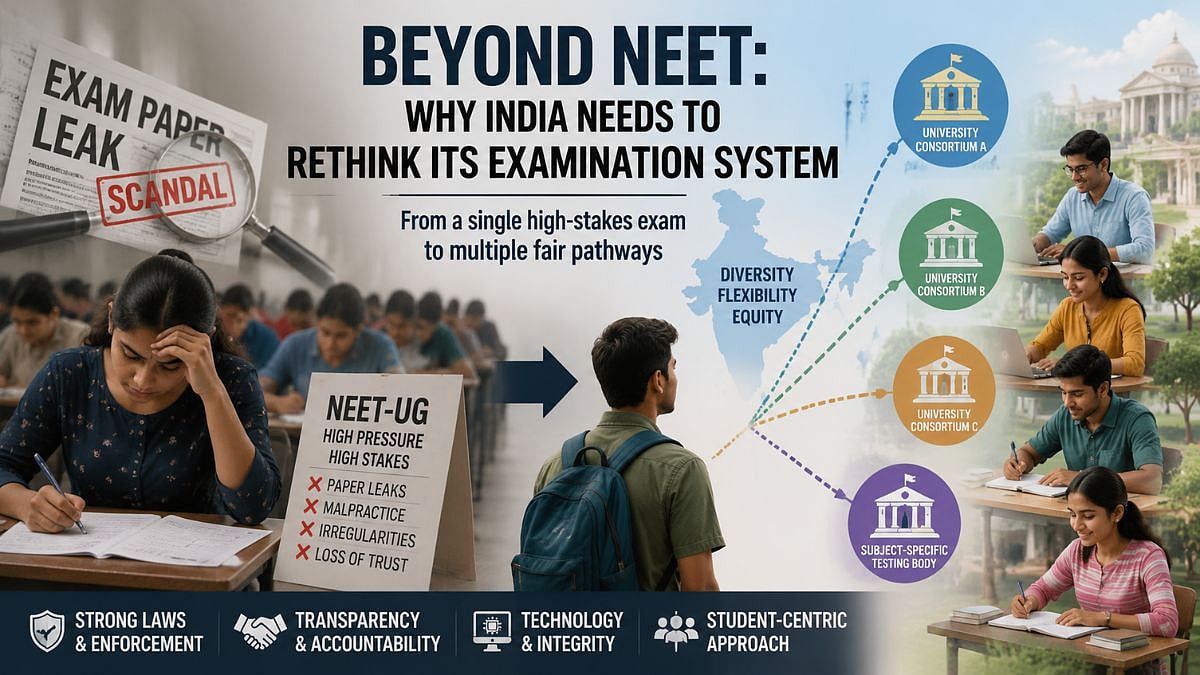
India’s examination system is in urgent need of reform, as the attempt to create a “One Nation, One Examination” framework for admissions to higher education has failed to inspire confidence among either students or the institutions it is supposed to serve.
Repeated paper leaks, allegations of malpractice, and administrative lapses have exposed the weaknesses of concentrating the fate of millions of students in a handful of centrally administered tests.
Limits Of Centralisation
The idea of a common examination is not inherently flawed. India has demonstrated that it can successfully conduct nationwide competitive examinations. The Union Public Service Commission (UPSC) and the Staff Selection Commission (SSC) have, over decades, earned credibility through robust systems, institutional autonomy, and rigorous standards. Their examinations are generally regarded as fair, transparent, and professionally managed.
The same cannot be said of several other national entrance examinations. The National Eligibility-cum-Entrance Test (NEET), in particular, has become a symbol of the risks associated with excessive centralisation. Allegations of question paper leaks and irregularities have repeatedly undermined public confidence, triggered widespread student protests, and generated intense political controversy. The controversy surrounding the examination became so severe that it ultimately claimed the political career of a Union minister.
Need For Stronger Institutions
Recognising the seriousness of the challenge, the government has moved to strengthen the legal framework through the Public Examinations (Prevention of Unfair Means) Amendment Act, 2026, which significantly amends the legislation enacted only two years earlier.
The amendments substantially raise the cost of malpractice by prescribing harsher prison terms, imposing heavier financial penalties on organisations that fail to conduct examinations securely, piercing the corporate veil that has often shielded promoters of companies implicated in examination fraud, and empowering agencies to crack down on organised criminal syndicates that profit from question paper leaks.
The legislation deserves recognition as a serious and well-intentioned attempt to restore integrity to public examinations. It acknowledges that examination fraud is no longer the work of isolated individuals but of organised networks involving institutions, private contractors, and criminal intermediaries. By seeking to hold every link in the chain accountable, the law represents an important step forward.
However, the problem is that legislation, however stringent, cannot by itself restore public confidence.
India’s experience with governance over the last 77 years has repeatedly demonstrated that the effectiveness of any law depends less on the severity of punishment than on the certainty and speed of its enforcement.
Unless investigations are swift, prosecutions are professional, and convictions are timely, even the toughest statute risks becoming a deterrent only on paper. Without effective implementation, the new law may possess more teeth to display than teeth to bite.
Rethinking The Examination Model
The larger question, therefore, is whether a continental-sized country like India can realistically depend upon a single examination conducted by a single agency for admissions to thousands of institutions serving students from vastly different educational and social backgrounds. The answer increasingly appears to be "No".
India’s diversity is its strength, and its examination architecture should reflect that reality. Instead of vesting overwhelming responsibility in an overstretched and understaffed agency such as the National Testing Agency (NTA), the Ministry of Education should consider a decentralised but coordinated model run by universities and institutions themselves.
Universities could be encouraged to form regional or subject-specific testing consortia. Groups of institutions could jointly conduct entrance examinations for engineering, medicine, dentistry, pharmacy, and other professional courses. Such bodies would be closer to the institutions they serve, more accountable, and better equipped to respond to regional requirements while maintaining high academic standards.
Decentralisation, however, should not risk translating into disorder. A national coordinating mechanism should harmonise examination calendars and establish common standards so that tests do not overlap. A student seeking admission to institutions in southern, northern, eastern, or western India should be able to sit for multiple entrance examinations without scheduling conflicts or unnecessary hardship. The Centre’s role should evolve from that of a monopoly examination provider to that of a regulator, standard-setter, and coordinator. This way, it will also be able to shield itself from future student ire over failed examinations.
Lessons From Global Systems
There are successful international models from which India can draw lessons. Admissions to leading universities in the United States and Europe are not based on a single government-run examination. Standardised tests such as the Graduate Record Examination (GRE), Test of English as a Foreign Language (TOEFL), and Graduate Management Admission Test (GMAT) are administered by specialised organisations, while universities retain considerable autonomy in determining admissions.
The result is a world-class system that combines standardisation where necessary with institutional flexibility and competition. India need not replicate these models wholesale; however, it needs to study them and adopt the best practices that they have evolved.
Our educational landscape is unique, and any reform must be adapted to Indian realities. However, the country can certainly learn that resilience comes from a diversity of institutions rather than excessive concentration of authority.
When millions of young people stake their futures on a single examination, one failure can become a national crisis. The debate, therefore, should move beyond the slogan of “One Nation, One Examination”. Stronger laws are necessary, but they are not sufficient.
The objective should not merely be to prevent the next paper leak but also to redesign an examination ecosystem in which no single breach can jeopardise the aspirations of millions of students. What India requires is not simply a tougher legal regime but a fundamentally stronger institutional architecture, one that combines decentralisation with coordination, autonomy with accountability, and technology with transparency.
A Better Way Forward
If we are able to do so, only then will the country be able to claim that it has created an examination system worthy of the talent, diversity, and aspirations of its youthful, teeming millions.
The Author is Editor, United News of India.

