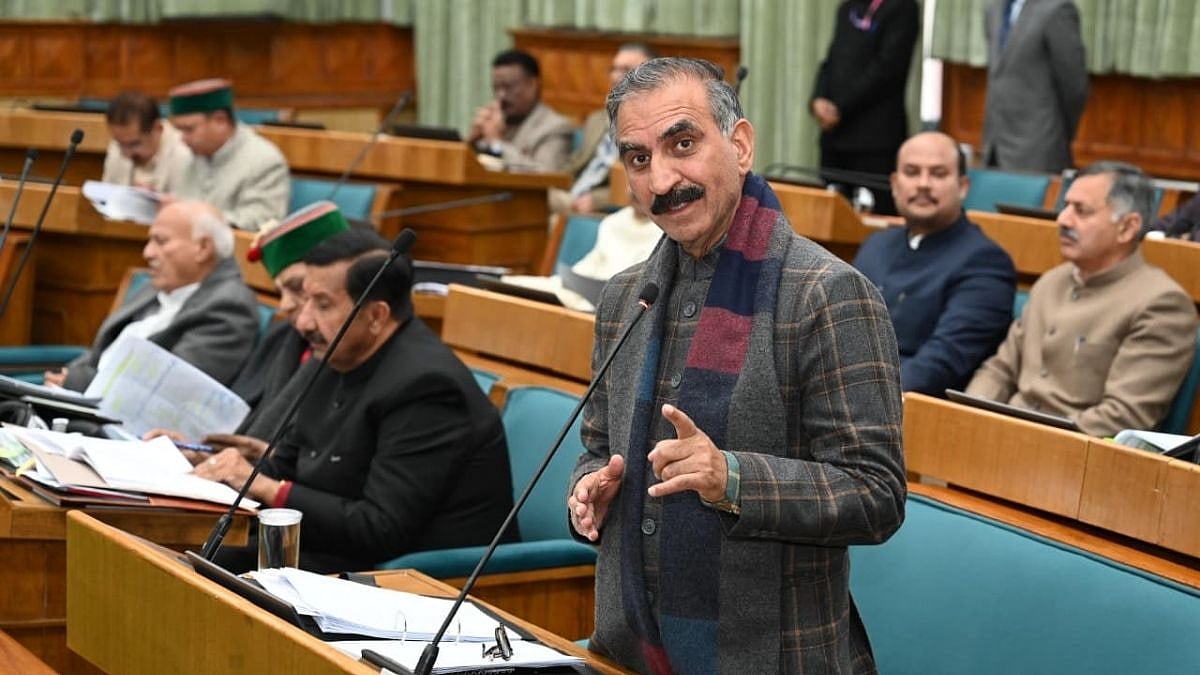
As Sukhvinder Singh Sukhu prepares to unveil Himachal Pradesh’s Budget for 2026–27, the exercise comes not as a routine annual statement but as a defining fiscal moment. The state finds itself caught between narrowing financial space and expanding public expectations.
The withdrawal of central support in the form of the Revenue Deficit Grant, mounting liabilities and modest revenue growth have together created a constrained fiscal landscape.
Within this tightening framework, the government must still deliver on development promises, sustain welfare commitments and respond to growing economic anxieties across social groups.
Rising aspirations, limited resources
The forthcoming budget has triggered heightened expectations across constituencies, each seeking targeted relief in a period of economic uncertainty. Among them, the unemployed youth represent the most restless segment.
Himachal’s job market has long been skewed towards government employment, which continues to be perceived as the most stable avenue. However, with limited fiscal headroom, large-scale recruitment appears increasingly difficult.
Recent estimates by the Centre for Monitoring Indian Economy indicate that unemployment levels in the state remain above the national average, with educated youth facing sharper distress. In this backdrop, attention is shifting towards alternative employment generation.
There is a growing expectation that the budget will prioritise skill development, promote tourism-linked livelihoods, and incentivise entrepreneurship to gradually reduce dependence on state jobs.
Agrarian concerns in a changing trade climate
The rural economy, anchored significantly in horticulture, presents another layer of urgency. Apple cultivation continues to define the economic landscape of districts such as Shimla, Kullu and Kinnaur, sustaining lakhs of households. Yet, growers are increasingly uneasy about external pressures arising from evolving global trade dynamics.
Rising imports, particularly from countries like the United States and New Zealand, have intensified concerns about price competitiveness. With domestic production and imports operating in comparable volumes, even marginal policy shifts at the national level can significantly affect farm incomes.
Growers are therefore looking towards the state government for protective and enabling interventions—ranging from improved cold storage and logistics to marketing support that can shield them from volatile price swings.
Women and the rural economy
Women-led economic activity has quietly emerged as a stabilising force in Himachal’s rural landscape. Self-help groups and cooperatives have expanded their footprint, contributing to household incomes and local economies. Expectations from this segment are centred on deeper institutional support—credit access, market linkages, and expansion of livelihood schemes.
There is also a parallel demand for strengthening public services, particularly in healthcare and education, where access remains uneven in remote and high-altitude regions. The budget is thus expected to reflect a more inclusive development approach that integrates gender and regional equity into fiscal planning.
Infrastructure push faces fiscal limits
One of the most visible stress points is likely to be capital expenditure. Infrastructure investment—critical for connectivity and economic growth in a hill state—may face downward pressure as resources tighten. A reduction in capital outlay would inevitably slow the pace of road construction, irrigation expansion, and public infrastructure development.
This carries broader implications. In a geographically challenging state like Himachal, infrastructure is not merely a growth driver but a necessity for service delivery. Any slowdown risks reinforcing regional disparities and constraining long-term economic potential.
The end of a fiscal cushion
At the core of the state’s financial strain lies the gradual withdrawal of the Revenue Deficit Grant recommended by the 15th Finance Commission. For years, this mechanism acted as a stabilising buffer, compensating for the structural gap between revenue receipts and expenditure.
With the grant now nearing its end, the state faces a substantial annual shortfall running into thousands of crores. For a budget of Himachal’s scale, this is not a marginal adjustment but a structural shock. The loss of this fiscal cushion compels the government to either enhance revenue mobilisation or rationalise expenditure—both politically sensitive choices.
Structural limits of the economy
The current fiscal stress is not merely cyclical; it reflects deeper structural realities. Himachal’s mountainous terrain limits industrial expansion and constrains the tax base. Unlike larger states with diversified economies, its revenue streams are concentrated in sectors such as tourism, hydropower, and horticulture—areas that generate economic activity but relatively modest tax returns.
Compounding this is the weight of committed expenditure. Salaries, pensions, and interest payments consume a dominant share of the state’s revenue spending, leaving limited fiscal space for new initiatives. Rising public debt further tightens this constraint, as higher borrowing translates into increased interest obligations.
Balancing welfare with sustainability
Himachal Pradesh has historically prioritised welfare, with schemes covering subsidised power, social security pensions, and educational assistance forming the backbone of its social contract. These programmes are particularly crucial in remote regions where economic opportunities are limited.
However, sustaining this welfare architecture in the face of shrinking resources presents a difficult policy dilemma. The reintroduction of the Old Pension Scheme has added to long-term liabilities, complicating fiscal management. The challenge before the government is to preserve social protection without undermining financial sustainability.
A defining budget moment
The 2026–27 Budget thus assumes significance beyond its immediate numbers. It will signal the direction of fiscal policy in a period marked by constraint and uncertainty. Choices made now—on spending priorities, revenue strategies, and investment focus—will shape the state’s economic trajectory in the coming years.
Enhancing revenue through better compliance, leveraging tourism potential, and attracting private investment may form part of the solution. Equally important will be improving efficiency in public expenditure to ensure that limited resources deliver maximum impact.
For Himachal Pradesh, fiscal management has always required careful balancing, given the inherent challenges of geography and scale. This year’s budget, however, raises the stakes. It must reconcile competing demands—discipline and development, restraint and responsiveness—at a time when both are equally imperative.
(Writer is a senior political analyst and strategic affairs columnist based in Shimla)

