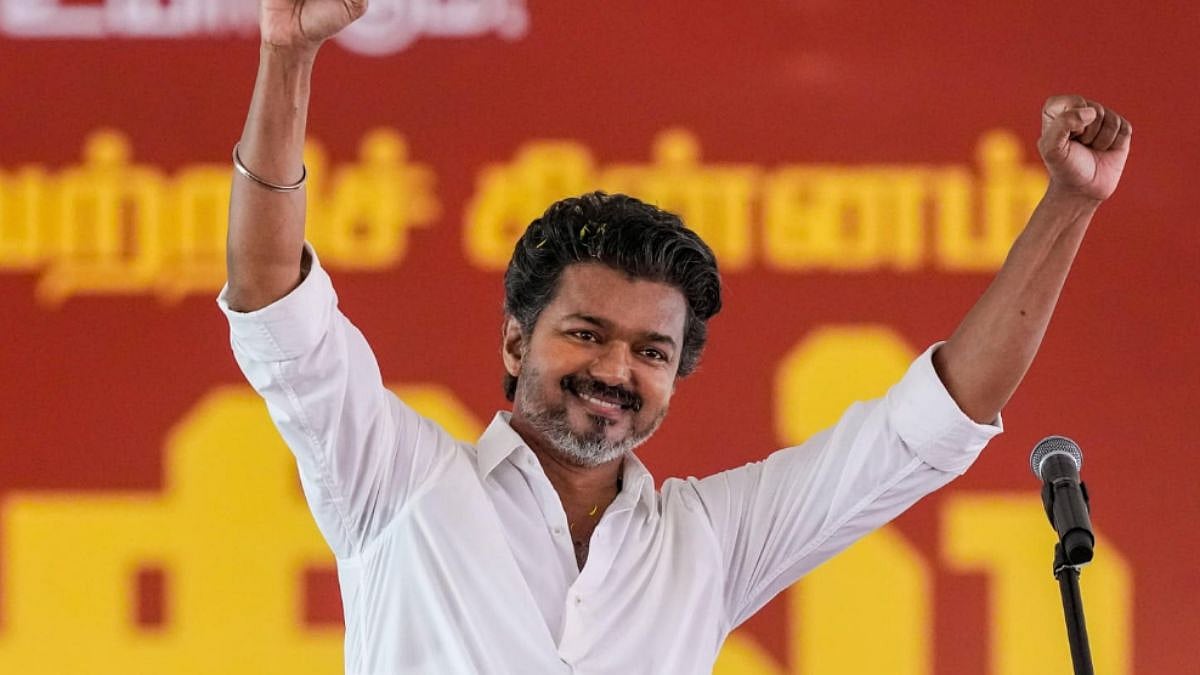
The induction of two Congress legislators into the Tamil Nadu ministry headed by C. Joseph Vijay marks more than a routine cabinet expansion. For the Congress, it represents the end of a political exile that lasted nearly six decades.
When S. Rajesh Kumar and P. Viswanathan took oaths alongside 21 ministers from the ruling Tamil Vettri Kazhagam, the symbolism was unmistakable. Since the rise of Dravidian politics in 1967, the Congress has remained either an ally without authority or a spectator to power in Tamil Nadu.
Though it periodically aligned itself with one Dravidian major or the other, it was carefully kept outside the portals of government. Both the DMK and the AIADMK understood the risks of reviving the Congress organisationally.
Giving it ministerial responsibility could eventually have enabled the national party to reclaim lost political ground. That unwritten compact has now been broken by Vijay, who appears less burdened by the insecurities that shaped Tamil Nadu’s coalition politics for decades.
Congress gains political relevance
The Congress can also draw satisfaction from the fact that it was the first party to support Vijay’s claim to form the government. With only five seats, its numerical contribution was modest, but politically the endorsement carried weight and lent legitimacy to the fledgling dispensation.
More importantly, Vijay appears determined to build a broad-based coalition rather than a narrow personality-centric regime. His reported willingness, during the elections, to allot even 75 seats to the Congress reflected a serious attempt at forging a durable pre-poll alliance.
The Congress underestimated Vijay’s ability to convert cinematic charisma into electoral success. Had a pre-poll alliance materialised, the political arithmetic of Tamil Nadu might have looked dramatically different.
Vijay’s invitation to parties like the Viduthalai Chiruthaigal Katchi and the Muslim League to join the government suggests he is seeking stability through inclusiveness rather than dominance through numbers alone.
Challenges remain for Congress
Yet, the Congress faces a larger dilemma that no ministerial berth can resolve. Across India, regional parties expect it to lead the national Opposition against the BJP while simultaneously resisting its revival within their own states. The contradiction is glaring.
The Left may cooperate with the Congress nationally but treats it as a principal adversary in Kerala and West Bengal. Regional formations share the same anxiety.
The DMK itself, despite being part of the Opposition bloc nationally, has chosen to maintain visible distance from the Congress in Parliament. In this sense, Tamil Nadu offers the Congress both an opportunity and a warning.
Participation in government can help it recover political relevance, but only if it rebuilds its organisation and reconnects with voters at the grassroots. Without regaining a meaningful foothold in major states such as Bihar, Uttar Pradesh and West Bengal, the Congress cannot realistically aspire to reclaim its once pre-eminent place in Indian politics.
