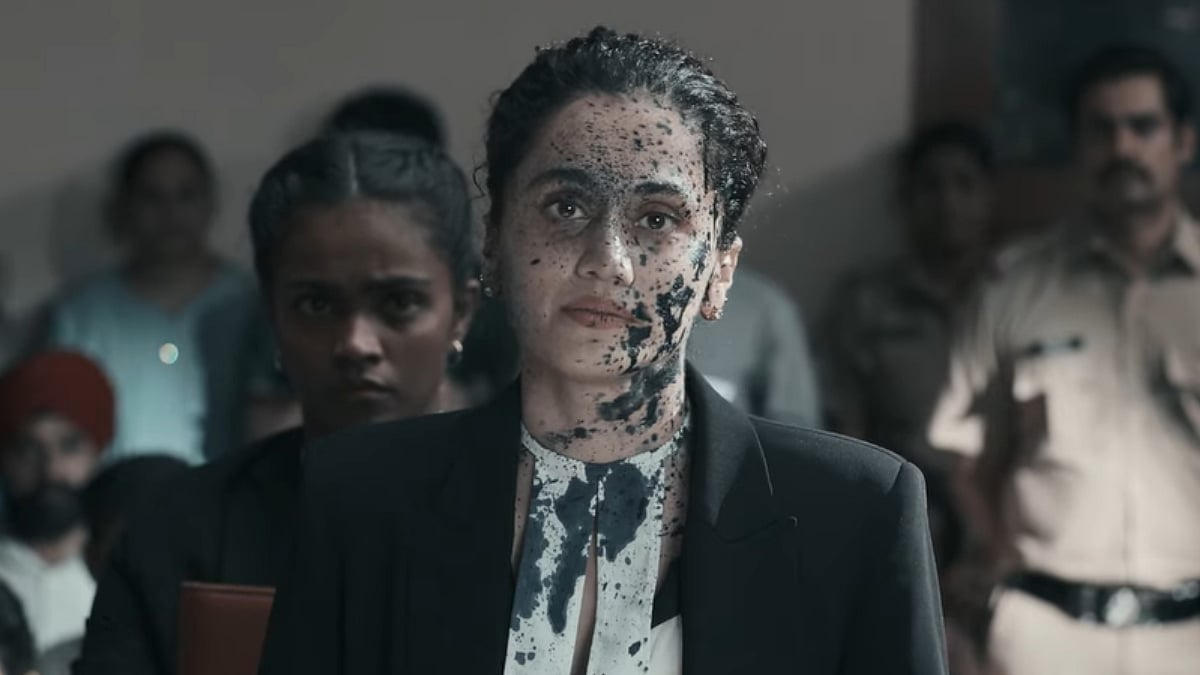
What happens to a schoolteacher, Parima, in the recent release Assi is every woman’s worst nightmare. On her way home from a party, she is abducted by four men, raped in a moving car, subjected to horrific violence and dumped on the railway tracks to die.
The film, directed by Anubhav Sinha, then does something that breaks the old rape-revenge trope used in Bollywood. It is as if the way the aftermath of sexual violence has been depicted in movies for decades underwent an evolution. That is probably because the attitude of society towards the survivor has changed to some extent. Nowhere in the film is the archaic term “izzat lut gayi” used.
When Parima (played by Kani Kusruti) is found by a man, he does not look away, thinking, “Why get involved in police hassles?” With the help of ordinary people like him, women quickly empty a cart to transport her; she is taken to hospital, and the Delhi cops, notorious for their apathy, actually get cracking right away. Parima is badly injured and traumatised, but never does she or her husband, Vinay (Mohammed Zeeshan Ayyub), even consider not going ahead with the complaint for fear of what people will say. He even takes their pre-teen son to the hospital and court so that he is not shielded from brutal reality.
Support, legal battle and institutional response
There is a scene when she returns home after being discharged from the hospital, and many women from the neighbourhood show up in support. They sit around her silently, allowing her to find a way to heal. A lawyer, Kaveri (Taapsee Pannu), takes up her case and fights a tough battle. Of course, there are attempts at a cover-up. Alibis are manufactured, DNA samples tampered with, CCTV footage goes missing and cops are bribed. Even though Parima is unable to identify the attackers, her vision has been damaged by them — which is something the defence lawyer harps on — the female judge (Revathy) is nothing but sympathetic.
In films about rape in the past, women either suffered and died so that a male (father, husband, brother or son) could take revenge or, in some B-grade films, the woman did her own avenging act. What was lacking — except for a handful of films like Ghar and Pink — was the psychological trauma caused by assault. Hindi cinema dealt with the subject either with sensationalism or dubious sensitivity: vigilante justice or courtroom theatrics, all of which burdened the woman with a victimhood she may not have wished for. Because scriptwriters and filmmakers did not know how else to portray a woman’s response to an assault except as tragically morose or murderously angry.
Beyond victimhood
Parima goes through physical and mental anguish but does not want to hide her face in court — the burden of shame is not hers to bear. It’s time society heaped that shame on the perpetrators. She is aware that even today patriarchal culture is such that her male students post offensive comments on social media. One of them asks why he was not “invited” to participate in the rape. Still, she is willing to go back to the classroom and face those same insensitive ruffians, but the principal says she is not ready to have her return because “we” — meaning a craven society — are not ready. Assi does not shy away from the horror of the consequences or dial down Parima’s and her husband’s struggles or her child’s bafflement. In reality, more often than not, rapists do get away due to lax investigation or loopholes in the law — but knowing which way the case may go, Parima is not afraid. She is not robotically courageous either — she has nightmares, and when she looks at herself in the mirror, she can see that she is not the woman she was before the rape. The external wounds may heal, but who can tell the extent of the scars on the psyche?
There is no getting away from the ugly fact that medical examination, police questioning and the court case that makes the survivor relive the incident over and over again could be detrimental to a woman’s mental health. No matter how brave the woman may be, there is always some residual fear or regret — what if she were not out late? What if she did not go to the party? What if she had not taken the metro alone?
A larger social reckoning
The title of the film refers to the fact that 80 rape cases are reported every day in India — which in no way indicates the real figure because women or their families are still reluctant to report the crime for fear of social stigma or retribution by the perpetrators. Even today, rapists out on bail threaten the survivor and her family. Even if cases are now fast-tracked, justice is still slow.
Social attitudes and victim-blaming started changing mostly after the Nirbhaya rape, when all the assumptions about why men rape went out of the window — she was not alone, she was not provocatively dressed and she was not intoxicated. If 80 cases are reported, it is a sign that at least a small section of society does demand justice for the survivor. There are people who refrain from judging the survivor or pitying her.
Unfortunately, the film, perhaps not trusting its own power, had to dilute it by introducing a vigilante, but to its credit, it is always on the side of the survivor. For Parima, the murder of two of the men or the court’s verdict is not the real victory; for her, it is the gradual inching towards normal life. To be able to walk down the street without fear, to be able to look the world in the eye without shame. She may emerge from the ordeal stronger, or she may crumble under the pressure to be ‘normal’, but nobody else can make those choices for her.
Deepa Gahlot is a Mumbai-based columnist, critic and author.

