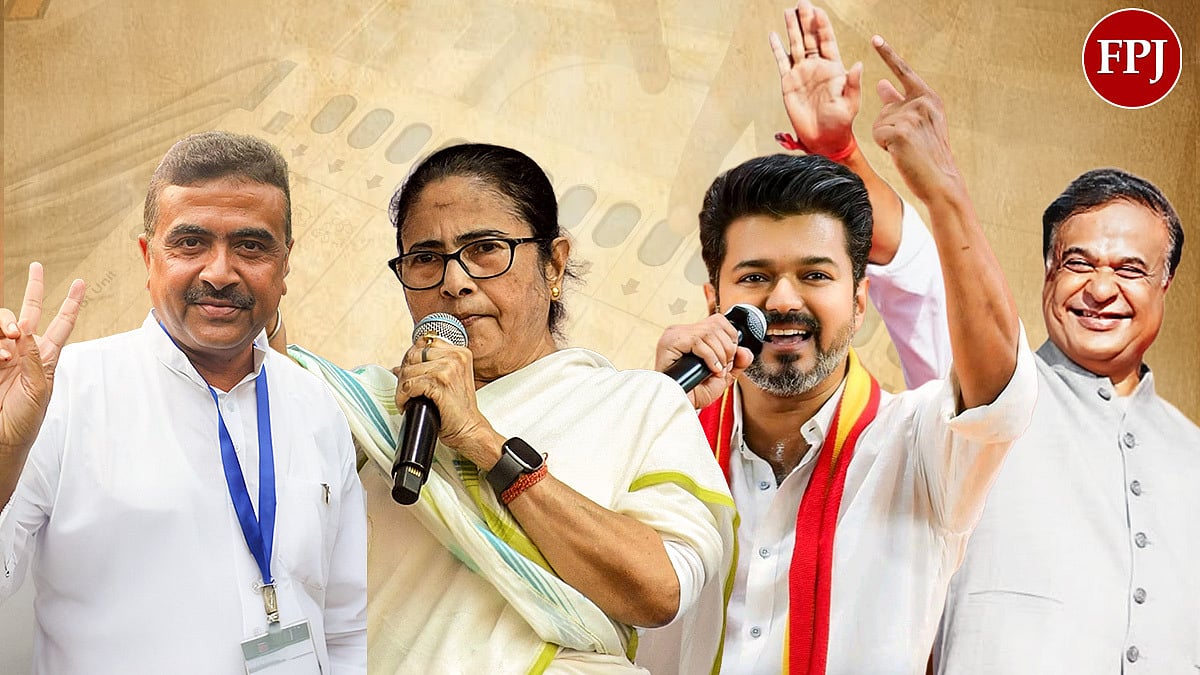
The elections to four states and one Union Territory, the most consequential since the 2024 Lok Sabha verdict, have done more than merely reshuffle governments; they have offered a glimpse into the future of Indian politics, one that is steadily, if unevenly, moving towards a bipolar, two-party-like system. The results were, broadly speaking, along expected lines. Yet, the scale of victories and the depth of defeats were nothing short of spectacular, suggesting structural shifts rather than routine electoral churn. At the centre of this transformation stands the Bharatiya Janata Party, which appears increasingly immune to the traditional curse of anti-incumbency. In states where it or its allies held power, the electorate chose continuity over change. This is striking, particularly in a political culture long defined by cyclical discontent. That this verdict came on a day when news broke of yet another bridge collapse in Bihar underscores a paradox: governance failures no longer automatically translate into electoral punishment.
Nowhere was this consolidation more visible than in Assam under Chief Minister Himanta Biswa Sarma. A former Congress leader who has seamlessly reinvented himself within the BJP, Sarma has demonstrated a ruthless political effectiveness. The Congress was reduced to a historic low, winning just 19 seats against the NDA’s commanding 102 in a 126-member Assembly. The BJP alone secured a majority well beyond the halfway mark. Sarma’s campaign, marked by sharp polarisation, including controversial remarks about voting patterns along religious lines, may have raised concerns about social cohesion, but electorally, it proved devastatingly effective. Yet, the numbers also reveal a more complex story: the BJP’s vote share of 37.81 per cent was not dramatically ahead of the Congress’s 29.84 per cent, indicating that the opposition vote, though substantial, remains fragmented.
If Assam demonstrated consolidation, West Bengal illustrated the potency of anti-incumbency. The rout of Mamata Banerjee’s Trinamool Congress, which managed 40.8 per cent of the vote against the BJP’s 45.84 per cent, marks a political earthquake. The BJP’s haul of 207 seats in a 293-member House would have exceeded even its own expectations. Banerjee has contested the verdict, attributing her defeat to the role of central forces and the Election Commission. While concerns over the scale of paramilitary deployment and the reported disenfranchisement of millions cannot be dismissed lightly, they do not fully explain the scale of the defeat. Anti-incumbency, coupled with the BJP’s sustained promise of development, appears to have tipped the balance. Still, it is equally true that a majority of voters did not endorse the BJP, reinforcing the idea that opposition unity, or the lack of it, remains a major determinant.
Tamil Nadu delivered perhaps the most dramatic twist. Actor-turned-politician C. Joseph Vijay, leading the fledgling Tamilaga Vettri Kazhagam (TVK), stunned the political establishment by winning 108 seats in a 234-member Assembly. His meteoric rise invites comparisons not with MG Ramachandran, who had deep roots in Dravidian politics, but with NT Rama Rao, who famously captured power in his first electoral attempt. Vijay’s offer of 75 seats to the Congress, had it been accepted, might have changed the arithmetic decisively. Having proved his popularity, Vijay will now have to prove his administrative acumen. The defeat of MK Stalin and the DMK, despite a record of reasonably effective governance, underscores a harsh electoral truth: performance alone does not guarantee re-election. Alliances, narrative control, and timing matter as much as, if not more, than performance. Ironically, the BJP, despite an aggressive campaign led by Prime Minister Narendra Modi and attempts to align with the Tamil cultural sentiment, remained a marginal player, securing just a single seat.
Kerala, too, witnessed a political upheaval. The Congress-led United Democratic Front swept to power in what can only be described as an electoral tsunami against the CPI(M)-led Left Democratic Front. For Chief Minister Pinarayi Vijayan, this was not merely a defeat but a repudiation of what critics have termed “Pinarayism”, a style of governance marked by centralisation and a perceived intolerance of dissent. The LDF’s slogan, “Who Else?”, now reads less like confidence and more like hubris. Vijayan’s narrow escape in his own constituency after trailing for several rounds symbolises the erosion of the Left’s once-formidable base. With this loss, the CPI(M) finds itself without power in any state, a remarkable decline for a party that once shaped national discourse.
In Puducherry, the story was different but equally instructive. N. Rangasamy’s personal charisma once again triumphed over organisational weakness. Leading the All India NR Congress, he secured a fifth term, capitalising on a fragmented opposition where the Congress and the DMK failed to present a united front. The BJP played only a supporting role yet benefited indirectly from the divisions among its rivals.
Taken together, these results point to a broader national trend: the gradual decline of regional parties and the emergence of a more polarised political landscape. This does not mean that India is heading towards a strict two-party system in the mould of Western democracies. The country’s social and linguistic diversity makes such an outcome unlikely. However, what is clearly taking shape is a bipolar contest, with the BJP on one side and a still-evolving, often disunited opposition on the other. The implications are profound. A bipolar system can bring clarity and stability, but it also risks deepening divisions and reducing the space for nuanced political discourse. For the Opposition, the lesson is unmistakable: unity is no longer optional. For the BJP, the challenge will be to translate electoral dominance into inclusive governance that addresses the aspirations of those who did not vote for it.
