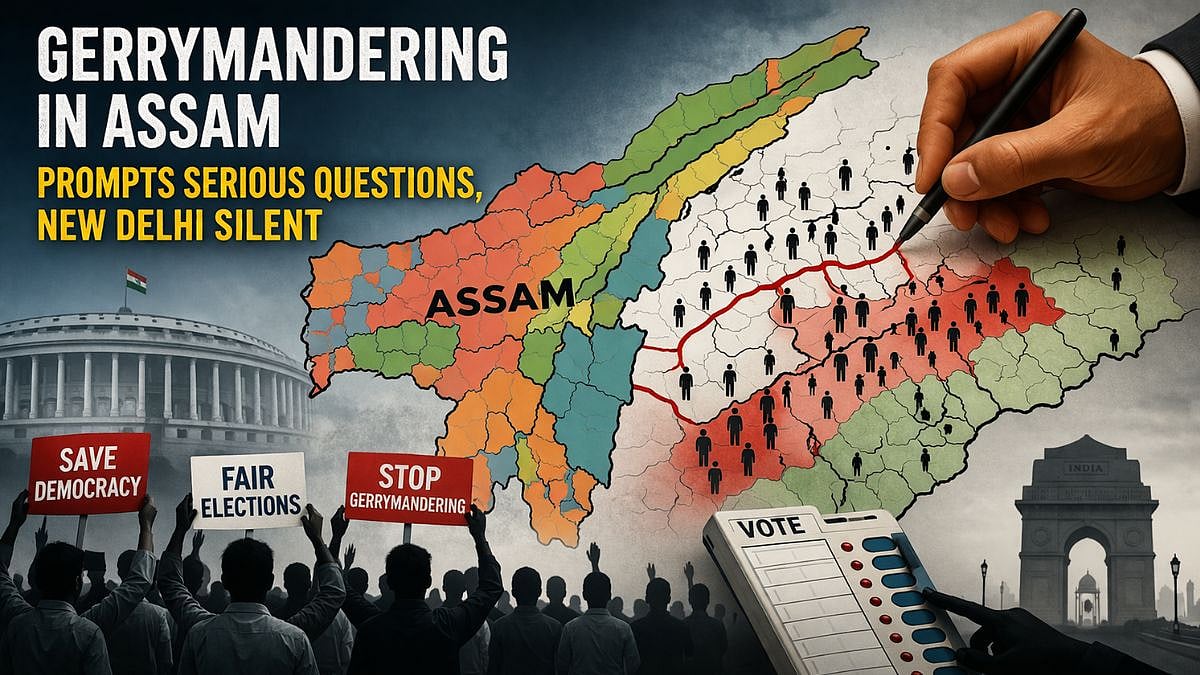
The non-stop noise about “vote chori” in West Bengal and allegations by the state’s ruling Trinamool Congress that the Election Commission is partisan and working to benefit the BJP cannot be written off as mere pre-poll political ranting by an embittered party. While the debate will continue as long as the BJP remains in power at the Centre and accusing fingers are pointed at the poll panel, something far more drastic took place in neighbouring Assam that was not debated as widely as it should have been.
Electoral roll changes and delimitation impact
For the record, final rolls published on February 10, 2026, confirmed 2.43 lakh deletions statewide in Assam after claims and objections, reducing the total number of electors to 2.49 crore—a 0.97 per cent drop from the draft—compared to the dreaded sword hanging over 51 lakh names on the verge of being disenfranchised in West Bengal. What Assam witnessed in the name of delimitation in 2023 has been alleged to be gerrymandering.
How constituency boundaries were altered
The Delimitation Commission did not go into the nitty-gritty of identifying and deleting the names of ineligible voters. Instead, it made drastic changes to constituency boundaries in such a manner that Muslim voters were concentrated in particular constituencies, thereby liberating adjoining constituencies from Muslim dominance. Muslim-heavy villages and polling booths were shifted into these pre-identified constituencies, while areas with stronger non-Muslim populations were moved to adjoining constituencies.
Understanding gerrymandering
Gerrymandering, also called “packing”, is the manipulative practice of drawing constituency boundaries to favour one political party, group, or candidate by diluting or concentrating votes unfairly. The term originated in Massachusetts in 1812 and was coined by critics of Governor Elbridge Gerry. During his tenure, the boundaries of state senate districts were drawn in a manner that confined voters to a few districts to limit their statewide influence. This exercise inspired the portmanteau “Gerry-mander” in the Boston Gazette.
Impact on representation
A similar practice was witnessed in Assam, where minorities were allegedly packed into fewer constituencies. As a result, the number of Muslim-dominated Assembly constituencies reduced from 29 to about 20 in the 126-member Assam Legislative Assembly, while voter demography in several other constituencies was also impacted.
Limited political response
The protests and allegations by the state’s Congress-led Opposition were mild. Perhaps they did not fully understand the exercise, since no names were deleted and no voters were detained or deported. It possibly did not trigger a major debate as it was not “vote chori” and had minimal impact on outcomes in the 2024 Lok Sabha elections in the state, with both the BJP and the Congress winning an identical number of seats—nine and three respectively—as they did in 2019.
Implications for upcoming elections
The time for reckoning has, however, come as Assam gears up to vote on April 9. Not only has Muslim dominance vanished from nine constituencies, but the list of reserved seats has also been drawn in a way that several constituencies with sizeable Muslim populations have been reserved, effectively preventing them from contesting those seats. This means the new Assembly is likely to have a smaller number of Muslim legislators, which stood at 31 in the outgoing House.
Historical context of migration
Migration and infiltration from East Pakistan, now Bangladesh, followed set patterns. Hindus fled after the 1947 Partition and the 1971 war. Illegal infiltrators, however, did not wait for such upheavals. They slipped in steadily, often occupying forest fringes without checks. Congress regimes in the 1960s and 70s ignored the issue. Local Assamese populations have become a minority in several districts and constituencies, outnumbered by Bengali-speaking voters. This sparked the AASU protests and the Bodoland movement.
Broader migration patterns
Like West Bengal, Assam has traditionally served not only as a destination but also as a transit point for migration elsewhere in the country, as people sought better opportunities and escape from impoverished conditions back home.
Concerns over democratic impact
Whether gerrymandering in Assam is by design or coincidence is difficult to determine—and if by design, then at whose behest? The Congress party was preoccupied with projecting Rahul Gandhi as a prime ministerial contender in 2024, while BJP-ruled Assam, with just 14 Lok Sabha seats, may have seemed too small to warrant focused attention in 2023.
What is alarming is that this American malice of gerrymandering appears to have arrived in India. The Assam experiment may not remain an isolated instance. If the BJP retains power in the state with increased numbers, similar strategies could be replicated elsewhere in the country, posing a greater threat to democracy than the alleged “vote chori”—a phrase coined by Rahul Gandhi and widely echoed.
Political discourse and public focus
While Rahul Gandhi’s allegations remain unproven and may stem from political frustration, gerrymandering in Assam reflects itself in the redistribution of voters across all 126 constituencies in the state.
There is a possibility that the issue may remain undiscussed, as more immediate concerns—such as LPG shortages or demands to cut excise duties on petrol and diesel—dominate political discourse. These populist issues resonate more directly with voters across the country, while the long-term implications of practices like gerrymandering receive far less attention—even among communities most affected.
Ajay Jha is a senior journalist, author, and political commentator.

