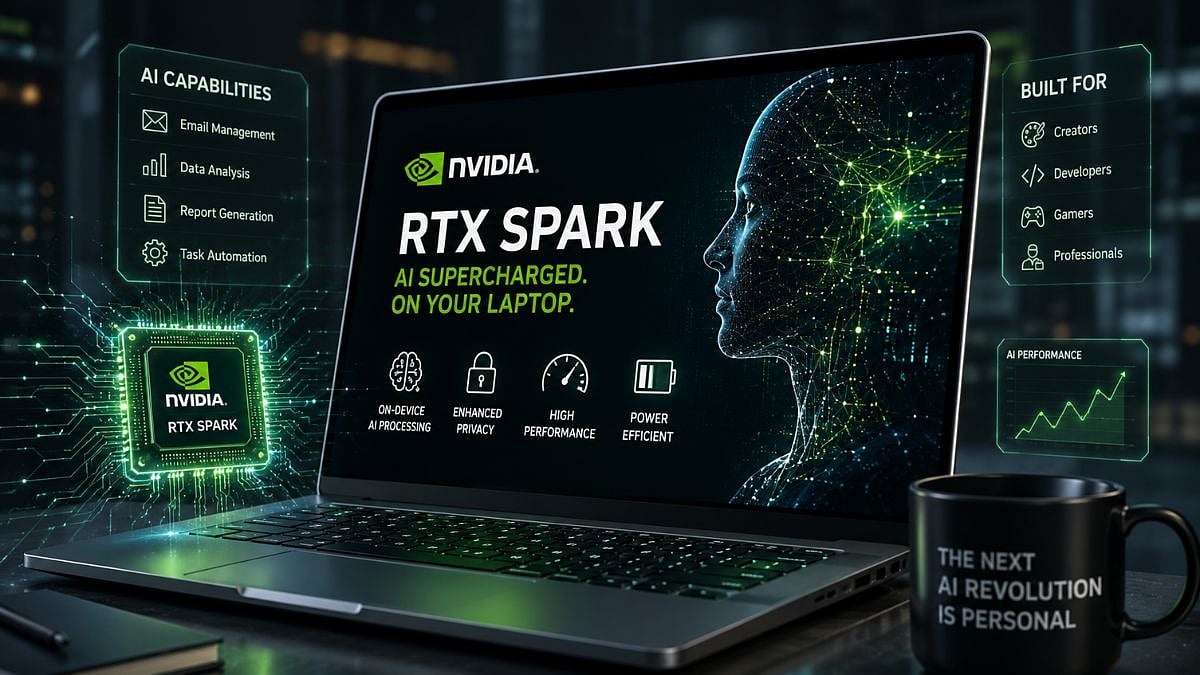
Politicians and governments are yet to come to grips with the potential impact of artificial intelligence on economies and the labour force, but one of the biggest companies in the field, Nvidia, is taking its AI chip expertise to the next frontier—a personal computer sitting in homes and offices. New laptops and desktops equipped with the company’s RTX Spark chip promise to enable creators, AI developers, and gamers to harness unprecedented power in their everyday activities.
Nvidia’s expansion into AI-powered personal computing
Nvidia made a shrewd foray into AI and data centre hardware, extending its dominance in the field of graphics processing units, raising its market valuation to $5 trillion, to which the data centre division contributed staggering revenues of $194 bn, up from $11 bn, in the space of an eye-wink: four years. RTX Spark, produced in partnership with Microsoft and combining its graphics expertise with a power-efficient Arm-based chip design, differs from traditional designs from Intel. It is being projected as the next big thing for personal computers, matching the scale of the smartphone’s revolutionary success over plain old feature phones.
Capabilities and user benefits
What the new chip offers is to help the laptop or desktop act as an AI processor capable of handling functions in the same machine without necessarily having to use external processing. This would give businesses and individuals privacy and relieve the burden on AI companies who must handle rising levels of processing in big, power-hungry centres. Simple agentic AI functions for a user would include automated email management, data analysis and reporting, and automation of repetitive tasks, such as document management, scheduling, and reminders.
Market positioning and industry impact
At the industry level, the advantage that Nvidia’s product can confer on Microsoft is evident, since the company was seen struggling as its Copilot+ PCs did not gain major traction, while Apple’s AI-enabled MacBooks got off to a good start. The new generation, more expensive PCs built around RTX Spark could attract technology users since it has a strong developer orientation, but it would take a genuine productivity upgrade for the individual user to embrace it. People continue to upgrade smartphones because they perform a variety of functions and have raised efficiency and productivity for everyone, including governments.
Parallel AI innovations and global challenges
Equally interesting is Nvidia’s parallel direction of travel into the world of robot development, including humanoid robots that could, with greater sophistication, perform tasks too difficult, costly, or dangerous for humans. On the evolutionary scale, it may not be inaccurate to consider the more advanced AI chips as nascent since several companies, including the designer firm Arm and AMD, are working on their own future iterations.
India, meanwhile, faces peculiar challenges: having to meet ambitions in the chip-making sector, where it has taken only baby steps, and tackle the high cost of acquiring cutting-edge AI technology with a weak rupee.
