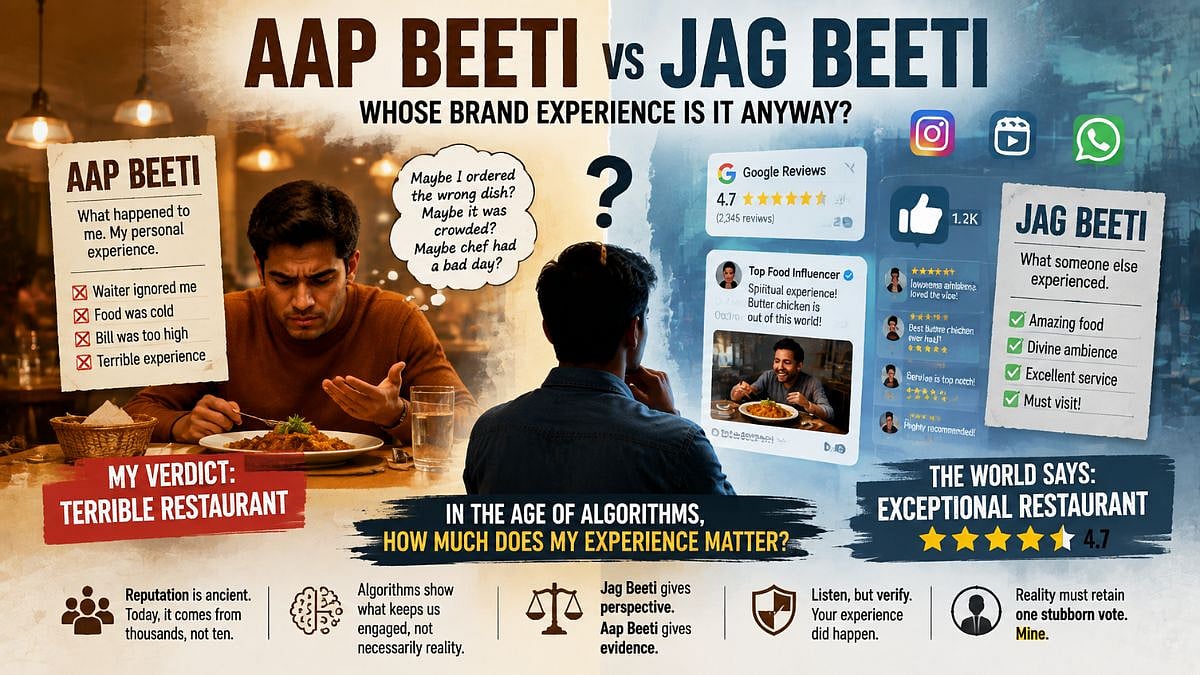
Once upon a less-connected time, we experienced a brand before forming an opinion about it. We ate the samosa. Stayed at the hotel. Drove the car. Visited the bank. Fought with customer care. Then we decided whether the brand was good, bad or deserving of vocabulary unsuitable for a respectable column. That was ‘Aap Beeti’. What happened to me and what I personally experienced.
Then came the internet. Reviews. Ratings. Influencers. Reels. WhatsApp University. And now AI, which can conveniently summarise what thousands of strangers think so that we don't even have to suffer the inconvenience of reading their opinions.
Welcome to ‘Jag Beeti’. What someone else experienced.
The interesting question is, how much does my real brand experience matter anymore?
When Experience Collides
Suppose I visit a highly rated restaurant. Google says 4.7. Influencers photograph themselves looking spiritually liberated after tasting the butter chicken. Reviews call the ambience "divine". My waiter ignores me. The food arrives cold. The bill arrives surprisingly hot. What is the truth?
My Aap Beeti says, ‘Terrible restaurant’. Jag Beeti says, ‘Exceptional restaurant’.
Strangely, instead of questioning the restaurant, I may start questioning myself. Maybe I ordered the wrong dish. Maybe it was unusually crowded. Maybe the chef had a bad day. We have begun giving brands the benefit of Jag Beeti.
Earlier, advertising tried convincing us that a brand was wonderful. We knew it was advertising, so we maintained appropriate suspicion. Today, hundreds of apparently ordinary people tell us the brand is wonderful. That is far more powerful because Jag Beeti arrives disguised as the democracy of selfless reviews. But democracy can also be algorithmically curated.
The algorithm does not necessarily show us reality. It, after all, shows us what will keep us watching rather than experiencing reality. And increasingly, it reaches us before reality happens. Before visiting a destination, I have seen 50 reels. Before watching a movie, I know its rating and have read the reviews. Before buying a phone, I have watched 12 unboxing videos. Before eating the famous dosa, I already know how crispy it is supposed to be and how its ingredients have been sourced for the curated experience the chef decided to give.
So, when Aap Beeti finally happens, it is no longer innocent. Jag Beeti is sitting beside me, whispering instructions. "Everyone loved it."
Beyond Brands
Perhaps that is why we sometimes hesitate to dislike what everybody apparently likes. We are part of the protests when our core may be aligning differently. But this phenomenon goes far beyond brands.
Consider the judiciary.
My personal experience with the judicial system may involve delay, complexity and frustration. Yet, Jag Beeti tells me about landmark judgments, institutional wisdom and constitutional safeguards. Which should define my perception?
Consider politicians.
I may find my local road broken, garbage uncollected and the bureaucracy impossible. But my digital feed continuously shows development, inaugurations, statistics, speeches and enthusiastic crowds. Aap Beeti meets Jag Beeti. An election happens somewhere between them.
Families are no different.
Instagram presents happy couples, successful children, exotic holidays and anniversary declarations suggesting 30 years of uninterrupted marital enlightenment. Meanwhile, inside another perfectly normal home, someone is asking: "Who finished the milk and didn't tell anyone?" Aap Beeti remains stubbornly unfiltered. Jag Beeti increasingly comes with background music.
Balancing Perspective And Reality
The danger is not that we listen to other people's experiences. Humanity has always done that. Reputation itself is ancient Jag Beeti. We asked neighbours about doctors, relatives about schools and friends about restaurants. The difference is scale, speed and selection.
Earlier, Jag Beeti came from 10 people we knew. Today, it comes from 10,000 people selected by an algorithm we don't know. And repetition creates its own reality. If I repeatedly see that a brand, politician, institution, family model or lifestyle is wonderful, my own contradictory experience begins looking like an exception. That is where we may slowly lose our grip on reality. Not because reality has disappeared. Because its parameters and axes are being continuously redrawn.
Perhaps the answer is not choosing Aap Beeti over Jag Beeti. Both matter. Jag Beeti gives perspective. Aap Beeti gives evidence. Jag Beeti can tell me that my bad experience may be an exception. But it should never persuade me that my experience did not happen. That distinction is critical. Because, eventually, a brand is not its advertising, reviews, ratings or influencer reels. A judiciary is not merely its celebrated judgments. A politician is not the applause on my feed. And a family is certainly not its anniversary photographs.
Reality must retain one stubborn vote. Mine. Otherwise, someday the algorithm may tell me I am extremely happy. And looking at all the likes, ratings and recommendations, I may have no option but to agree.
Sanjeev Kotnala is a brand and marketing consultant, writer, coach and mentor.

