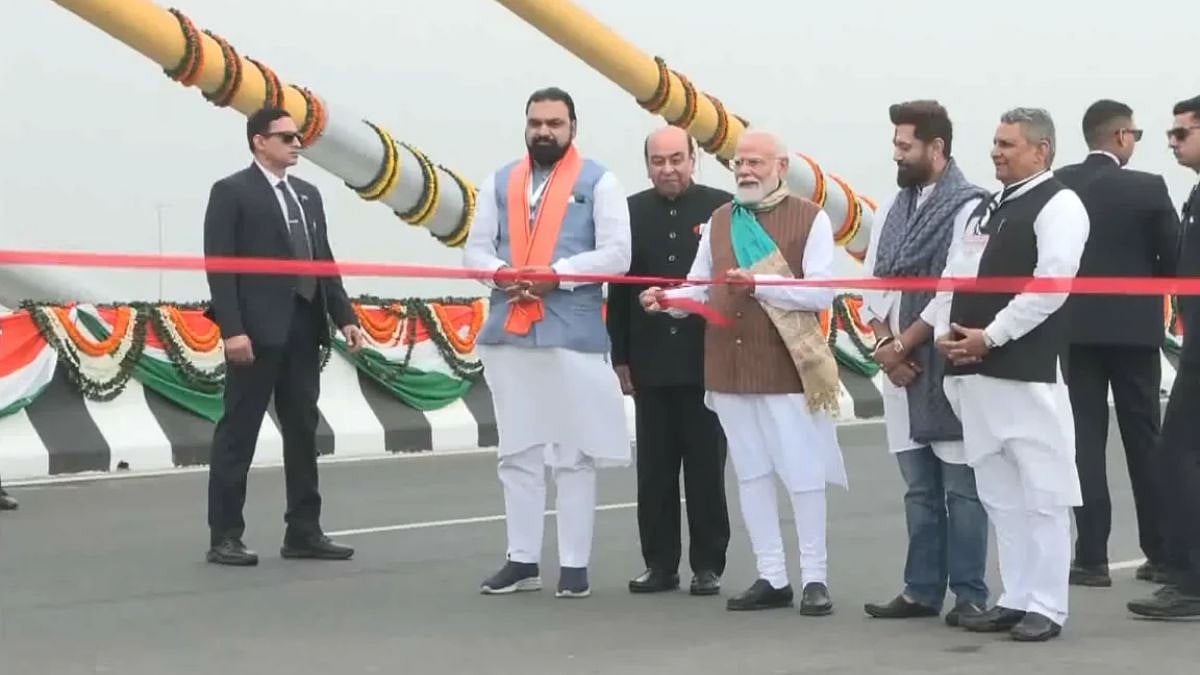
The convention that buildings, roads, bridges, and stadia are named after people who are no longer alive seems to have become outdated. The new fashion is to immortalise living leaders by naming public infrastructure after them.
A stadium in Gujarat, named after a much-revered leader whose statue has outshone the Statue of Liberty in New York, was renamed after a living leader. When Uttar Pradesh built a state-of-the-art international airport, it was found more convenient to name it after the same leader.
Seen against this backdrop, there is nothing particularly surprising about naming the longest river bridge across the Ganga after former Bihar Chief Minister Nitish Kumar. The Nitish Setu has eclipsed the Mahatma Gandhi Setu, which first connected North Bihar with South Bihar in the early eighties.
The Bridge And Its Political Legacy
When Prime Minister Narendra Modi inaugurated the new bridge on November 21, some people might have recalled that Nitish Kumar himself had inaugurated it once. Kumar can legitimately take satisfaction that it was his government that initiated the ambitious project.
An inconvenient detail, however, is that his deputy chief minister at the time was Tejashwi Yadav of the RJD. Interestingly, the bridge was initially proposed to be named after Guru Gobind Singh, the tenth Sikh Guru, whose association with Patna Sahib is too well known to require elaboration.
His name would have given the structure a historical and spiritual significance transcending party politics. But the government eventually chose to honour a living political leader.
There is no denying the importance of this engineering marvel. Stretching 9.76 kilometres across the Ganga, the bridge connects Kachchi Dargah near Patna with Bidupur in the Vaishali district, passing through Raghopur Diara.
It is India’s longest operational river bridge and has the potential to transform connectivity. What was once a difficult journey, involving boats and circuitous road travel, has become a convenient 20-minute drive. Farmers, students, patients, and traders will all benefit.
A Test Of Public Confidence
Yet, one detail should make Nitish Kumar somewhat uncomfortable. The record of bridges constructed in Bihar during his tenure has not always inspired confidence.
There was a time when bridges collapsed one after another, either during construction or soon after being opened to traffic. Fortunately, the Nitish Setu was built by a reputed engineering consortium using advanced technology, and few expect it to suffer a similar fate.
A bridge is an enduring symbol of connectivity. It brings people together, shortens distances, and opens up opportunities. It should not become an instrument for political one-upmanship or an occasion to take potshots at previous governments.
Those celebrating the achievement would do well to remember that bridges are built to connect, not to divide. Their greatest tribute lies in serving the people, not in bearing the names of those who commissioned them.
To get details on exclusive and budget-friendly property deals in Mumbai & surrounding regions, do visit: https://budgetproperties.in/

