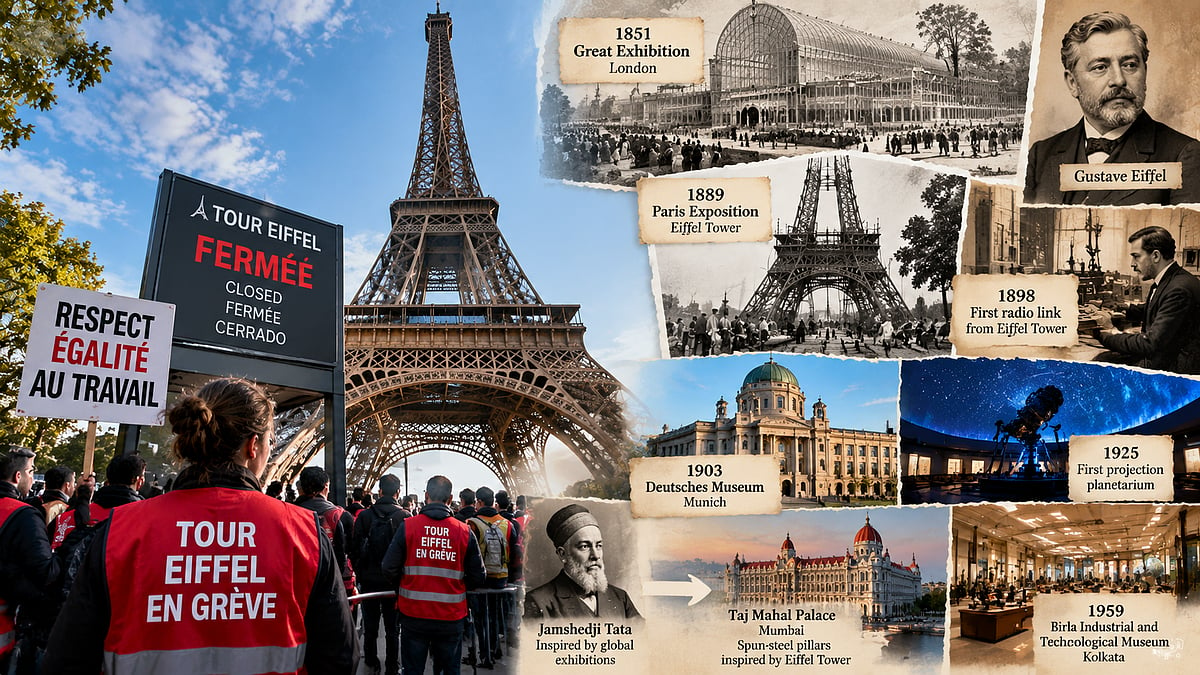
The Eiffel Tower, a global landmark in Paris, had to shut down on Monday, September 7, after the staff went on strike, protesting a request by a visiting delegation of the Bochasanwasi Akshar Purushottam Swaminarayan Sanstha (BAPS) that appeared to limit its interactions with female employees.
This episode has grabbed global headlines and has drawn India into an unwelcome controversy that has occasioned editorials in the Indian press on religion, gender, and the role of governments in such matters. French authorities are investigating the matter; BAPS has expressed regret while disputing the allegations. The Government of India has distanced itself from this matter, terming the BAPS-Eiffel Tower controversy a "matter purely between the entities concerned".
As a science communicator and museum professional of four decades, this controversy has motivated me to tell a different Eiffel Tower story: a story which is a product of a nineteenth-century idea that reshaped the modern world—the international industrial exhibition.
That story began not in Paris but in London, in 1851. The Great Exhibition of the Works of Industry of All Nations opened in Hyde Park's Crystal Palace on May 1, 1851. Over six million people visited during its five-and-a-half-month run, viewing more than 100,000 exhibits of industry, science, manufacture, and art from across the world—the first experiment in mass public education through spectacle, letting ordinary people walk through the exhibition and see what factories, laboratories, and workshops the world over were creating.
The Exhibition's profits founded the South Kensington Museum in 1857, which evolved into the Victoria and Albert Museum and the Science Museum (formally separated in 1909), joined later by the Natural History Museum in 1881. Together they made London a world centre of public science and culture—and inspired the science-museum movement that would eventually take root in India.
New York staged its own version of the exhibition in 1853. Paris followed with Universal Expositions in 1855, 1867, 1878, and 1889. India, too, entered this exhibitionary world with the Calcutta International Exhibition of 1883-84, held across the grounds of the Indian Museum and the Maidan.
These exhibitions were not merely trade fairs; they were marketplaces of ideas, where an engineer could study another country's machine or an artisan encounter unfamiliar design. They turned invention into diffusion, letting societies ask of each other's achievements: can we do this too, and better?
For the Paris Exposition of 1889, marking the centenary of the French Revolution, Gustave Eiffel—with engineers Maurice Koechlin and Émile Nouguier and architect Stephen Sauvestre—proposed a 300-metre iron tower (Eiffel Tower), one of the 107 designs submitted. It was selected and built in two years, two months and five days, using some 18,000 prefabricated metal parts and 2.5 million rivets—precision engineering that still impresses today.
Eiffel Tower’s future was, ironically, never secure: it had permission to remain for only twenty years. Eiffel saved it by giving it a new purpose—science. He encouraged meteorological, aerodynamic, and wireless research at the Tower. On November 5, 1898, Eugène Ducretet used it to establish the first radio link in Paris, transmitting to the Panthéon four kilometres away. A monument built to display technology had become an instrument for producing knowledge—perhaps the most enduring lesson it ever taught.
The exhibition ethos travelled far beyond Europe. Jamshedji Tata deliberately planned his foreign travels around the great exhibitions in Paris, Germany, and Chicago. On a visit to Paris, he was struck by the Eiffel Tower's spun-steel pillar technology and ordered pillars for the ballroom of what became the Taj Mahal Palace in Bombay—pillars that still hold up its banquet hall today. The same exhibition-and-technology circuit fed his resolve to build a hydroelectric station at Khopoli, which began generating power in 1915. Tata was not merely a spectator at these fairs; he mined them for ideas to build modern India.
The exhibition movement also gave rise to Europe's science museums, foremost among them the Deutsches Museum in Munich, founded in 1903 by Oskar von Miller, who wanted science experienced by the public rather than reserved for specialists. In 1923, the museum demonstrated the world's first projection planetarium, built with Zeiss; it began regular public shows on May 7, 1925, projecting some 4,500 stars onto its dome.
That story, too, reached India. Dr Bidhan Chandra Roy, physician and chief minister of West Bengal, visited the Deutsches Museum and returned convinced that a museum could carry science to ordinary citizens. With support from Jawaharlal Nehru and G.D. Birla, his vision led to the Birla Industrial and Technological Museum in Kolkata, inaugurated on May 2, 1959—India's first science museum. From it came the Visvesvaraya Museum in Bangalore, the Nehru Science Centre in Mumbai, and, in 1978, the National Council of Science Museums, which I had the privilege of serving for 35 years.
Trace the chain, and it reads almost like a genealogy: Crystal Palace to international exhibitions, to the South Kensington museums, to the Paris Expositions, to the Eiffel Tower, to the Deutsches Museum, to the planetarium, to the Birla Museum, to the NCSM. It is not so much a line of institutional descent as a circulation of ideas, each generation borrowing, adapting, and passing on what it had seen.
That is what makes the present controversy an opportunity as much as an embarrassment. The Tower was born in an age when nations competed through ideas and engineering as much as armies and empires. Exhibitions made achievement visible; museums preserved it; entrepreneurs like Tata absorbed it; India, in time, adapted that philosophy to its own needs.
The Eiffel Tower deserves to be remembered for something larger than one September's headlines. It was once a gateway to an exhibition. In a deeper sense, it became a gateway to the modern idea that science and technology belong to the public—and that, perhaps, is the history worth putting back into the conversation.
The writer is a Senior Advisor CSMVS, Trustee, Gandhi Smarak Nidhi and Former Director Nehru Science Centre, and NGMA Mumbai.

