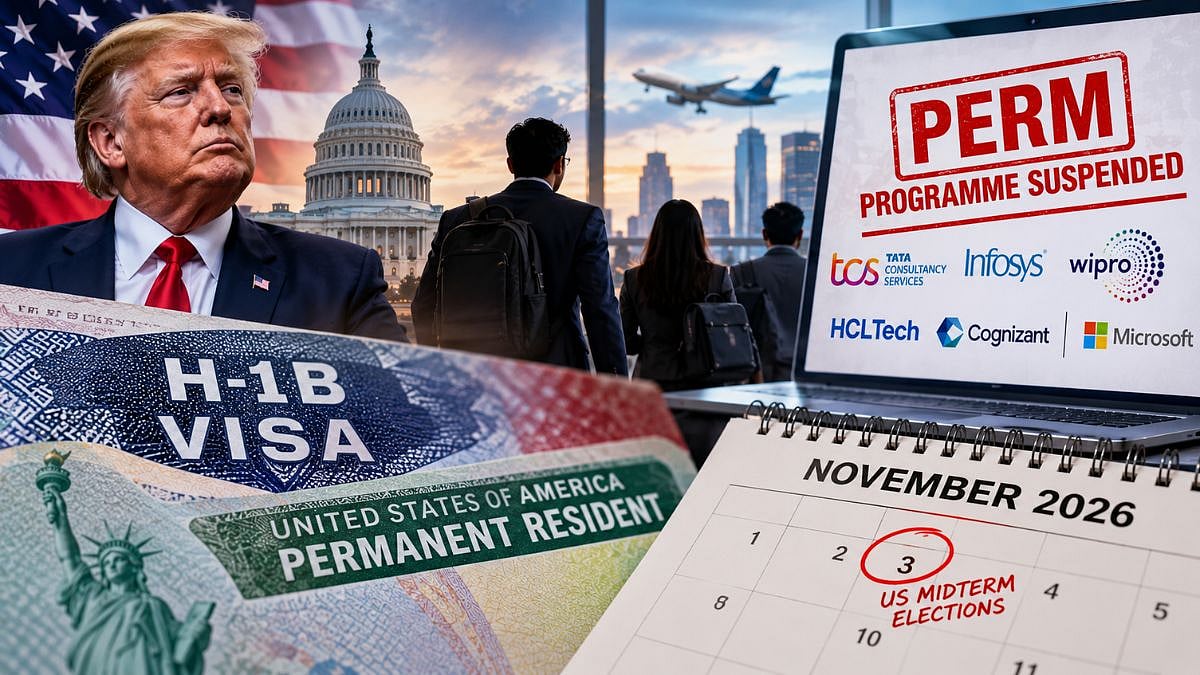
The US administration’s decision to suspend eight IT services companies, including Tata Consultancy Services (TCS), Infosys, Wipro, HCL Technologies, and Cognizant, from the Permanent Labour Certification (PERM) programme brings the US closer to imposing restrictions on H-1B visa holders. The US government has also extended a similar ban to its own companies, including Microsoft.
As of now, no decision has been taken to directly revoke H-1B visas, but the significance of the latest move is not lost, as this move blocks an important route through which foreign professionals can obtain permanent residency in the US.
While the H-1B is a temporary work visa for skilled foreign professionals in specialised occupations, PERM is a labour certification process that lets an employer claim that hiring a foreign worker for a role would not harm opportunities for American workers and that qualified US workers are not available.
Scrutiny Over The PERM Decision
PERM worked more like an incentive for companies to attract top talent. The administration has justified the decision by claiming that some employers have used the programme to favour foreign workers over Americans while making it harder for local candidates to secure jobs. On the face of it, these serious allegations warrant scrutiny but lack supporting evidence.
For Indian IT companies, the immediate business impact may be limited, as the Indian government pointed out in its statement. Over time, Indian IT services companies have used the H-1B visa quota far less than they did a couple of years ago, while increasing local hiring in the US. Indian IT companies accounted for less than two per cent of PERM applications filed between October 2024 and September 2025, according to an ICICI Securities assessment reported by Reuters.
The latest decision also follows the imposition of a $70,000 fee on student work training, and nine universities are reportedly under investigation.
Political Calculations Ahead Of Mid-Terms
It is clear that no logic supports such decisions, but, politically, US President Donald Trump expects them to nudge fence-sitters to vote for Republican candidates in the November 3 mid-term elections, which will decide whether it is Trump’s party or the Democrats who control Congress and pass federal laws. A mid-term loss will effectively neutralise Trump.
Meanwhile, the Indian government should stand firm behind its corporates and seek evidence for enforcing such a move. Their press statement is more of an attempt to dilute the impact. It will not mount stiff resistance, given the domestic issues that are taking up most of its time.
A Long-Term Shift For Indian IT
What should not be lost sight of is the fact that restricting skilled immigration is now popular politics in America and likely to outlast this administration. For domestic companies, while they have been reducing their dependence on visas over time, that shift must now be completed rather than managed.

