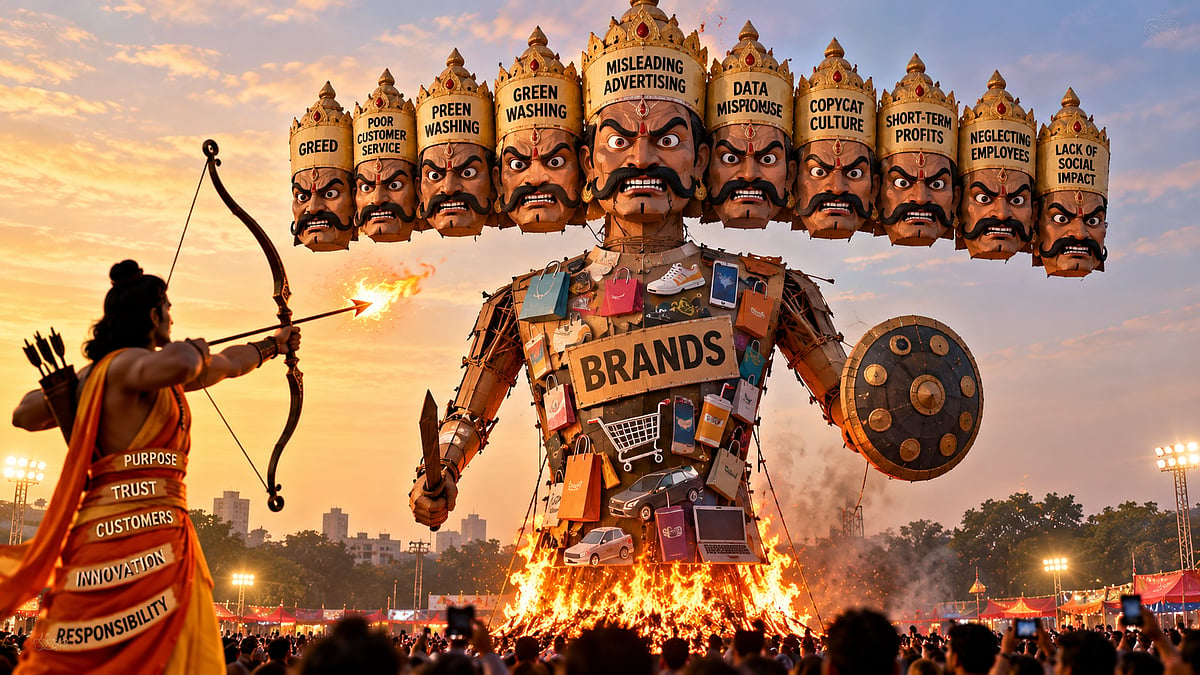
Dussehra has a wonderfully uncomplicated story. Ram defeats Ravana, good triumphs over evil, the effigy goes up in flames, and we reassure ourselves that the world has a moral centre. But perhaps brands and the consumers should look at the story a little differently. In the digital and social media world, Ravana is no longer an obvious villain standing across the battlefield. He often hides inside the brand itself, appearing as an attitude, a temptation, a blind spot, or simply the consequence of trying too hard to stay relevant.
The temptation of digital attention
Take attention, for instance. Every brand wants it, and social media has made attention the most aggressively contested real estate in the world. The temptation is to get louder, funnier, edgier, or more provocative simply because the algorithms seem to reward it. A brand can easily become famous for something that has very little to do with what it actually stands for. The danger isn't about getting noticed; it's about being noticed for the wrong reason. Attention is powerful, but attention without meaning is little more than noise in a different garb.
Then there is speed, another wonderful gift of the digital age that can quickly become a brand's undoing. A trend appears in the morning, peaks by lunch, and becomes embarrassing by dinner, yet brands still rush into conversations simply because everyone else is there. The desire to be contemporary can sometimes make a brand look desperately contemporary. Being fast is not wrong; the problem begins when speed replaces judgement.
The smartest brands aren't necessarily the ones that arrive first, but the ones whose presence feels like they belong.
Brands and the court of opinion
Social media has also given every brand a permanent invitation to the court of public opinion. A campaign can be applauded by millions and questioned by thousands at the same time, while an old post can suddenly acquire a completely new meaning years later. Consumers now have a voice, a camera, a screenshot button, and their own distribution network. That has fundamentally changed the relationship between brands and audiences.
The brand no longer gets the luxury of speaking from a stage while everyone else simply listens; the audience is on the stage too.
Influence versus meaningful brand identity
Influence brings another interesting contradiction. Brands increasingly borrow the credibility, personality, and following of influencers to create relevance, but the borrowed personality can sometimes become larger than the brand itself. That's not wrong; culture has always travelled through people, from celebrities to opinion-makers to neighbourhood heroes.
The Ravana appears when the brand forgets the difference between borrowing attention and building meaning. A famous face can open the door, but it cannot decide what the brand ultimately means to the person walking through it.
Data, emotion and consumer understanding
Data is perhaps the most sophisticated of these modern demons. Brands today can know an extraordinary amount about consumer behaviour, from what people search for to what they abandon in a shopping cart. Yet, information and understanding are not the same thing. A dashboard can tell us what people did; it cannot always tell us why. Somewhere between the spreadsheet and the human being sits the real mystery of marketing, and that mystery remains gloriously resistant to complete automation.
Social media rewards emotion, and anger and outrage are among the most efficient emotions for generating engagement. A brand can find itself responding to a controversy before it even understands what it's about. On the positive side, brands are now far more accountable to the people they serve, and that is not a bad thing.
The challenge is simple. When millions of voices amplify accountability, it can become a very noisy conversation.
The dangers of brand ego
Perhaps the most interesting Ravana is brand ego. Marketers spend years nurturing brands, developing their identities, guarding their visual language, and obsessing over every expression. Understandably, they begin to believe that the world is equally obsessed with them. It isn't, and that is actually liberating. Consumers have their own lives, problems, aspirations, ambitions, and distractions; the brand gets invited into that life only for a moment. The opportunity is not to demand importance but to earn significance.
And then there is fear. Fear of being criticised, misunderstood, taking a position, appearing irrelevant, and sometimes even being different. Fear can make a brand extremely careful, but excessive caution has its own cost.
A brand that never risks being wrong may also never become memorable. After all, most of the brands we admire weren't built by avoiding every possible mistake; they were built on enough conviction to move forward despite uncertainty.
Finding Ram and Ravana within brands
The Dussehra metaphor is interesting. Osho often questioned our tendency to divide life into neat categories of good and bad, light and darkness, and right and wrong. His larger philosophical invitation was to see the whole of ourselves rather than pretend the other half doesn't exist. Perhaps brands and the people who build them could take a similar view.
None of us is a Ram. And perhaps none of us is entirely Ravana either. Life is a continuum, and we keep fluctuating between the two, sometimes within the same day, sometimes within the same decision. It applies to brands too. Confidence can become arrogance, boldness can become recklessness, sensitivity can become opportunism, and caution can become cowardice.
Whether the Ram within us deserves celebration or the Ravana deserves condemnation is, therefore, a remarkably contextual question.
The answer very often is, you got it right, it depends.
The enduring Dussehra lesson for brands
I think this is the more useful Dussehra lesson for brands. The objective is not to imagine that every demon can be permanently defeated and every virtue permanently secured. Brands, like people, are living entities in a constantly changing cultural landscape. Their battles keep shifting, their temptations keep changing, and the audiences keep evolving.
The Ravana will return next year in another form. That is not necessarily bad news. It simply means the brand always has another opportunity to discover what it really stands for.
Sanjeev Kotnala is a brand and marketing consultant, writer, coach and mentor.

