Indian society and economy went through a major change in 1990s. The change or shift was so significant that it affected the lives of the Indians. Such kind of developments never happened in the Independent India. In a nutshell, it can be said that the opening of Indian economy in 1991 has changed the life style of crores of Indians and demolition of Babri Mosque in 1992 has divided Indians like never before. India of post-liberalization is quite different than the India of pre-liberalization days. Similarly, today’s Indian society is quite different from Indian society before the demolition of Babri Mosque.
In 1991, as finance minister Dr. Manmohan Singh introduced liberalized economic policy and instantly it became part of a globalised world economy. The debate still goes on whether liberalization has helped common people or not. Even few colleagues of Manmohan Singh used to say that liberalization needs ‘human face’. Now it is twenty five years, since India opened up its economy. It is time to introspect and analyze how liberalization has impacted Indian economy and culture. Economy and culture are closely tied. Economy does influence culture. Feudal values and culture gets demolished with the growing economy. It also changes the lifestyle.
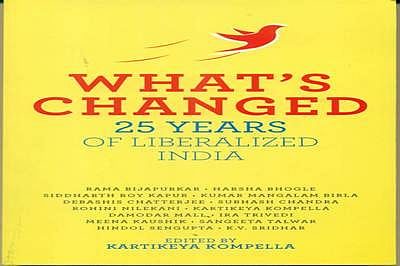
The book What’s Changed: 25 Years of Liberalized India compiled by Kartikeya Kompella touches the issue of liberalization and how it influenced the economy, culture, education and lifestyle of Indians. The book has 14 chapters which touch how liberalization has influenced Indian cricket, retail shops, consumer behavior, the brands, philanthropy, bollywood etc. The experts who wrote on these issues are part of that respective field and not mere academics. It includes Harsha Bhogale, Rama Bijapurkar, Ira Trivedi, Damodar Mall, Debashis Chatterjee, Sangeeta Talwar, Meena Kaushik, K V Sridhar, RohiniNilekani, Siddharth Roy Kapur, Dr. Subhash Chandra, HindolSengupta, Kumar Mangalam Birla and of course KartikeyaKompella.
Ira Trivedi in her essay A Nation in Heat-India’s Sexual Revolution writes: Society benefits from a sexual revolution of the kind that India is going through. There is greater gender equality, more opportunities for women, an increasing culture of respect and tolerance and waning of homophobia.
liberalization created tumultuous change in society and it made its impact on cricket also. HarshaBhogale compares the pre-liberalization days with post-liberalization age by comparing the two sides that won 1983 prudential World Cup and the 2007 ICC World T20 Cup. Then Board of Control for Cricket in India (BCCI) President NKP Salve announced sum of one lakh rupees each for each members of the squad and fifty thousand to the manager. BCCI had no money to give to the players. Finally, Salve requested LataMangeshkar to sing at a fund raising concert. This is a story of today’s richest board in the world. Liberalization brought a change in the fortunes of cricketers. In the post-liberalization days each members of the 2007 winners got eighty lakh from the BCCI. And now, cricketers who gets opportunity to play in the IPL mints money.
KartikeyaKompella in his essay The Liberalized Brand emphasis how the reform in 1991 opened the doors of the economy and so influx of foreign brands. Good quality products became easily available. The concept of stakeholders emerged and they started getting importance. It is true in case of customers and investors but the scenario has not changed much for working class. They lost hard fought collective bargaining and contract system became a reality. The working class suffered in the process.
In Empowerment of Women in India-A Slow and Evolving Phenomenon, SangeetaTalwar, by giving several instances argues that in the Vedic age, around 3000 years ago, women occupied a high place in Indian society with equal standing as men. But, from about 500 BC scenario started changing. Lineage began to be traced to the male line and son became the sole heir of the family property. The sufferings of women continued. It was unacceptable to Mahatma Gandhi. In 1921, Gandhi wrote in Young India that women are embodiment of sacrifice, silent suffering, humility, faith and knowledge, and should have the right to participate in all activities of life like men and have equal rights of freedom and liberty. He said,” She is entitled to a supreme place in her own sphere of activity as man is in his.” Later, the principle of gender equality was enshrined in the Constitution. Economic independence gave strength to the women.
Kumar Mangalam Birla in The Changing Face of India rightly opines that liberalization brought fundamental change in the business environment and changed the playing field radically. Industrial licensing was largely abolished. The change is also in the rising profile of women in Indian business.
One needs to read the book to understand how the policy of economic reform changed the society. It raised the aspirations of the people. A new middle class emerged and it is growing at a rapid speed. The book is published by Random House India.
