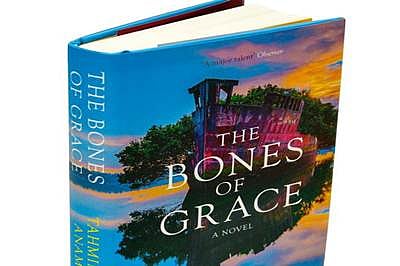
This is the story of a heart torn between the moorings of a childhood sweetheart in Dhaka and the enthralling, all-consuming pull of astranger met over the strains of Shostakovich Preludes in Sanders Theatre, Cambridge. The former as unquestionable as the flow of the Ganga with its estuarine embraces over Bangladesh before it meets the Bay of Bengal; the latter as natural and worrying as the tectonic shifts of the subcontinental plate – alarming, deep, and unsettling. The former resulted in marriage. The latter in constant yearnings, intermittently satisfied.
This is a story of a team of paleontological explorers and their intellectual moorings to the skeletal remains of a prehistoric, amphibian whale called Ambulocetus (nicknamed Diana) probably washed on the shores of the ancient Tethys and the gut-wrenching description of the lives involved in dismantling a mighty cruise ship called Grace, on a beach in Chittagong. The former is an activity permitted by a militia that couldn’t have cared lessfor the multi-millennia of natural preservation they stood on; the latter is an activity encouraged by the Government for reclamation of precious steel at the cost of precious lives of its citizens.“Bones of grace” is what a local member of the Diana team dubs the assembled vertebrae – and then he is imprisoned and killed by the militia for being the son of a rival chieftain;Graceis systematically reduced to its bare bones as the narrator comes closer and closer to a kind of self-realisation on different planes of her existence.
This is a story of continual hope: that on unearthing Diana’s hip bones and her femur a major part of the paleontological, evolutionary mystery would be solved; that a movie on the plight of those engaged in ship-breaking would “make a dent in the world”; that on finding the object of one’s search, the seeker will find peace within and the world will be the better for it. But as Thomas Hardy observed (in Tess of The D’Urbervilles) “Nature does not often say ‘See!’ to her poor creature at a time when seeing can lead to happy doing; or reply ‘Here!’ to a body’s cry of ‘Where?’ till the hide-and-seek has become an irksome outworn game.” And all through the story we see the narrator digging into herself, delving into her past, questioning her adherence to cultural limitations. She examines her relationship with her husband analysing it from the pre-wedding days and through the wedding night and beyond. She questions the motives of her adoptive parents in divulging to her the bare fact of her adoption – leaving her with a craving emptiness about her biological mother and a burning urge to understand the conditions which had forced her to abandon her child. She finds the truth. Relationships get realigned, the world gets re-ordered. And yet … hope with gentle persuasion and comforting words, lingers on in all its tenderness.
And all through the story we see the narrator digging into herself, delving into her past, questioning her adherence to cultural limitations. She examines her relationship with her husband analysing it from the pre-wedding days and through the wedding night and beyond. She questions the motives of her adoptive parents in divulging to her the bare fact of her adoption – leaving her with a craving emptiness about her biological mother and a burning urge to understand the conditions which had forced her to abandon her child. She finds the truth. Relationships get realigned, the world gets re-ordered. And yet … hope with gentle persuasion and comforting words, lingers on in all its tenderness.
It’s a letter addressed to that stranger to explain everything that happened and everything that could not happen. It is an attempt to bridge the huge cultural gap that needs the support of some four hundred pages … Towards the end the reader can pretend to understand the significance of the Thomas Tranströmer quote on the frontispiece: “our life has a sister ship, following quite another route. While the sun blazes behind the islands.”
Bones of Graceis the third of the trilogy which started with A Golden Age and The Good Muslim published in 2007 and 2011 respectively by John Murray. This, last of the three books, has references to the participation of the common people in the war of 1971; it mentions the trial and conviction of a war criminal; it also has references to the rape victims (Birangona women). Each of the three books is a stand-alone – with the Bangladesh freedom struggle as the backdrop, and Tehmima carries the war-scarred and other players with aplomb.Each character is skilfully, carefully carved, whether it is the rich and comfortable in Dhaka or the wretched God-forsaken workers (where “the atmosphere had been thinned by the fleeing of hope”) in Chittagong; the cultural nuances as seen in traditions and interpersonal relationships are brought out in stark contrast, sometimes, to the narrator’s “foreign” habits of food, fellowship and frankness. One marvels at the very subcontinental emotions and emotional reactions portrayed by the author.
This is also a story of a mind torn between the umbilical moorings of an orphan to her natural mother and the suave, educated loyalty towards her adoptive parents who have given her a life far beyond what her natural mother could have ever dreamed of. The former, aroused between the 4th and 5th Prelude at Sanders, becomes an obsession while the latter … well, that needs to be read in the original!
Review by
Stanley Coutinho
Retired Dy. Director-General,
Ministry of Defence.
Now Consultant in Management and Legal Matters.
