Published: March 2016
ISBN No: 978-0-06-220261-1
Pages: 325
Publisher: Harper Collins
Price: 699(Hardcover)
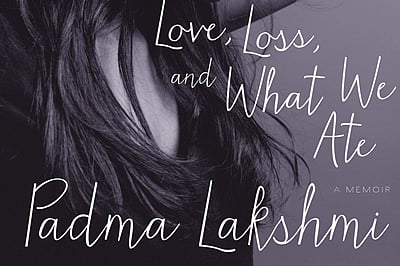
Padma Lakshmi’s Love, Loss and What We Ate: A Memoir is a self analysis and a heart searching journey of the author’s personal life and her quest for meaningful relationships.Inspired by Nora and Delia’s Ephron’s play Love, Loss and What I Worethe book makes an interesting claimof exploring human relationships and navigating the world through the culinary lens.The book weaves together author’s childhood stories, her love relationships, her work and her culinary skills that eventually shaped her personal and professional life. While South India, her birth place and grandparents home provided her the first exposure to the culture of food, her immigration to United States (with her mother) exposed her early to the struggle of finding ones identity in a racist West. Divided into seventeen chapters, each interspersed with food recipes, the book primarily details her physical and emotional struggles in making meaningful personal and professional associations. It also speaks of the simple rituals of cooking that were sometimes liberating, helped the author sail through difficult times and ultimately find her successful self.
The book begins with a description of her relationship (and her subsequent disillusionment) with the famous writer Salman Rushdie. An aspiring model and actress then, Padma highlights her efforts of making herself a compatible partner to a high profile writer, it included cooking lavish meals for Rushdie’s friends. She describes it as an effort to overcome a sense of insecurity and inferiority she felt in the presence of great intellectuals. Pursuing an ambition of being much more than Rushdie’s wife, she ventures successfully into acting in movies and reality shows like Top Chef on television, but her professional and a painful physical condition; endometriosis, causes rifts in their relationship which ends up in a divorce. Speaking boldly of Rushdie’s insensitivity towards her health condition and her unhappiness of constantly trying to be his ideal womanand wife, she finally decides it was time to move on and begin her journey onward. Recovering from surgeries to cure endometriosis and a broken marriage, Padma claims that cooking provided an ideal catharsis to “.cut the greyness around her…” Coming from a matrilineal south Indian family where food and femininity were always intertwined, and a brave mother who mustered courage to get out of an unhappy marriage, flew to America to earn freedom(influenced by news of Second Wave Feminism movement) the author very often makes a case for her passion for food and her feminine side that refused to compromise. Her culinary skills always provided solace and helped her sail through difficult times; it her provided the much needed affirmation of being a woman.Subsequently, the book also details her relationship with a venture capitalist Adam Dell and a high profile entrepreneur Teddy Forstmann. She describes her relationship with Teddy Forstmannas that bonded by kindness, affection, based on acceptance and unconditional love. She admits that she took her differences with Teddy too seriously and simultaneously dated Adam Dell. Dell, unlike Rushdie and Forstmann was her age, yet she missed Teddy’s company and Padma states that her “feminist side” decided to let go of neither. Still recovering from her divorce, she casually dated both, until miraculously she conceived. Deprived of the warmth of fatherhood, the book describes in detail, her efforts to secure good parenting for her daughter. From, securing the identity of her child’s biological father, braving the difficulties of pregnancy, fighting court cases for custody she sailed through it with Teddy’s unconditional love and generosity. Apart from the love she shared with Teddy, the book describes the unflinching love and support she received from her family back in India. Inspite of being disturbed by her mother’s marriage partners in America, she continued to be her source of strength and courage.
Yet, a feeling of homelessness and a struggle to settle down with an identity in a foreign land is what characterized most of her personal and professional relationships. Most of her life she struggled with self-confidence as she tried to come to terms with her identity in the racist west. The book describes several years of her life that she spent loathing her skin colour, scars, her height, language, endometriosis and her struggles to fit into a world of modelling dominated by white coloured people.Padma describes her journey from modeling assignments that required her to break the cultural norms and stigmas associated with female nudity, acting in films, career as a columnist in eminent fashion magazines, author of cookery books, hosting prominent cookery shows on television to starting a business in fashion andjewelry. Most of her successful ventures were a result of her travels and commingling of cultural influences. Like many immigrants, she confides (on several occasions) that she never felt completely at home in either East of the West. She kept both these lives compartmentalized until her divorce and success in her profession as a “top chef” brought her two selves together. It was her culinary expertise that helped her blend the two cultures, find her creative self and her true identity.
The book makes a philosophical case of the central role that food plays in a women’s personal and professional life. Her identity and relationship with herself and her body is defined by the food she creates and consumes. Celebrating the body, the corporeal(over mental aspects) and the food that sustains existence and provides identity to an individual is certainly a fascinating claim. Padma’s love and bonding with her grandmother, mother, female cousins are examined and discussed through the prism of food recipes, the book describes the unfolding of her professional decisions and each of her personal relationships with the men she loved(and her daughter)along side the unfolding of her culinary creativity, it is in their interaction that she ‘becomes’ and finds an identity. Yet, on the critical note, the book falls short of living upto the promise of “I am what I eat” as food does not appear as the primary site of knowing the world. It appears as an aid, it seems to play an effective regulative role in making meaning of her personal and professional choices. Food is an active and constitutive dimension of meaning making process, it is not the primordial way in which the world is revealed to her. The book seems to be making a stronger claim for a psychological connection between human relationships and food rather than an understanding it as one of the fundamental ways in which the world is revealed, constructed and lived.While there is detailed discussion of food items and recipes; physical objects like utensils, spaces like kitchen, market places, shooting sets of Top Chef (and the relationships constructed there) are hardly discussed and seem to not play any significant role in life experiences, thus the autobiography does not effectively break the public private divide.Love, Loss and What We Ate: A Memoir remains a book about Padma’s personal journey,it falls short of making a claim forwomen whose lives, relationships, identities and powers of resistance are mapped by spaces, objects and the art of food making.
