Bengaluru Police Showcase AI, Metro Integration & Crowd Planning Success For IPL At RCB Innovation Lab Indian Sports Summit
Bengaluru City Police outlined IPL match safety and crowd management reforms at the RCB Innovation Lab Indian Sports Summit. Led by Seemant Kumar Singh, the plan for M. Chinnaswamy Stadium included 450 AI cameras, metro integration via Bengaluru Metro, expanded holding areas and faster dispersal systems, improving safety and fan experience during IPL matches.

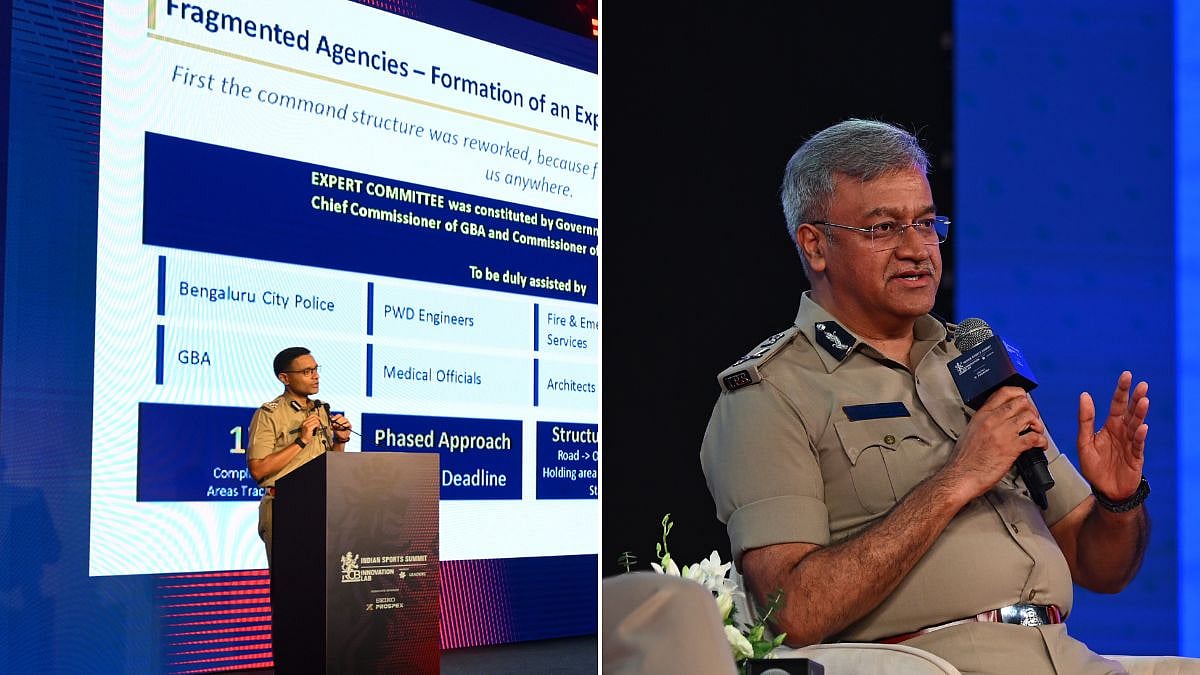
Bengaluru Police Showcase AI, Metro Integration & Crowd Planning Success For IPL At RCB Innovation Lab Indian Sports Summit | file photo
Bengaluru: Bengaluru City Police, at the recently held RCB Innovation Lab Indian Sports Summit, unveiled the extensive planning and operational measures that enabled the successful hosting of IPL matches at the M. Chinnaswamy Stadium this season, delivering a significantly smoother and safer experience for fans.
Speaking at the event, Seemant Kumar Singh, IPS Commissioner of Police, Bangalore City explained how the effort was focused on balancing fan experience with large-scale urban event management.
“Our objective was to ensure cricket returned to Bengaluru in a safe, organised and seamless manner. Over six months, every stakeholder came together to redesign matchday operations, improve infrastructure and create systems that could handle large crowds efficiently while ensuring spectators had a positive experience,” said Commissioner Seemant Kumar Singh.
A high-level expert committee comprising Bengaluru City Police, fire and emergency services, engineers, medical officials, architects and transport authorities worked on a phased roadmap to improve crowd movement, emergency response and spectator flow inside and outside the stadium precinct.
Key initiatives included the deployment of over 450 AI-enabled cameras integrated into a central Venue Operations Centre, live stand-capacity monitoring across all gates, expanded holding areas for over 21,000 spectators and redesigned pedestrian movement systems.
ALSO READ
Vamsi Krishna, Joint Commissioner of Police -West, Bengaluru City Police highlighted the importance of city-wide planning in improving the overall fan experience.
“The match experience starts long before fans enter the stadium. From metro connectivity and parking management to gate operations and dispersal systems, every movement was mapped in detail. The focus was to reduce congestion, improve accessibility and make the overall journey easier for spectators,” he said.
One of the standout measures this season was the large-scale integration of Bengaluru Metro services with match operations. Match ticket holders were encouraged to use metro services, with nearly 70 percent of spectators travelling via public transport by the final match of the season. Officials stated that post-match dispersal time reduced dramatically, with stadium areas clearing within approximately 35 minutes due to this initiative.
ALSO READ
Additional measures included dedicated emergency lanes, shuttle services from parking zones, bilingual signage systems, mobile wayfinding volunteers, real-time public announcements and multiple operational simulation drills before the season began.
Commissioner Seemant Kumar Singh also credited Bengaluru’s fans for adapting to the new systems introduced this season.
“The cooperation from spectators was extremely encouraging. Bengaluru’s passion for sport is unmatched, and this season demonstrated how responsible fan behaviour and coordinated planning can come together to create a world-class sporting environment,” he concluded.
RECENT STORIES
-
-
-
-
-