Dussehra Rush Puts Pune's Vehicle Washing Centres Under Water Pressure
The Pune Municipal Corporation (PMC) and the district administration initially announced a 10% water cut from October 15, with water supply suspended every Thursday. The District Collector has now recommended planning for a 20% reduction

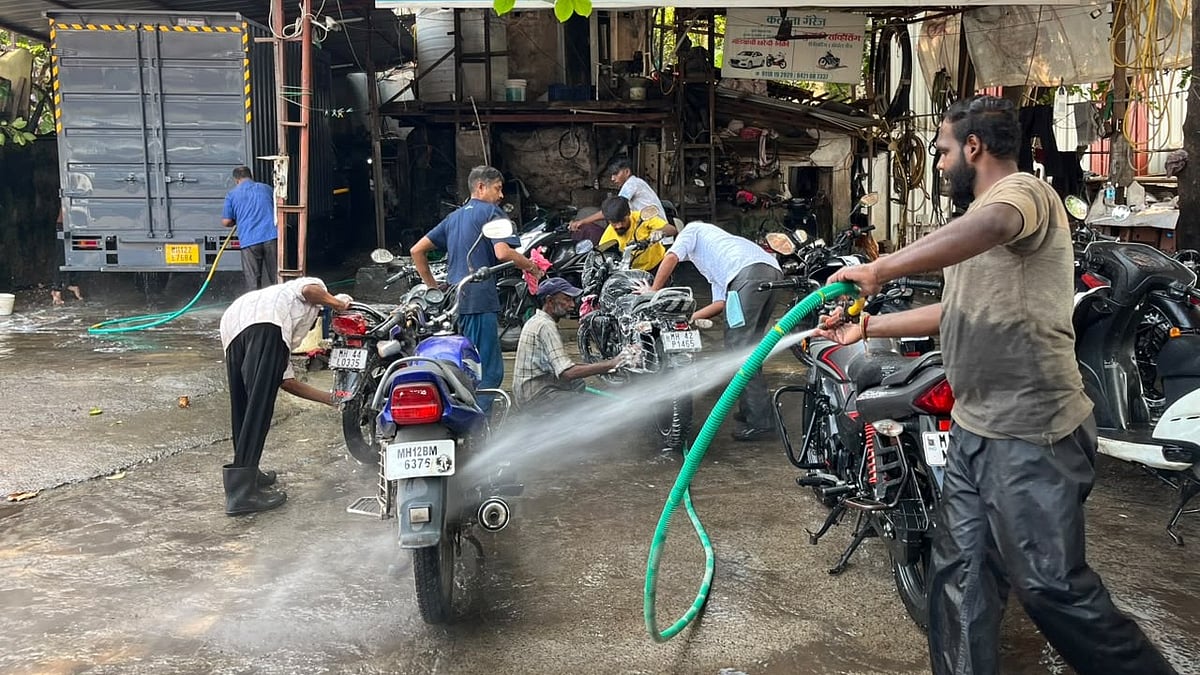
Dussehra Rush Puts Pune's Vehicle Washing Centres Under Water Pressure | FPJ Photo
Pune: Pune’s vehicle washing centres are witnessing a festive rush, with two-wheelers, cars and even heavy vehicles lining up for a thorough clean-up. However, as drought conditions across Maharashtra put water conservation in focus, the increased demand has raised an uncomfortable question: how long can businesses that depend on large quantities of water continue operating amid restrictions on supply?
The Pune Municipal Corporation (PMC) and the district administration initially announced a 10% water cut from October 15, with water supply suspended every Thursday. The District Collector has now recommended planning for a 20% reduction.
While operators of washing centres with borewell connections say they are willing to share water if required by the authorities, those dependent on municipal supply are concerned about managing their businesses amid restrictions and rising demand.
At a two-wheeler washing centre run by Nitesh Mahadev Petkar, the daily footfall of 20 to 30 vehicles is expected to rise to around 150 to 200 during the festive period.
Petkar said, “On regular days, around 20 to 30 vehicles come here. During Dussehra, the number can go up to 150 or even 200. We increase the rates by ₹10 to ₹20 during the rush, and the current rate for a two-wheeler is ₹120.”
The centre also washes heavy vehicles, including trucks and JCB machines. While a two-wheeler can be cleaned within minutes, larger vehicles require considerably more time and water.
Asked whether he would stop operations if the civic administration needed water to meet public requirements, Petkar said he was ready to cooperate.
He said, “If the authorities ask us to stop the business because people need water, we will shut the centre for that period. If necessary, we are also ready to fill tankers and supply water. There is no problem with that.”
Four-wheelers bring in more business, consume more water
At another washing centre, Praveen Petkar, who has been in the business since 1993, said the festive season had increased demand for vehicle cleaning, although his centre had not raised its regular rates.
He said, “We charge ₹500 for a four-wheeler, ₹750 for a larger vehicle and ₹1,500 for a truck. These are our existing rates. A single car requires around 200 to 250 litres of water, while the requirement for a truck is much higher.”
Praveen said his centre was willing to cooperate with the civic administration if water was required for public use. He also recalled supplying water for Metro construction work in the past.
His account highlights the scale of water consumption involved in vehicle washing, particularly when several cars and heavy vehicles are cleaned over the course of a day.
Municipal supply-dependent centres face a different challenge
For washing centres without borewell connections, the situation is more complicated. These establishments depend on municipal water supply and must manage their operations according to its availability. Any further restrictions could directly affect the number of vehicles they can wash and their daily earnings.
Ramesh Shinde, a two-wheeler washing centre owner, said, “Earlier, we used to wash around 25 to 30 two-wheelers daily, but with the water cuts, we have to manage our work carefully. During the festive season, demand increases, but water availability remains a concern. We have increased our rates to ₹180 per two-wheeler because of the additional pressure on our operations. If the water supply is reduced further, we may have to limit the number of vehicles we wash each day.”
Sunil Jadhav, a four-wheeler washing centre owner near the Pune Municipal Corporation building, said, “We depend entirely on the municipal water supply and do not have a borewell. The water cuts make it difficult to manage our daily work, especially during the festive season when more customers come to get their vehicles cleaned. We charge around ₹450 to ₹500 for washing a car, but if the supply becomes irregular, we may have to reduce our working hours or temporarily stop operations. We understand that people need water for essential purposes, but the authorities should also consider the difficulties faced by small businesses like ours.”
Festive demand versus responsible water use
The surge in vehicle washing during Dussehra presents a challenge for an industry that depends on reliable water availability. While the festival brings additional business, the drought situation has renewed questions about the responsible use of water for non-essential activities.
For washing-centre owners, the immediate concern is balancing festive demand with the possibility of tighter restrictions. For the administration, the challenge is to ensure that available water is prioritised for essential public needs while taking into account the practical difficulties faced by businesses.
RECENT STORIES
-
-
-
-
-