The Netherlands Push In India
Netherlands deepens farm ties with India, focusing on seeds, hydroponics, AI and biological solutions to raise farmer incomes and build climate-resilient agriculture systems.

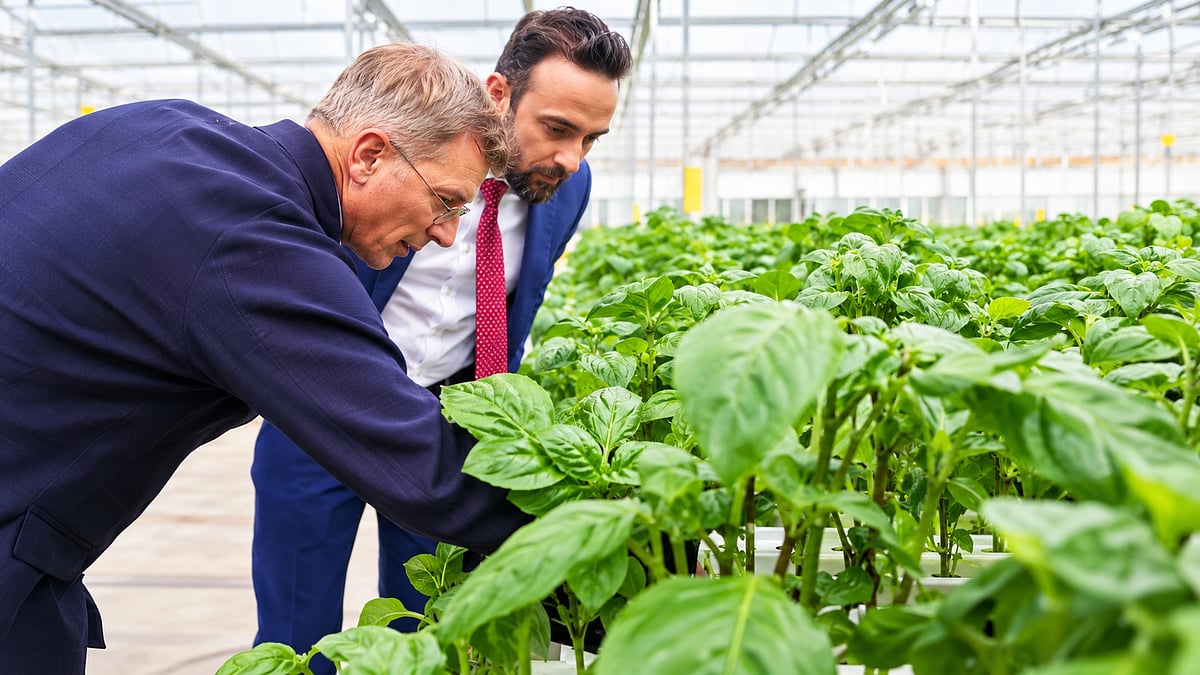
Silvio Erkens, minister Food Security, Fisheries and Horticulture, Netherlands, examining the produce in one of the farms. |
It is rare to see an entire delegation from a foreign country coming to India to discuss fruit and vegetables. But the Netherlands has proved to be an exception. This is for two reasons. First, the Netherlands has watched this sector grow in India to a level where it makes sense to prod it forward into the next major stage of development.
Second, India was essentially closed to the idea of letting foreign scientists meddle with India’s agriculture. But this has changed since 2000 as part of liberalisation. Private sector seed companies have been encouraged to expand operations in India.
The mission statement of the Netherlands says it is very keen to strengthen sustainable horticulture and build more resilient food systems. India combines a large and diverse horticultural sector with strong production capacity and growing demand for high-quality fruit and vegetables, while the Netherlands brings expertise in sustainable horticulture, protected cultivation, greenhouse systems, high-quality seeds and water management.
Together, the two countries have complementary strengths and a longstanding partnership in horticulture. The focus is on connecting Indian production and experience with Dutch knowledge and technology, strengthening existing relationships and creating new opportunities for innovation and business.
Better returns for farmers
The idea is to give Indian farmers a better income than that offered by merely growing grains and pulses. They are needed, true. But grains like wheat are grown in abundance.
A guaranteed buyback through the Food Corporation of India has encouraged farmers to cling to grain cultivation. But farm incomes have remained stagnant. Fruit and vegetables offer the promise of more income, variety and shorter cropping patterns.
That could explain why the Netherlands chose to bring a delegation of farmers to India. They visited Delhi and Mumbai and are on their way to Bangalore.
Heading this team is Silvio Erkens, Minister for Food Security, Fisheries and Horticulture, Netherlands.
Erkens says the decision to work together was made when the Indian prime minister visited the Netherlands and signed a cooperation agreement with the Dutch government.
“One of the first areas that we decided to look at is agriculture, particularly seeds,” he says.
Learning from Dutch hydroponics
People often do not know that the Netherlands is easily a leader in Agri-tech. One example is the manner in which it has developed hydroponics. It is currently the second-largest exporter of tomatoes globally despite being a small country.
Much of this has been achieved through the deployment of sophisticated hydroponic farms.
ALSO READ
Erkens explains that Bangalore will remain one of the key centres in India from where the concept of hydroponics — also called closed systems in the Netherlands — will be promoted.
Most hydroponic centres in the Netherlands are located very close to each other, allowing them to share knowledge, practices and experiences.
Moreover, the country has a dry season each year because of climate change. The hydroponics sector has therefore become even more relevant because it uses micro doses and produces more crops despite using less water.
Dutch companies eye India
Many Dutch companies coming to Bangalore also have plans to partner with Indian companies for technology and investments.
Indian companies are also looking at opportunities in the Netherlands. “We have 40 Dutch companies present in India in the following sectors — vegetable seeds, seed potato, animal nutrition, food processing equipment, and seed coating,” says a spokesperson from the Netherlands.
Among the more visible companies are REKA, a Dutch company specialising in biological solutions for soil enrichment; NedSpice, which is into processing spices; NewCold, which is setting up cold storages to provide agro-logistic solutions; and Dutch vegetable seed companies such as East West Seed, Enza Zaden and Bejo Zaden.
The Netherlands is also in the process of setting up Centres of Excellence in India. Of the five centres currently being discussed, two are in the approval phase.
All the centres will focus on vegetables, flowers, potatoes and temperate fruits. However, one will focus on dairy training and another on seed treatment.
Agriculture remains a major strength
The Netherlands is a major player across the agricultural sector. It has three segments in its agri exports: dairy and eggs, horticulture and meat.
Other important crops grown in the Netherlands include barley, corn, potatoes, sugar beets and wheat. But hybrid seeds appear to be the most promising area, even in India.
“In Delhi, we spoke about how to increase farmer incomes and also our plans to introduce technology in the farm sector, especially when it comes to seeds and horticulture,” Erkens says.
According to him, seeds are one of the sectors where the Netherlands wants to intensify its efforts.
The country also wants to reduce the use of pesticides and replace them with biological alternatives while examining the use of Artificial Intelligence in agriculture.
Hydroponics could play a bigger role
Hydroponics is expected to play an important role because the system does not use soil. As a result, soil-based pesticides do not affect plants grown using this method.
Moreover, with less water, crops can be grown faster, including fruit and vegetables.
Erkens points out that even though many people do not know much about the sector, it remains one of the most innovative areas in agriculture. It offers significant opportunities in seeds that can cope with climate change, minimise pesticide use and bring farmers more income.
The Netherlands remains the market leader in seeds, though China has been catching up rapidly. That is one more reason why the minister wants India to work closely with his country.
India’s vegetable seed industry
Marion van Schaik, agricultural counsellor at the Embassy of the Kingdom of the Netherlands in India, says India’s vegetable seed industry is an important example of how agriculture can evolve through interaction between entrepreneurship, science, policy and international exchange.
K Vijayraghavan, chairman and managing director of Sathguru Management Consultants and part of the delegation touring India, says India’s vegetable seed industry has come a long way.
According to him, it has moved from a relatively fragmented and predominantly local system to a dynamic industry with strong capabilities in breeding, seed production and commercialisation.
[By RN Bhaskar]
RECENT STORIES
-
-
-
-
-