US Intelligence Warns Russian President Vladimir Putin Could Test NATO’s Resolve With Cyberattacks, Hybrid Operations
US intelligence assessments suggest Russian President Vladimir Putin may be increasingly willing to authorise provocative actions against NATO territory, including cyberattacks and hybrid operations. US officials believe Moscow could be testing NATO’s unity and the Trump administration’s response, while NATO chief Mark Rutte has warned of Russia’s growing threat to Europe and North America.

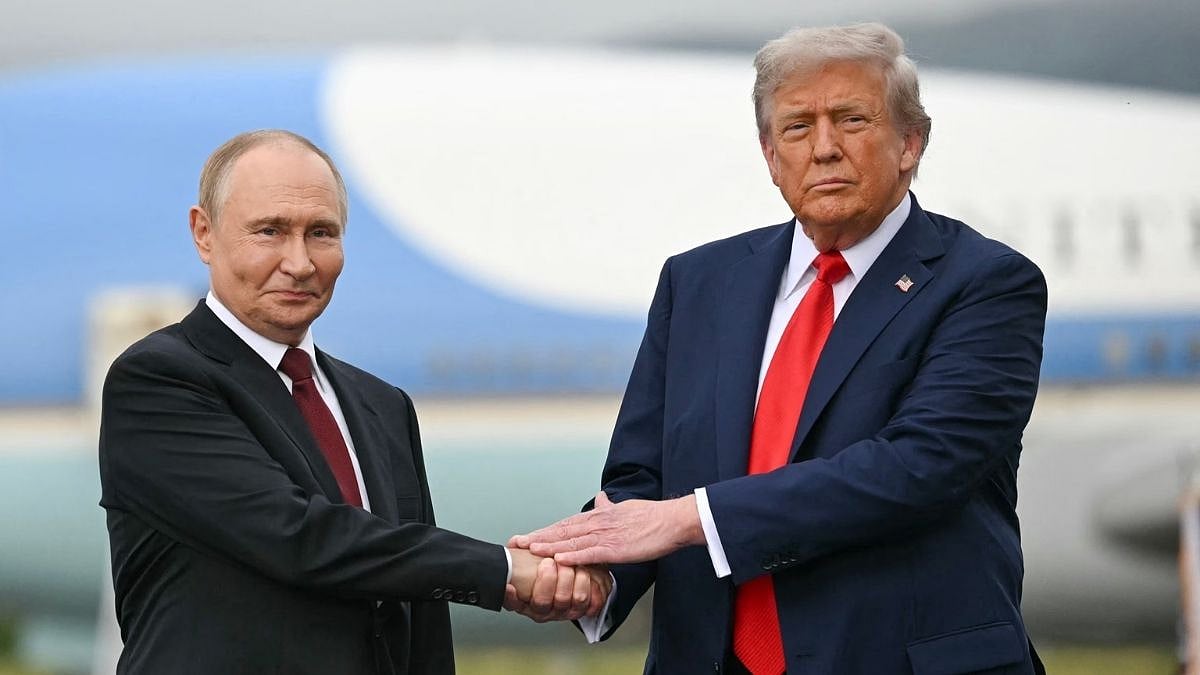
US Intelligence Warns Russian President Vladimir Putin Could Test NATO’s Resolve With Cyberattacks, Hybrid Operations | X
Washington DC: US intelligence assessments indicate that Russian President Vladimir Putin may be increasingly willing to authorise provocative actions that could spill onto NATO territory.
CBS, citing US officials briefed on the matter, reported that these actions could include hybrid operations, cyberattacks, and other deniable measures that fall short of a full-scale conventional military campaign. The assessments highlight a shift in Putin's risk calculus compared to just a few months ago, according to US officials.
These officials noted that the primary goal is likely not to trigger a broader war, but rather to test NATO's cohesion and evaluate the Trump administration's willingness to respond if a NATO ally comes under attack, CBS reported.
ALSO READ
Earlier last month, Russian President Vladimir Putin accused Western countries of applying "double standards" by selectively invoking the UN Charter while ignoring the principle of national "self-determination" when it did not suit their interests.
Claiming that Western sanctions had failed to achieve their objectives, Putin said that since 2022, "the West has set its Russophobic machine running at full speed," imposing a record number of sanctions that he described as ineffective.
The Russian president further alleged that Russia's opponents, having failed to defeat the country "on the battlefield," had resorted to "outright terrorist methods" against the Russian people.
ALSO READ
"But the people of Russia can never be broken. They never have been - and they never will be," he said.
He also declared that Russia would achieve its objectives in the "special military operation" in Ukraine, while accusing the West of pursuing a campaign of "Russophobia" and attempting to undermine the country, according to a statement released by the Russian Foreign Ministry.
Putin said the past five years had been "difficult and exceptionally consequential" for Russia, describing the period as one in which "the fate and future of our people" had been at stake.
In his remarks, Putin asserted that Russia had historically responded to external threats with national unity and said the same spirit was evident today.
ALSO READ
On the other hand, NATO Chief Mark Rutte, earlier in April, highlighted the immediate and multi-theatre threat Russia poses to Europe and North America and emphasised that the Western alliance's defense network is actively intercepting Russian incursions while protecting both sides of the Atlantic.
The NATO chief detailed recent operational responses along NATO's eastern flank to demonstrate how European allies are stepping up to defend collective airspace.
"When Russian MIG-31s crossed into Estonian airspace last fall, it was European aircraft - Italians in the lead, backed up by Finns and Swedes - that turned them back," Rutte stated. "When a flock of Russian drones wandered recklessly into Poland around the same time, I'm proud to say that it was a Dutch F-35 that fired the shot that took down the danger."
ALSO READ
He noted that mutual defense remains the central rationale for NATO's existence, warning that Russian threats cannot be isolated from broader global coordination among adversary nations. Recalling the founding era of the alliance, Rutte observed, "I'm always reminded of your earliest predecessor, the very first Secretary General of NATO, who said that the challenge of the Alliance, maybe the purpose of NATO, is keeping the Russians out and the Americans in."
"That was one reason to create NATO," Rutte continued. "But the main reason to create NATO is because there is a case to be built for the Europeans, for the transatlantic community as a whole, including the United States and Canada, to stay safe. And for the United States to stay safe, you need a secure Europe, yes. But you also need a secure Arctic. You need a secure Atlantic. Because otherwise the Russians and others might pose a threat."
(Except for the headline, this article has not been edited by FPJ's editorial team and is auto-generated from an agency feed.)
RECENT STORIES
-
-
-
-
-