'India Will Not Bow To Nuclear Blackmail': New Delhi Warns Pakistan At UN, Vows Fitting Response To Terror Attacks
India has warned Pakistan at the UN that nuclear threats will not deter its response to terrorism. Anmol Sher Bedi defended Operation Sindoor, highlighted Pakistan's alleged terror links and nuclear proliferation record, and reiterated India's position on Jammu and Kashmir.

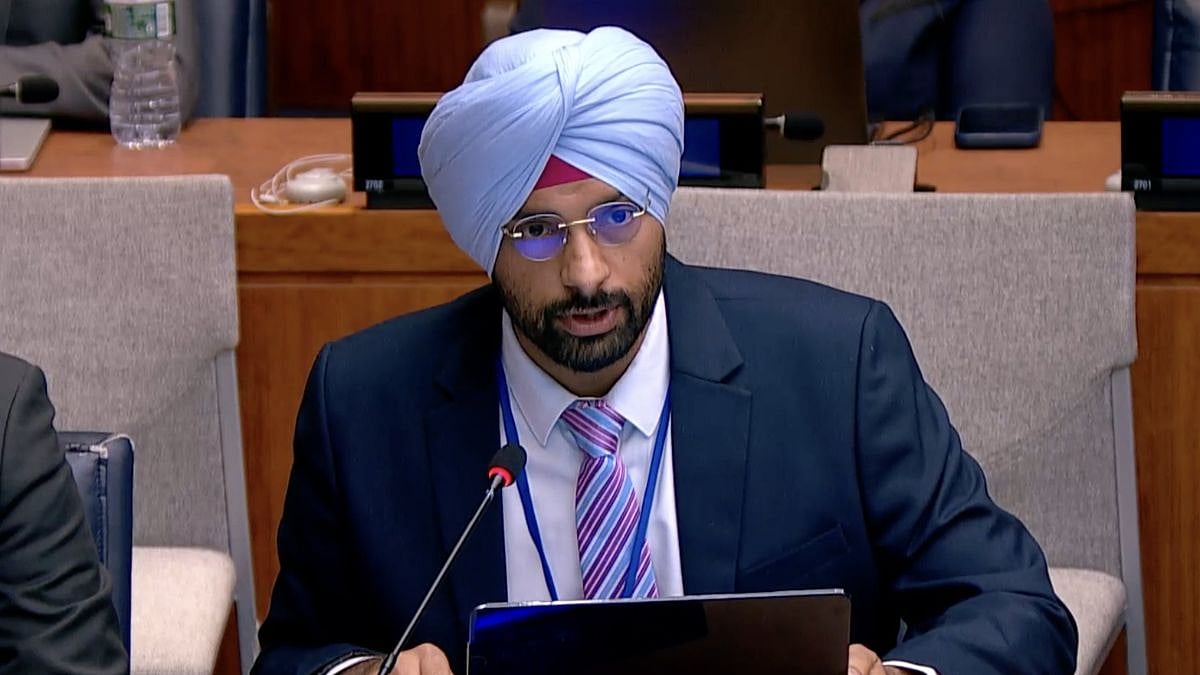
'India Will Not Bow To Nuclear Blackmail': New Delhi Warns Pakistan At UN, Vows Fitting Response To Terror Attacks | X / @bedi_sher
United Nations: India has warned Pakistan that it will not be deterred by Islamabad using nuclear weapon risks to attempt to evade the repercussions for its terrorism, and will respond to terror attacks.
Also Watch:
“India will not bow to nuclear blackmail,” Anmol Sher Bedi, the senior adviser in India's Permanent Mission to the UN Conference on Disarmament in Geneva, said on Friday.
He served notice on Pakistan that “any terrorist attack against India will receive a fitting response” and it will “make no distinction between those who sponsor terrorism and those who mastermind it”.
India defends Operation Sindoor
Operation Sindoor last year against terrorist bases in Pakistan “followed a grave provocation” of the terrorist attack in Pahalgam by Pakistan-based terrorists who killed 26 civilians, he said.
“India acted in self-defence,” he said, and “these actions were measured, targeted, and designed to be non-escalatory”.
“Nuclear weapons must not be treated as routine instruments of statecraft” and “a posture that relies on nuclear overhang to limit the consequences of subconventional activity raises the risk of escalation and not the prospect of restraint,” he said at the meeting in New York of the General Assembly's First Committee, which deals with disarmament issues.
India reiterates defensive nuclear policy
He was responding to Tahir Andrabi, Pakistan's permanent representative to the UN in Geneva, who spoke at the New York meeting.
Bedi gave the committee the reassurance that India's nuclear capabilities are not directed at anyone and stressed they “are defensive in nature”.
“They are shaped by our own security environment,” he said.
India, unlike Pakistan, has declared a policy of no-first-strike, meaning it will not be the first to use nuclear weapons against any country.
Bedi, who responded strongly to Pakistan, is from Amritsar and ranked second in the 2016 public service exam. He holds a computer science degree from BITS Pilani and has studied Mandarin in China.
Pakistan's nuclear proliferation history highlighted
ALSO READ
He exposed the facts behind Pakistan's call for nuclear cooperation, citing the nuclear bazaar run by Abdul Qadeer Khan, who headed its nuclear programme, that provided nuclear bomb know-how to other countries and traded nuclear material for missile technology with North Korea.
Bedi warned countries to look out for their own safety when they cooperate with Islamabad on nuclear and military technology.
“On proliferation, India refers to the history of the AQ Khan network, which contributed to the Security Council Resolution 1540 almost two decades back,” he said.
“This is relevant in the context of demands for unquestioned nuclear cooperation and transfer of advanced weapons and military capabilities,” he said.
“We urge all states and all responsible suppliers to exercise the highest degree of vigilance, not because of India, but for their own security,” he said.
UN resolution on nuclear proliferation
Security Council Resolution 1540, adopted in 2004, is a binding measure that prohibits all countries from transferring weapons of mass destruction to terrorists, euphemistically referred to as “non-state actors”, or enabling them to obtain them.
It also set up a body, known as the 1540 Committee, to monitor compliance with the resolution.
ALSO READ
India questions Pakistan's crisis response
What destabilises the region, Bedi said, is Pakistan using cycles of crises fuelled by terrorism.
“In India's experience, crises in the region have tended to follow a recurring pattern: first, provocation; second, denial of responsibility; and third, appeals for restraint once a response has been made,” he said.
“That is how instability becomes useful, and that is how the cycle keeps on repeating,” he said.
Bedi pointed out that this is enabled by Pakistan's system of governance where the real power is wielded by the military.
“Those in power are neither elected by people nor accountable to them, their decisions carry no risk and impose no cost for those who take them,” he said. “That is how crisis becomes an instrument of power.”
Where the real power lies in Islamabad behind the facade of a civilian government was made clear during Secretary-General Antonio Guterres' recent visit to Pakistan, when he took the unusual step of meeting the military chief Asim Munir, while formal talks with military leaders are not in his usual itinerary.
Indus Water Treaty and Kashmir dispute
Bedi said that India put the Indus Water Treaty in abeyance because it was signed on the understanding of trust and cooperation, and Pakistan undermined them.
As for Andrabi raising the Kashmir issue, Pakistan does so regardless of the topic on the meeting agenda, Bedi said, “Jammu and Kashmir is an integral and inalienable part of India. We call for India's illegally occupied territories to be vacated and returned back.”
(Except for the headline, this article has not been edited by FPJ's editorial team and is auto-generated from an agency feed.)
RECENT STORIES
-
-
-
-
-