NEET Protest: Students Deserve Answers, Not Batons, Writes Author R Raj Rao
In the wee hours of Friday, when Sonam Wangchuk finally broke his fast, he reiterated that no action should be taken against the protesting students, to which the government seems to have reluctantly agreed. The government has also agreed to meet representatives of the CJP at the Constitution Club, a "neutral" venue. However, it is still silent about Pradhan’s resignation

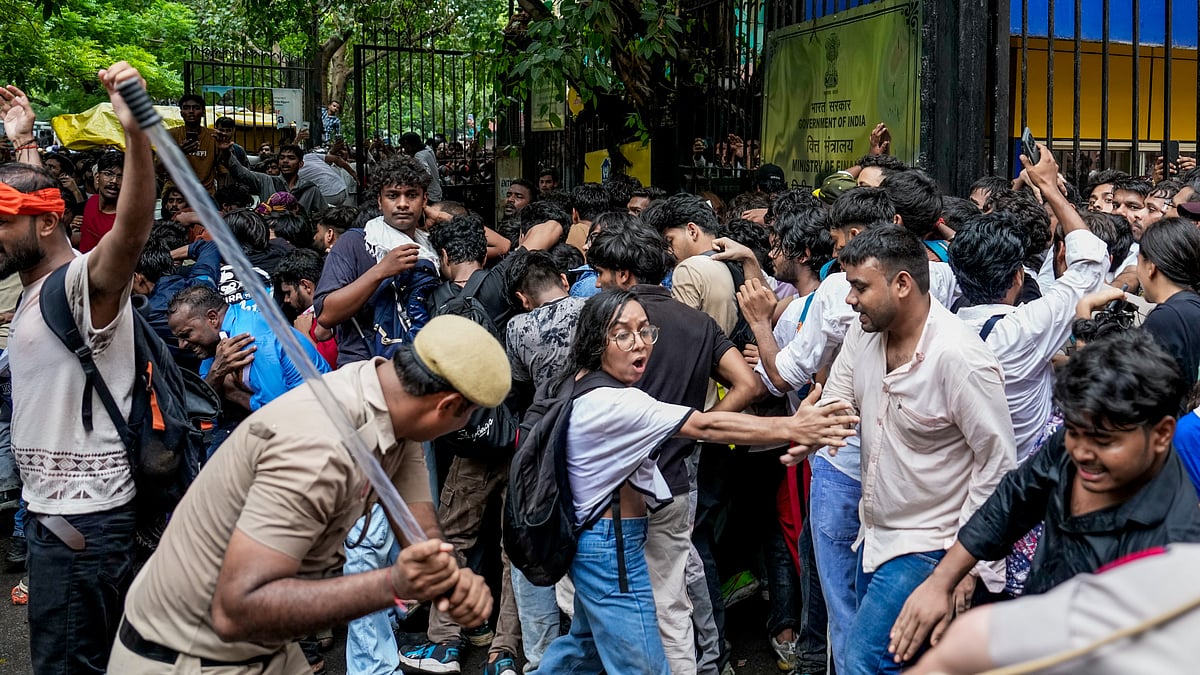
NEET Protest: Students Deserve Answers, Not Batons, Writes Author R Raj Rao | PTI Photo
By now, videos of students who were brutally beaten with batons for protesting against the NEET paper leak in New Delhi have travelled all over the world. Friends from Canada and Germany have called to ask me what’s going on in the country. Earlier, there were unconfirmed reports of cops and paramilitary forces opening fire on the students. But yesterday, a news channel obtained hospital reports that proved that pellets had actually been fired at a protester. A BJP spokesperson on the programme called it “adding fuel to the fire.” Can we be blamed for recalling Jallianwala Bagh?
Devious attempts have been made, however, to turn the tables on the protesters and establish a false equivalence. We are told that more policemen than students were injured in the mayhem, implying that it was the students who were the offenders.
Apparently, a mysterious van with bagfuls of stones was found parked at Jantar Mantar a day before the protests. The Cockroach Janta Party (CJP) has categorically denied that it was responsible for the presence of the van. It suspects that the police brought the van there to malign it. The attacks on the police, then, were not by students but by the henchmen of the police. But if not henchmen, could they have been members of the ABVP, the student wing of the ruling party, which is known for storming into campuses and disrupting events?
However, assuming that some students, beaten black and blue by the cops, retaliated by hurling a stone or two at them, the attacks were purely in self-defence. It was the police who were on the offensive here, while the students were on the defensive.
The government has claimed that not all the youngsters present at the protests were bona fide students. But every interview and byte given by students to television channels and social media platforms has shown that they were indeed students. Accusations that they belonged to political parties, or were backed by Pakistani handlers, and so on, have turned out to be patently false.
In any case, opposition parties joining the protests are not “hijacking” them, as the government alleges. Rather, they are lending weight to the movement. In a scenario where the regime dreams of a democracy sans an opposition, the CJP is, I think, doing the opposition a favour by allowing it to align with the movement, thereby giving it traction.
But let’s not miss the larger picture. In a highly influential essay, the cultural theorist Gayatri Spivak asks, "Can the Subaltern Speak?" But who are the subaltern? They are anyone on the disempowered side of the identity binary, be they Dalits, tribals, queer people, Muslims, Christians, people with disabilities, children, animals, or the aged. By this formulation, students too are the subaltern.
ALSO READ
Submissiveness is a characteristic of the subaltern. They are forced to submit to the empowered aggressor, who is everything that the subaltern is not. In real life in India, the empowered aggressor is the Hindu, upper-caste, able-bodied, heterosexual man with a tremendous sense of entitlement. It is also institutions, including the state and the police, that are, after all, agents of the state. Thus, for the police to claim they are victims while the students are perpetrators is perverse.
Exceptions notwithstanding, students in general are forced into submission by parents, families, teachers, schools, colleges, universities, and the machinery of the state. This leaves them with little or no agency. It is worth noting that, during the Jantar Mantar protests, students were everywhere condescendingly referred to as "children," although technically most of them were adults, since they were above eighteen. This was a way of exacting submission from them. A good example of this is the Chief Justice of India’s refusal to look at videos of the protests in order to apportion blame. The CJI, who disparagingly called the youth of the country "cockroaches" (which is how the CJP came into being), said the Supreme Court had "no time" to watch the videos. Experts have called this a travesty of justice.
Now, the worst form of submission that the state planned to exact from the students was the filing of FIRs against them in Delhi police stations for protesting outside Parliament. Civil society is fully aware of the dangers of such FIRs, for they can lead to detention under the dreadful Unlawful Activities (Prevention) Act (UAPA), as has happened in the past. This has led to JNU students like Umar Khalid being incarcerated for over six years without bail. In this context, it is necessary to point out that no one has spoken of filing FIRs against the police on behalf of the students.
It was for this reason that Sonam Wangchuk toned down his earlier demand for Dharmendra Pradhan’s resignation by saying he would end his fast if the government at least "considered" Pradhan’s resignation. His condition for doing so was the quashing of all FIRs against the students who protested. Wangchuk was worried about the safety of the students.
In the wee hours of Friday, when Wangchuk finally broke his fast, he reiterated that no action should be taken against the protesting students, to which the government seems to have reluctantly agreed. The government has also agreed to meet representatives of the CJP at the Constitution Club, a "neutral" venue. However, it is still silent about Pradhan’s resignation. The CJP should remain firm in its demand for the minister’s resignation. For if it capitulates merely based on oral assurances, it will be back to business in a couple of years. The past will be forgotten, and paper leaks will continue to happen.
I have conceded above that a few students at the protest site may have thrown stones in retaliation. But, as I said, this was in self-defence. The day students go on the offensive and become the first to throw stones, there will be a revolution.
(The writer is a well-known author and former head of the English Department at Savitribai Phule Pune University)
RECENT STORIES
-
-
-
-
-