Drought-Hit Beed Stares At Crop Losses, Water Crisis
The Bindusara reservoir, the primary source of drinking water for Beed city, has plunged to just 5% of its live storage capacity, compared with 100% during the corresponding period last year

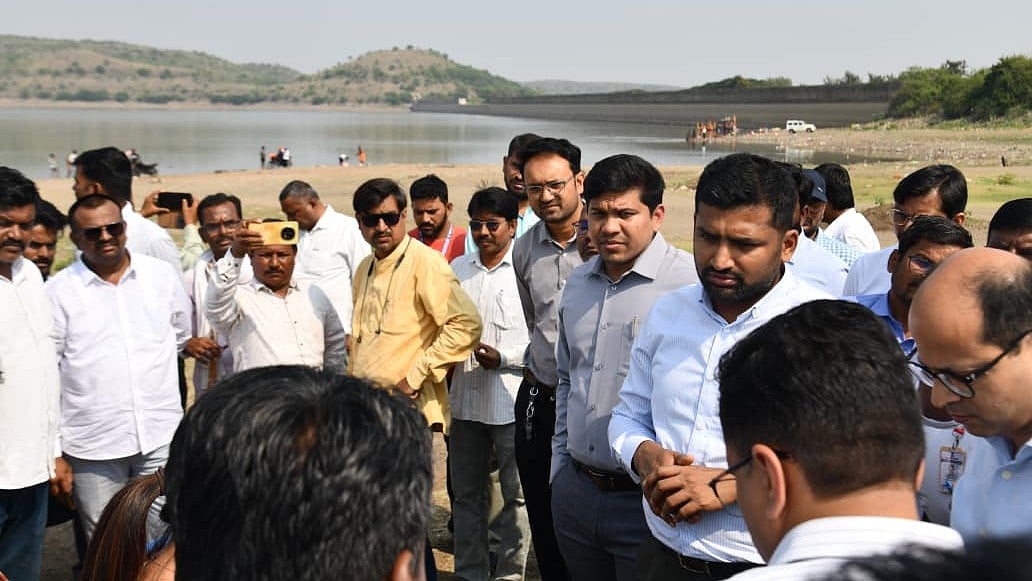
Drought-Hit Beed Stares At Crop Losses, Water Crisis | Sourced
Beed: A prolonged dry spell has pushed Beed district towards a severe drought, devastating Kharif crops, drying up water bodies and triggering an acute fodder shortage. The situation came to light during a two-day inspection tour by an Inter-Ministerial Central Team, which assessed crop damage and interacted with distressed farmers seeking urgent government intervention.
The team comprised Union Joint Secretary for Agriculture Muktanand Agrawal, State Agriculture Secretary Parimal Singh and Beed District Collector Dr Vivek Johnson.
The Bindusara reservoir, the primary source of drinking water for Beed city, has plunged to just 5% of its live storage capacity, compared with 100% during the corresponding period last year. With the city requiring around 38 million litres of water daily, the civic administration has been forced to depend heavily on the Majalgaon dam, reserving the remaining local supplies exclusively for drinking purposes.
Rural areas are also facing an acute water shortage. Percolation tanks in villages, including Morgaon in Beed tehsil and Vaidyakinhi and Daskhed in Patoda tehsil, have reportedly dried up, while groundwater levels have fallen sharply. A rainfall deficit lasting nearly 65 days has left soybean crops scorched across large tracts of farmland, leaving cultivators struggling to recover their investment.
In Daskhed, farmer Sudhakar Thombre spent ₹54,000 cultivating soybean on three acres but now expects a harvest worth only ₹9,000 to ₹10,000, amounting to barely 1.5 to two quintals. Another farmer, Rekha Kokate, expects to harvest just 40 kg of soybean from her nearly two-acre plot.
Horticulture has also suffered heavily. Pomegranate and sweet lime (mosambi) orchards, developed over several years with substantial investment, are drying up because of the water shortage. Farmers fear that losing these orchards will have long-term financial consequences, as rebuilding them would require considerable time and money.
ALSO READ
The crisis has extended to livestock owners, who are struggling to arrange fodder. Brothers Vaibhav and Ankush Shinde of Bedukwadi in Patoda tehsil, who together produce around 130 litres of milk daily, said their existing stock of home-grown fodder would last only another 15 days. Commercial fodder prices have reportedly risen to ₹11,000 per tonne, adding to the burden on dairy farmers. Poor crop growth has also forced some cultivators to use mechanical harvesters, leaving little crop residue for cattle feed.
Farmers have demanded financial assistance of ₹2 lakh per hectare to protect standing orchards, a ₹50,000 subsidy for farm ponds, and the immediate opening of government fodder depots and cattle camps.
During its visit to Vaijala, the central team inspected damaged fields and interacted with onion, marigold and maize growers. Onion farmer Bankat Yede said water scarcity had forced him to reduce cultivation from 10 acres to just one acre, but even that crop remained at risk as farm ponds had dried up. Floriculturist Pandurang Maske and maize grower Kakasaheb Namdev Yede said rising temperatures and dry soil had stunted plant growth and reduced the size of marigold blooms, further squeezing farm incomes.
ALSO READ
Meanwhile, social activist Dr Ganesh Dhawale questioned the timing of rain-gauge installations at Pali and Khandala villages in Beed tehsil. He alleged that the equipment was installed on Friday night, shortly before the central team’s scheduled visit. He also claimed that Limbaganesh village had been waiting for a rain gauge for eight months.
Rainfall records are important for assessing deficits and determining drought-relief requirements. Dhawale said delays in installing monitoring equipment raised concerns about the availability of reliable, village-level rainfall data. The allegations have brought rainfall-monitoring infrastructure under scrutiny as the central team assesses the extent of drought-related distress in the district.
RECENT STORIES
-
-
-
-
-