'Ravana Was Like Elon Musk Of That Era': Baahubali Writer Anand Neelakantan On Ramayana At Mumbai Book Festival 2026
Author Anand Neelakantan discussed the many interpretations of Indian epics at the Mumbai Book Festival 2026 on November 27. In a session moderated by Shweta Patta, he explored Ravana's perspective, the changing understanding of dharma and the existence of multiple Ramayana traditions. He also stressed that storytelling requires writers to inhabit their characters' viewpoints.

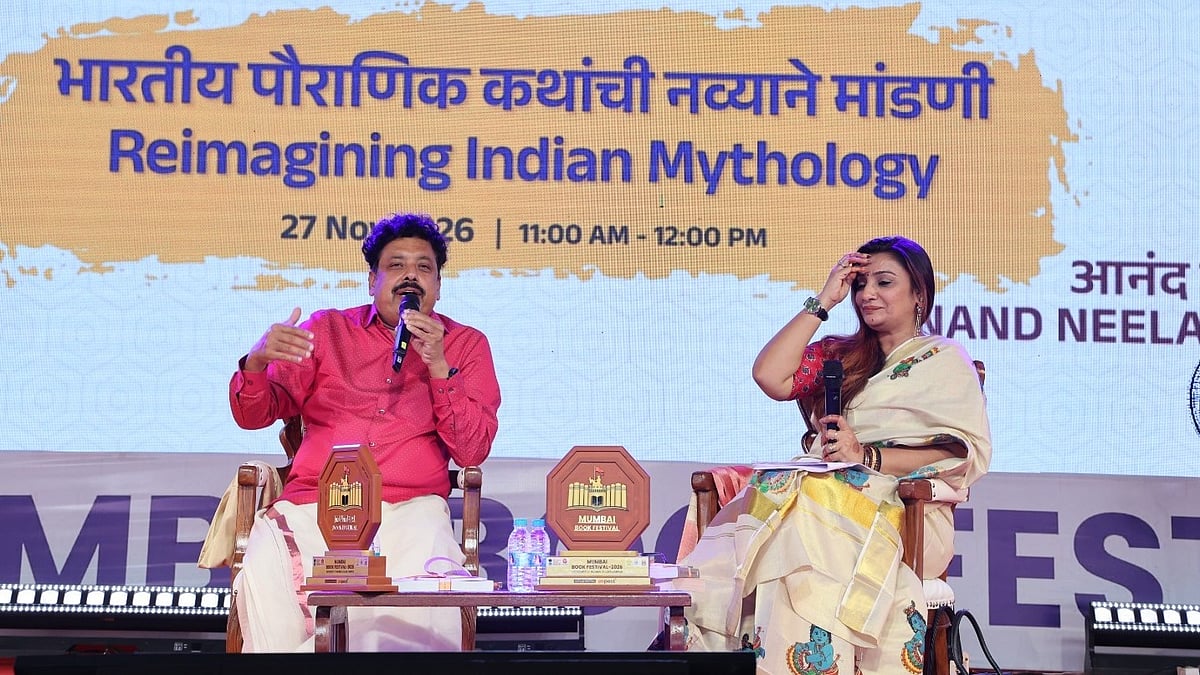
Mumbai Book Festival 2026 |
Indian mythology is rarely short of heroes and villains, but what happens when a familiar story is viewed through the eyes of the character usually cast as the antagonist? At the Mumbai Book Festival 2026, author and screenwriter Anand Neelakantan invited readers to look beyond conventional interpretations of Indian epics and question the idea of absolute good and evil. His session, moderated by Shweta Patta, explored the many perspectives within the Ramayana and Mahabharata, the changing understanding of dharma and the freedom to interpret age-old stories differently.
Held on Friday, November 27, at Kalina Campus, the discussion was part of the Mumbai Book Festival, which began on November 24 and continues until November 29. Drawing from his books, television writing and research into regional retellings, Neelakantan explained why he believes Indian epics are better understood through debate than through fixed labels.
Why Indian epics are not simply about heroes and villains
Reflecting on the idea of portraying Ravana from a different perspective in Asura: Tale of the Vanquished, Neelakantan said Indian Puranas do not necessarily follow the rigid hero-versus-villain structure often applied to them. Instead, he pointed to dharma, adharma, karma and karmaphala as the ideas that shape these narratives.
He also challenged audiences to compare the lives of Ram and Ravana beyond their familiar labels. While Ram is revered as Maryada Purushottam, Neelakantan highlighted the hardships he endured, including exile, separation from Sita and the loss of allies during the battle. Ravana, meanwhile, enjoyed a prosperous life until the final phase of his story.
ALSO READ
Describing the contrast, he said, "He's like Elon Musk of that era. Having his own life. So given a choice, the last 5-6 weeks, it's a problem. But until then he had a jolly good life."
He clarified that presenting Ravana's perspective did not mean overlooking his flaws. In Asura, chapters alternate between Ravana's account and Bhadra, a common man who questions his justifications. Neelakantan explained that the ordinary person's struggles remain regardless of who occupies the throne.
Why there are many versions of the Ramayana
The author also spoke about how regional traditions have shaped different interpretations of the Ramayana. Referring to his book Many Ramayanas, Many Lessons, he recalled how watching Ramanand Sagar's television adaptation was a culture shock for those who had grown up with South Indian versions such as Kamba Ramayanam and Ezhuthachan's Ramayanam.
ALSO READ
He pointed out that even Valmiki's Ramayana has different Sanskrit recensions, while several regional retellings present variations in the characters and their relationships. According to him, these differences reflect how dharma can change with the place, period, family and society.
"You cannot have one Ramayan. That's the beauty of it," he said, adding that he had encountered at least 32 versions in which Sita is described as Ravana's daughter.
'There is no neutrality in storytelling'
Neelakantan further discussed how writers must inhabit the worldview of the characters they create rather than judge them from a distance. Whether writing Ravana, Duryodhana or another figure, he approaches the process as role-play, stepping into the character's perspective to understand their motivations.
"There is no neutrality in storytelling. You have to take a stand," he said, explaining that writing from a particular character's point of view means presenting the world through their lens.
He also emphasised that Indian philosophical traditions encourage questioning and discussion rather than treating every narrative as an unquestionable commandment. For him, the moral dilemmas in the Ramayana and Mahabharata are central to their enduring appeal.
The session offered readers a fresh way to revisit familiar epics, not by replacing one interpretation with another, but by recognising the many perspectives that have kept these stories alive across generations.
Level up your brain the fun way. Play daily games and quizzes on FPJ Smart!
RECENT STORIES
-
-
-
-
-