Indore's Narmada Pipeline Bursts At Kanadia Bypass Amid 27% Rainfall Deficit; Precious Water Goes To Waste | VIDEO
Indore continues to witness repeated Narmada pipeline bursts amid a looming water crisis caused by a 27% rainfall deficit. The latest incident at Kanadia Bypass resulted in substantial water wastage. Earlier repairs had recovered one crore litres daily, highlighting infrastructure concerns. Despite IMC’s 48-hour repair deadline, recurring leakages raise questions over water conservation.

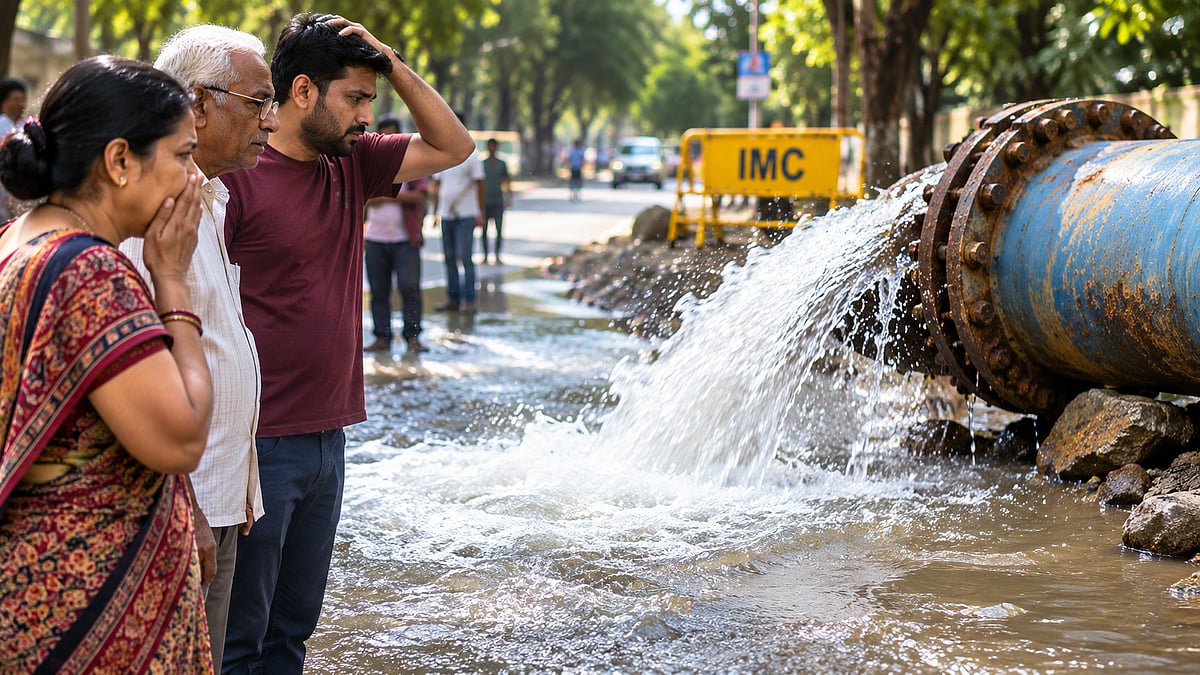
Indore's Narmada Pipeline Bursts At Kanadia Bypass Amid 27% Rainfall Deficit; Precious Water Goes To Waste | VIDEO | AI Generated Image
Indore (Madhya Pradesh): At a time when Indore is grappling with a 27% rainfall deficit and a looming water crisis, repeated leakages in the Narmada supply network continue to waste precious drinking water. The latest pipeline burst near Hanuman Temple on Kanadia Bypass on Sunday morning has once again raised questions over the Indore Municipal Corporation's (IMC) maintenance of the city's water distribution network.
The incident comes barely two weeks after the civic body ordered officials to repair leakages within 48 hours and identify vulnerable points in the pipeline network.
According to officials, the distribution pipeline burst around 10 am during regular water supply, sending a large quantity of water onto the road. Municipal workers rushed to the spot and began repairs.
The Water Works Department said excessive pressure was suspected, though the exact cause was yet to be established. Officials clarified that the damaged pipeline was a distribution line, not a main supply line, and regular water supply was unlikely to be affected.
27% Rainfall Deficit Deepens Concerns
The incident comes against the backdrop of Indore district being declared water-scarce following deficient rainfall and declining groundwater levels.
According to figures reported earlier by The Free Press Journal, the district received 633.1 mm rainfall between June 1 and Sept 30 against the normal 868.1 mm, a deficit of nearly 27%.
On Oct 27, Collector Shivam Verma banned private borewell drilling in urban and rural areas under the Madhya Pradesh Drinking Water Preservation Act, 1986, to prevent further groundwater depletion.
Surface water reserves are also under stress. An FPJ report on Oct 9 revealed that Chhoti Bilawali and Limbodi lakes had reached zero level. Badi Bilawali stood at just 12.1 feet against its full level of 34 feet, while Pipliyapala recorded 7.1 feet against 22 feet.
Earlier Repairs Saved One Crore Litres Daily
The scale of water wastage through damaged pipelines came to light earlier this year when the IMC undertook major repairs to the Narmada network.
On Feb 26, Mayor Pushyamitra Bhargav said the repairs had increased water availability by 10 million litres per day (MLD), equivalent to one crore litres. Further repairs were expected to add another 10 MLD, taking the potential gain to 20 MLD.
The figures underline how plugging leakages can improve water availability without developing new sources. However, recurring pipeline failures continue to undermine these efforts.
Repeated Bursts Disrupt Supply
Apart from wasting water, pipeline damage has repeatedly disrupted supply across residential areas.
On Oct 26, the IMC shut down Narmada Phase I and II pumps for 11 to 12 hours for pipeline interconnection, leakage repairs and maintenance. The shutdown affected morning supply the following day in 19 overhead water tank zones, including Annapurna, Scheme No 103, Rajmohalla, Banganga, Gandhi Hall, Lokmanya Nagar and MOG Lines.
Repairs were undertaken on a 1,100-mm pipeline near Kesarbagh railway crossing, a 900-mm pipeline at Bijalpur and a 600-mm pipeline near the District Institute of Education and Training.
In June, the IMC imposed a ₹5 lakh penalty on Bharti Airtel after a Narmada pipeline was allegedly damaged during optical fibre cable installation in Zone 13, disrupting supply and wasting treated water.
Similarly, in January, residents of Bhagirathpura faced flooding after a recently repaired Narmada pipeline began leaking again at the same spot.
IMC's 48-Hour Repair Deadline Under Scrutiny
On Nov 2, Municipal Commissioner Kshitij Singhal directed officials to repair leaking pipelines, joints and valves within 48 hours of receiving complaints.
He also ordered a seven-day survey across municipal zones to identify leakages. Assistant engineers were asked to submit compliance certificates, while disciplinary action was proposed against officials responsible for delays or water wastage.
The IMC also directed officials to disconnect redundant old pipelines running alongside new ones within a month.
The latest burst has again brought the effectiveness of these measures into focus, highlighting the need for preventive maintenance and better pressure monitoring.
Summer Shortage Adds To Challenge
With a possible summer shortage looming, the IMC has begun preparing a ward-wise water management plan.
In October, Mayor Bhargav directed officials to identify water-stressed areas and assess pipelines, borewells and storage facilities. The civic body also planned closer monitoring of the main Narmada pipeline from Jalood and a review of tanker arrangements.
With groundwater levels declining and local water bodies holding limited reserves, every litre saved has become crucial.
While officials maintain that Sunday's burst will not disrupt supply, repeated pipeline failures raise a pressing question on how effectively can the city conserve water if its distribution infrastructure continues to suffer leakages at a time when every litre matters?
RECENT STORIES
-
-
-
-
-