Supreme Court Directs Centre, CBSE To Add Opt-Out Option In APAAR Consent Form; Bars Unauthorised Data Sharing
The Supreme Court directed the Centre and CBSE to add an opt-out option to the APAAR consent form, ensuring parents can refuse consent for generating APAAR IDs. It also ordered strict compliance with the Digital Personal Data Protection Act, 2023, and barred unauthorised sharing of students' personal data.

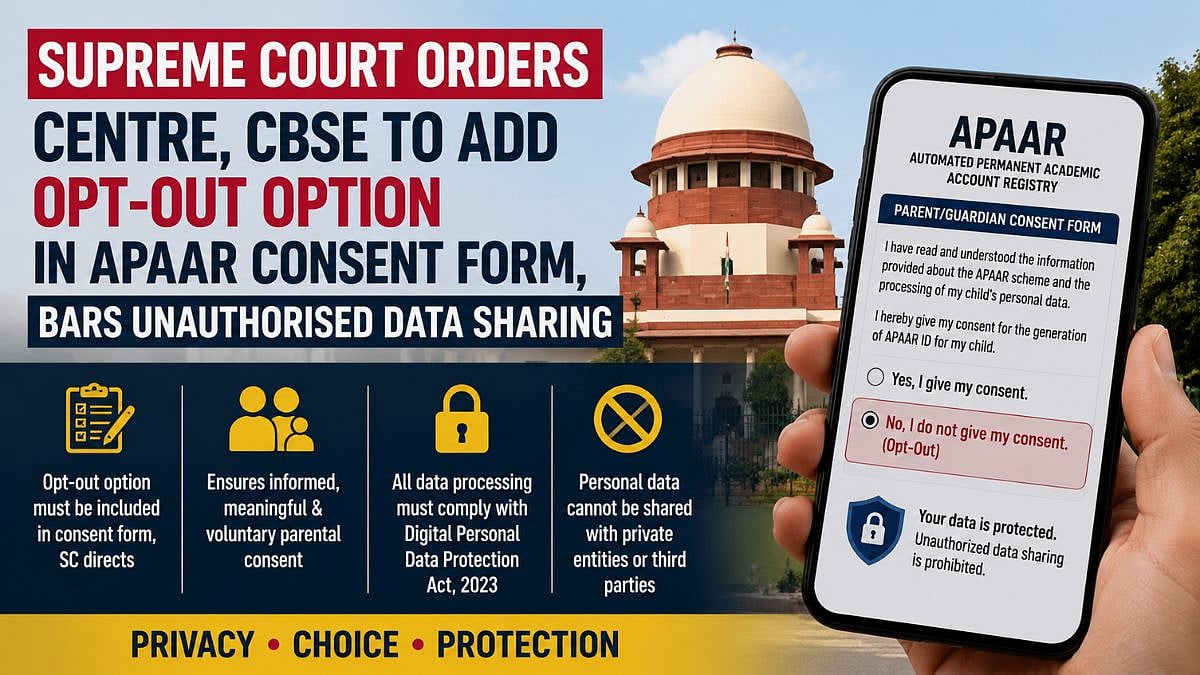
The Supreme Court directed the Centre and CBSE to introduce an opt-out option in the APAAR consent form and strengthen safeguards for students' personal data | AI Generated Representational Image
New Delhi, July 25, 2026: The Supreme Court has directed the Union Government and the Central Board of Secondary Education (CBSE) to amend the model consent form under the Automated Permanent Academic Account Registry (APAAR) scheme to explicitly provide parents and guardians with an option to refuse or withhold consent for generating an APAAR ID.
A Bench comprising Chief Justice of India Surya Kant, Justice Joymalya Bagchi, and Justice V. Mohan made it clear that the directions issued by the Orissa High Court in Rohit Anand Das v State of Odisha (2025) must now be implemented across the country.
The apex court said an opt-out option is a crucial safeguard to ensure that parental consent is meaningful, informed, and not merely a formality, Live Law reports.
Consent Must Be Voluntary
The Supreme Court relied on paragraph 19 of the Orissa High Court judgment, which had directed authorities to amend the model consent form by including an opt-out or refusal option. The High Court had also asked the authorities to consider the revised draft suggested by the petitioners and pass the necessary orders within two months.
Extending those directions nationwide, the Supreme Court observed that providing parents with the freedom to decline participation is essential for protecting the principle of informed consent. It directed all authorities implementing the APAAR scheme to incorporate the safeguard on a pan-India basis.
The court was hearing a petition filed by parents of students studying in CBSE-affiliated schools, who challenged the constitutional validity of the APAAR scheme.
Appearing for the petitioners, Senior Advocate Indira Jaising argued that the scheme effectively creates a State-run surveillance mechanism within the education system by enabling long-term tracking, profiling, and monitoring of children's academic progress without offering parents an option to opt out.
The petitioners also contended that the scheme allows extensive collection and long-term retention of personal data, which could potentially be used beyond educational purposes.
They informed the court that they had already communicated their refusal to their respective schools to consent to the generation of APAAR IDs for their children.
Privacy Safeguards Reinforced
Jaising further argued that although a Ministry of Education circular dated Oct. 11, 2023, made parental consent mandatory, the prescribed consent forms neither provided an option to refuse participation nor clearly explained the purpose, scope, or retention period of the data being collected.
She also pointed out that CBSE, through circulars issued on Aug. 5, 2025, and Aug. 27, 2025, made APAAR ID registration a mandatory condition for registering students of Classes IX to XII for Board examinations from the 2026 academic year onwards.
Since the APAAR ID is linked to Aadhaar, the petitioners argued that this effectively compels children to enrol for Aadhaar, despite the Supreme Court's 2018 ruling that Aadhaar cannot be made mandatory for children.
The petitioners submitted that these measures fail to satisfy the constitutional tests of legality, legitimate aim, necessity, and proportionality laid down in the Supreme Court's Justice K.S. Puttaswamy (2017) judgment on the right to privacy.
Addressing concerns over misuse of personal information, the Supreme Court emphasised that all collection, processing, storage, retention, sharing, and use of data under the APAAR scheme must strictly comply with the provisions of the Digital Personal Data Protection Act, 2023.
The court said authorities are bound by the obligations imposed on data fiduciaries to ensure lawful, secure, and purpose-limited processing of personal data.
Also Watch:
ALSO READ
The Bench also made it clear that personal information collected under the APAAR scheme cannot be disclosed, shared, or made available to any private entity or third party except in accordance with law and only for purposes authorised under the scheme. It observed that any sharing of such data beyond the scheme's scope or for extraneous purposes would be impermissible.
Petition Disposed Of
With these directions, the Supreme Court disposed of the petition.
To get details on exclusive and budget-friendly property deals in Mumbai & surrounding regions, do visit: https://budgetproperties.in/
RECENT STORIES
-
-
-
-
-