'It Was A Mistake': Kashmiri Muslim Clerics Apologise For Standing During Vande Mataram At Waqf Board Event
Several Muslim clerics in Kashmir have apologised and sought Allah's forgiveness after standing during Vande Mataram at a J&K Waqf Board event in Srinagar. They also recited the kalima. The Muslim Majlis-e-Ulama condemned the rendition, arguing that portraying the motherland as divine conflicts with Islam's principle of Tawheed (oneness of God).

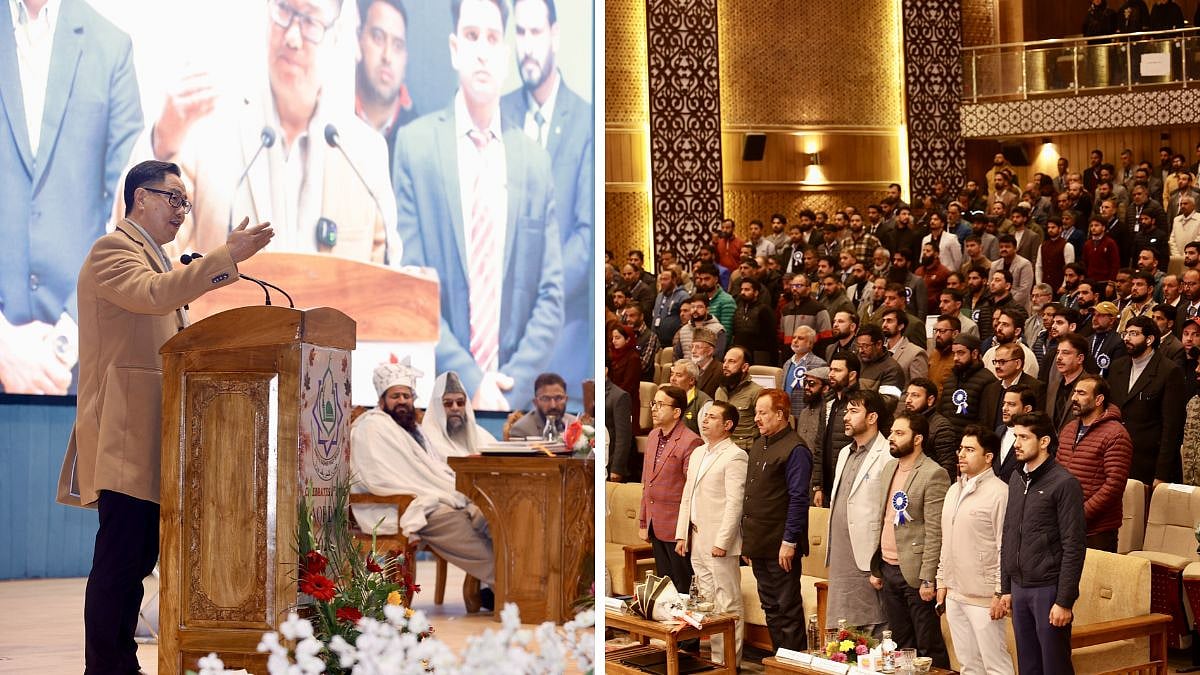
'It Was A Mistake': Kashmiri Muslim Clerics Apologise For Standing During Vande Mataram At Waqf Board Event | X @KirenRijiju
A controversy over the recitation of the national song, Vande Mataram, at a Jammu and Kashmir Waqf Board event in Srinagar has intensified, with several Muslim clerics expressing regret and seeking Allah's forgiveness two days after they stood during its rendition. The clerics reportedly objected to the song on religious grounds, as some Islamic scholars consider its portrayal of the motherland as a divine figure incompatible with the faith's principle of monotheism.
In a video message circulated on social media, a group of clerics apologised for their participation and recited the kalima, the central Islamic declaration of faith, as an affirmation of their religious beliefs and a plea for forgiveness.
How The Vande Mataram Row Started
The incident dates back to Monday, when dozens of imams and Muslim clerics attended the Waqf Board's first-ever Waqf Day celebration. Union Minority Affairs Minister Kiren Rijiju was the chief guest at the event, where all six stanzas of Vande Mataram were played.
The function was organised by the J&K Waqf Board, headed by BJP leader Darakhshan Andrabi. The board oversees several prominent mosques and religious shrines across Jammu and Kashmir, including the Dargah Hazratbal. A large number of imams associated with the board, along with other Muslim clerics, were present at the gathering.
ALSO READ
Videos showing the clerics standing during the rendition of Vande Mataram subsequently circulated widely on social media, triggering criticism from sections of the Muslim community.
"It was a mistake. We regret it and seek forgiveness from Allah," a group of clerics said in a video statement shared online.
Why Some Muslims Object To Vande Mataram
The opposition to Vande Mataram among some sections of Muslims stems from its perceived religious imagery. They maintain that respecting and loving one's country is distinct from worshipping it. The national song, whose title translates to 'I bow to thee, Mother', is viewed by some as depicting the motherland as a deity, which they argue conflicts with Islam's strict belief in the oneness of Allah.
According to Islamic scholars who oppose the song on religious grounds, the faith prohibits worshipping or bowing before anything other than Allah or attributing divinity to a person, object or territory. Mirwaiz Umar Farooq has also raised this argument while expressing opposition to the song.
Meanwhile, some prominent religious scholars have welcomed the clerics' apology, describing their expression of regret and repentance as a positive development.
ALSO READ
Muslim Majlis-e-Ulama Condemns Recitation At Waqf Event
However, the Muslim Majlis-e-Ulama, an umbrella body of religious and social organisations in Kashmir led by the Mirwaiz, strongly condemned the episode. Reiterating its position on Tawheed (oneness of God) and religious freedom, the organisation maintained that love for one's homeland must not be confused with its worship.
"While Islam encourages love for one's homeland, it draws a clear distinction between love for one's homeland and its worship or deification. Any expression or practice that attributes divinity to the motherland is contrary to the fundamental Islamic belief of Tawheed and is, therefore, un-Islamic and impermissible for Muslims," it said in a statement.
The organisation also questioned the decision to play the national song at an event hosted by the Waqf Board, an institution responsible for protecting Muslim religious endowments.
"It is highly regrettable and unacceptable that Vande Mataram was played at a function organised by the Waqf Board itself, an institution entrusted with safeguarding Muslim religious endowments and their sanctity,"
ALSO READ
The Muslim Majlis-e-Ulama further argued that there was no legal requirement for Vande Mataram to be played at an official gathering, as its rendition was optional. It accused the Waqf Board of disregarding the religious beliefs and sensitivities of Kashmiri Muslims, claiming that the decision had caused considerable hurt and resentment.
Neither the Waqf Board nor Union Minister Kiren Rijiju has issued a response to the controversy so far.
Level up your brain the fun way. Play daily games and quizzes on FPJ Smart!
RECENT STORIES
-
-
-
-
-