India Has Served 8 Terms On UNSC, So Why Is It Still Seeking A Permanent Seat?
India’s decades-old campaign for a permanent seat at the United Nations Security Council is based on its population, economic weight, democratic credentials and peacekeeping contributions. Despite eight terms as a non-permanent member, India remains outside the veto-holding group. The push highlights the wider debate over reforming an 81-year-old global power structure.

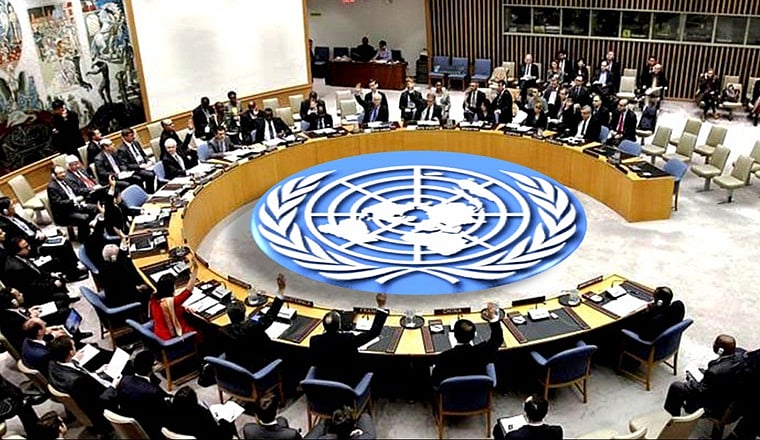
India Has Served 8 Terms On UNSC, So Why Is It Still Seeking A Permanent Seat? | File Pic
India has served eight terms as a non-permanent member of the United Nations Security Council, but New Delhi has long argued that temporary membership is no longer enough for a country of its size and global standing. Its push for a permanent seat goes back decades, with India formally declaring its candidature during the 49th session of the UN General Assembly in 1994. UN records from the period confirm that India declared itself ready to take on the responsibilities of permanent membership.
The demand comes against the backdrop of a Security Council whose permanent membership has remained unchanged since the UN’s creation in 1945. China, France, Russia, the United Kingdom and the United States hold the five permanent seats and possess veto power. The other 10 seats are held by members elected by the UN General Assembly for two-year terms.
An 81-year-old power structure
India’s central argument is straightforward: the world of 2026 is vastly different from that of 1945, but the permanent membership of the Security Council does not reflect that change.
New Delhi has called for expansion in both permanent and non-permanent categories, seeking greater representation for developing countries, particularly from Asia, Africa and Latin America. India has argued that merely adding more non-permanent seats would leave the basic power structure untouched because the five permanent members would retain their special position.
The Council has been expanded only once. An amendment to the UN Charter increased its membership from 11 to 15, adding four non-permanent seats. The five permanent seats remained unchanged. The Council today consists of 15 members, five permanent and 10 non-permanent, Hindustan Times reports.
ALSO READ
India’s case rests on several factors, including its population, democratic system, economic and geopolitical weight and contribution to UN peacekeeping. New Delhi maintains that these factors make a stronger voice for India in global decision-making necessary.
Eight terms, but no veto
India has been elected a non-permanent member of the Security Council eight times. It served in 1950-51, 1967-68, 1972-73, 1977-78, 1984-85, 1991-92, 2011-12 and, most recently, 2021-22.
During these terms, India participated in Council deliberations and decisions on international peace and security, covering issues such as conflicts, peacekeeping, sanctions and international cooperation.
But a non-permanent seat is fundamentally different from a permanent one. Every Security Council member has one vote, but only the five permanent members have veto power over substantive decisions.
That distinction lies at the heart of India’s campaign. A permanent seat would not simply give India a place at the table for longer than two years. If an expanded Council gave new permanent members the same privileges as the existing five, it would potentially give India substantially greater influence over decisions on international peace and security.
Why the veto matters
The veto is one of the Security Council’s most consequential powers. A substantive resolution can be blocked when a permanent member casts a negative vote, even when it has broad support from other Council members.
This means the debate over permanent membership is ultimately also a debate about who gets exceptional decision-making power in the international system.
India’s position is that the present structure gives a special role to five countries based on a global order shaped eight decades ago, while countries that have since become major political, economic and demographic powers remain outside the permanent category.
At the UN Millennium Summit in New York in September 2000, then Prime Minister Atal Bihari Vajpayee reiterated India’s case, saying the country had “let it be known for some years” that it considered itself qualified to shoulder the responsibilities of permanent membership.
Peacekeeping strengthens India’s pitch
India has also consistently pointed to its record in UN peacekeeping.
While launching India’s campaign for election as a non-permanent member for the 2028-29 term, External Affairs Minister S Jaishankar said the country had contributed nearly 300,000 personnel to about 50 UN peacekeeping missions since the organisation’s inception and had more than 4,300 personnel serving in 10 missions.
Jaishankar also highlighted India’s advocacy of dialogue and diplomacy and its efforts to amplify the concerns of the Global South.
Earlier official Indian figures have similarly placed the country among the leading contributors to UN peacekeeping, recording more than 270,000 troops across 52 missions.
ALSO READ
Another UNSC campaign begins
New Delhi has officially launched its campaign for another non-permanent term in 2028-29 under the theme “Shanti: India for the United Nations Security Council 2028-29 — Norms, Trust, Integrity”.
The Council’s current non-permanent members are Denmark, Greece, Pakistan, Panama and Somalia, whose terms end in 2026, and Bahrain, Colombia, the Democratic Republic of the Congo, Latvia and Liberia, whose terms end in 2027. UN records confirm the present membership.
Australia, meanwhile, plans to seek a non-permanent seat from 2029, with Prime Minister Anthony Albanese launching a campaign for one of the two seats available to its regional bloc.
For India, however, repeated non-permanent membership has not diminished the argument for a permanent seat. Rather, New Delhi presents its eight previous terms as evidence of sustained participation in the Council.
Reform has moved slowly
The question of restructuring the Security Council was taken up for review by the UN General Assembly in 1992, followed by the establishment of an Open-ended Working Group in 1993.
Yet decades of discussion have failed to produce agreement on crucial questions, including how large an expanded Council should be, which categories should be enlarged and what criteria should determine new permanent members.
That difficulty is hardly surprising. Expanding the Council is not simply an administrative exercise. It involves redistributing influence in one of the world’s most powerful multilateral bodies.
India has maintained that criteria such as population, contribution to the UN system, participation in peacekeeping and capacity to play regional and global roles should be considered. UN records show India was making essentially this case in the 1990s.
ALSO READ
Who backs India?
India has received support for a greater role in the Security Council from several countries over the years.
Four of the five permanent members have long supported India’s permanent-membership aspirations. China’s position has been more guarded. At the recent BRICS Summit in New Delhi, China and Russia reiterated support for the aspirations of Brazil and India to play a greater role in the UN, including its Security Council.
BRICS leaders also backed reform of the Council to make it more democratic, representative, effective and efficient, with greater representation for developing countries.
American economist Jeffrey Sachs has also publicly backed India’s claim. “Think of all countries in the world, there is no country other than India that has such a strong claim as the sixth permanent member of the UN Security Council,” Sachs said in an interview with PTI. He also called on India and China to overcome their differences and said Beijing should support New Delhi’s candidature.
Support for India is not new. In 2002, Mauritius, Bhutan, Cuba, the Dominican Republic, Russia, Vietnam, Laos, Cyprus and Cambodia had expressed support at the UN for India’s candidature.
Cyprus has since reiterated its support for India’s permanent membership in a reformed Council, while Palestine has also publicly backed New Delhi’s long-standing aspiration.
Also Watch:
The bigger question
India’s campaign raises a question that extends beyond its own candidature: can an institution created to manage global peace and security retain its legitimacy if its most powerful membership category continues to reflect the geopolitical realities of 1945?
India’s argument is that it cannot. But changing the structure requires countries to agree not only that reform is necessary, but also on who should receive new seats and what powers those seats should carry.
More than three decades after India formally put forward its candidature, that agreement remains elusive. Its latest campaign for a non-permanent term therefore highlights the paradox at the centre of its UNSC journey: India continues to seek election to a rotating seat even as it argues that the Council’s permanent power structure needs fundamental reform.
RECENT STORIES
-
-
-
-
-