Reducing Stress Level of Students: A Big Challenge Among Teachers
Students today face rising stress due to academic pressure, competition, and personal issues. Teachers play a key role in identifying vulnerable students and creating a supportive, transparent, and positive classroom environment to reduce anxiety and promote overall wellbeing.

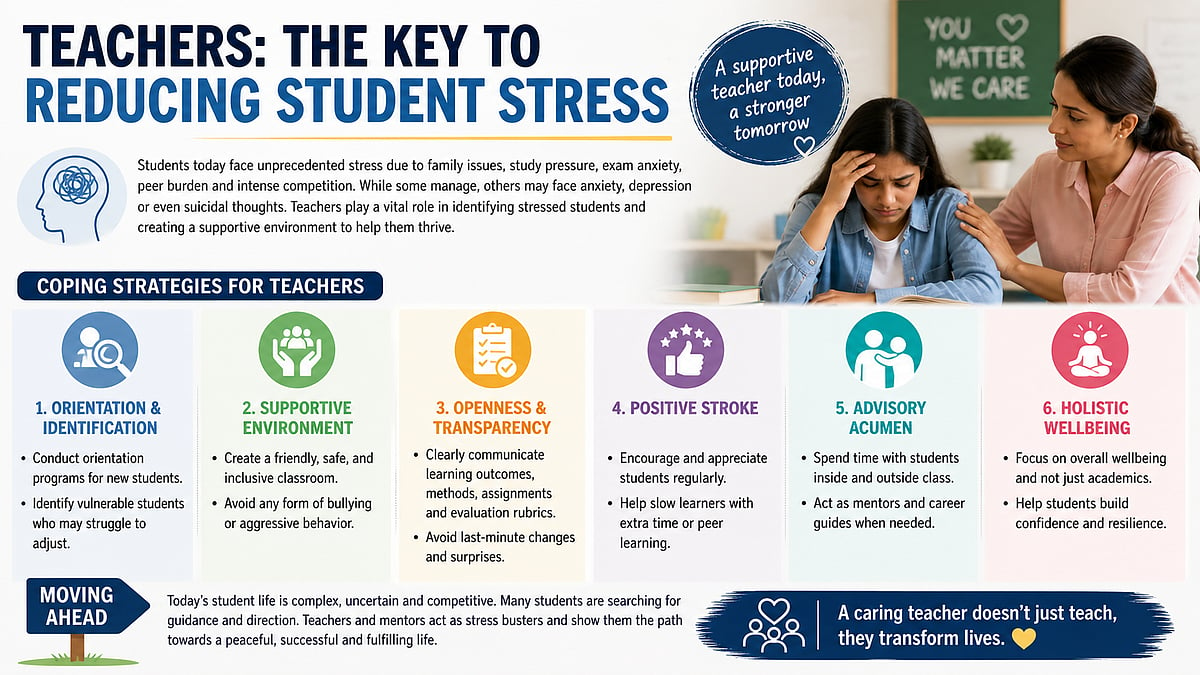
AI
Students in the current generation at all levels are experiencing unprecedented levels of stress. Family issues, study pressure, examination anxiety, peer burden, and extreme competition in the job market are some of the reasons for this. While sometimes the students can manage, other times it becomes a breaking point, and they become vulnerable, resulting in symptoms of anxiety, depression, etc. Some extreme cases may also result in suicidal tendencies.
In the above context, identifying the stressed students and strategies to mitigate them becomes crucial for teachers as students spend a significant amount of time at academic institutions, and many of these “stress stimulants” arise on account of the academic environment and pressures.
Coping Strategies:
Teachers are not trained as counsellors. Their main role is to create an enabling environment that encourages students to learn. Teachers have other responsibilities, such as research or administrative duties. Nevertheless, since schools/colleges are the shelter next only to homes and students spend a significant time of the day there, the teachers are required to create an environment where there is less stress (distress). It is a moral as well as a legal responsibility of the teacher to enhance the “overall well-being” of the students.
Some strategies that can be adopted by teachers are as follows:
ALSO READ
Orientation Program and Identification of Vulnerable Students: The first step is the identification of such “potential students” who are susceptible to or can easily be stressed at least stimulus. We have seen that many students who are first-generation learners or have studied in the vernacular language in schools and are coming to the undergraduate level often get overwhelmed by the environment and feel stressed.
College education, in terms of curriculum and pedagogy, is distinct from the school environment. For example, some subjects may be completely new, or some methods, such as case study analysis, may seem overwhelming. Therefore, a teacher, particularly at the entry level, must be extra careful to ensure that all students understand the “change in ambience” from school to college. Therefore, the “orientation program,” is of high importance.
Supportive Environment
It is the prime responsibility of a teacher to create an academic ambience in the class that is friendly, supportive, open, and objective so that all students feel recognized, protected, safe, enabling, and stimulating. This social and emotional bondage between teachers and students helps the learners not only to remain engaged but also to come back to the class next time with renewed hope and assurance. What is being taught is important; however, more important is the feeling of students’ happiness inside the class. Any aggressive or bullying behaviour or “I know everything” approach on the part of the teachers must be avoided under all circumstances.
ALSO READ
Openness and Transparency
This is crucial. Students prefer an open and transparent environment. Therefore, in the first session itself, a teacher must specify clearly the learning outcomes, teaching methodology, assignments to be rolled out, projects / experience bound immersion programs, details of end term examination and rubrics at length on which the students will be evaluated.
The surprise elements like cancellation / rescheduling of classes should be “extremely rare.” This will help students understand the subject in totality and certainty, including its importance. Since many students, particularly at the college level, may be interested in knowing the relevance of the subject with reference to their “career aspirations,” the practical utility of the subject must also be explained.
Positive Stroke
To keep the students engaged and motivated until the end, it is always better to impart positive strokes and appreciative gestures throughout the course rather than a negative stimulus. A statement like “I am sure you will score better next time” even to a bad performer is always encouraging and motivating.
Our role as teachers is to help students learn in their own way at their own pace, and any threatening posture does not help. A teacher who offers a positive stroke helps a student to grow in a “positive direction” and is remembered by the student over a longer period. Teachers should spend extra time with slow learners or resort to “peer learning” as a tool for knowledge reinforcement.
Advisory Acumen
This is especially important: a good teacher is one who spends time with students not only “within the class” but also “off the class” in a friendly but professional manner. Informal communication is as important as formal interaction. The role of “mentoring” is important in this context. Teachers should not only facilitate the holistic development of students but also function as catalysts in their self-growth.
The role might sometimes change to a “career counsellor” as many students may have the first line of defence in a teacher whom they will fall back upon in search of “life goal posts.” When played effectively, these advisory roles help create an atmosphere of positivity, reducing students’ stress levels.
Moving Ahead
Student life in the current times is extraordinarily complex, uncertain, volatile, and sometimes unpredictable. While we may see students goalless and wandering, they are, in fact, searching for “Gurus” who can handhold them and show them the path.
To charter the voyage of life that is otherwise quite full of stress, a good teacher (mentor) helps as a stress buster and transition into the zone of peace. Therefore, teachers play a crucial role in creating a life that is peaceful and at the same time, professionally fulfilling.
RECENT STORIES
-
-
-
-
-