Mission Impossible Of Holistic Development Of Students: Big Challenge Before Educators
Holistic development in education goes beyond academics, focusing on knowledge, skills, creativity, values and personal growth. Educators face the challenge of balancing multiple dimensions to nurture well-rounded students.

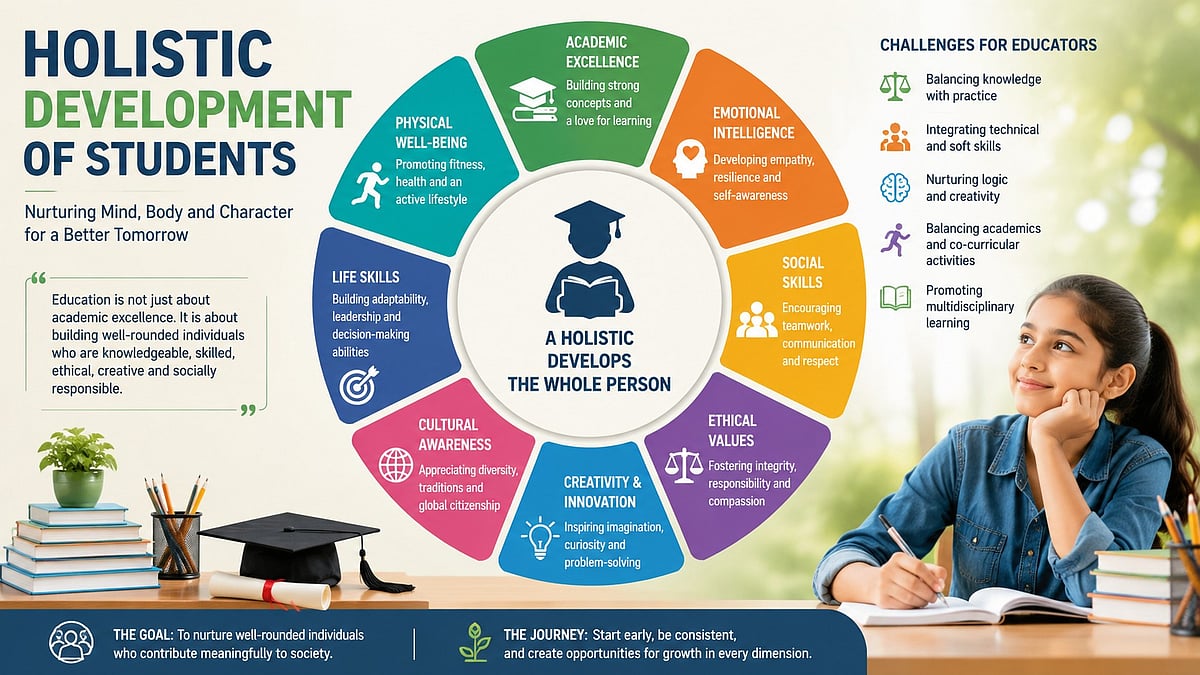
One of the most frequently discussed themes in contemporary educational discourse is the concept of "holistic development of students." Educational institutions, at all levels, are increasingly expected to nurture well-rounded individuals rather than merely producing academically successful graduates.
However, despite the popularity of the term, there is often little clarity regarding what exactly holistic development means and how it can be achieved in practice. The word "holistic" is derived from the concept of the "whole" or "totality." It is based on the philosophy that the whole is greater than the sum of its individual parts. In simple terms, it suggests that while individual competencies are important, true development occurs when all dimensions of a person's personality evolve in an integrated manner.
Context of Education:
Let us examine the issue more closely in the educational context. Every educational system seeks to prepare students for life, work, and citizenship. However, life itself is multidimensional and requires a wide range of competencies. Therefore, the expectation from educational institutions is not limited to academic excellence alone.
A student is expected to possess knowledge, practical competence, communication skills, ethical values, emotional maturity, leadership qualities, creativity, adaptability, and social responsibility. The challenge is that each of these dimensions requires a different approach, learning experiences, and assessment mechanisms.
Some of the major interpretations of holistic development and the challenges associated with them are discussed below.
Knowledge and Practice: One of the most important dimensions of holistic development is the integration of knowledge and practice. Knowledge becomes meaningful only when it can be applied effectively in real-life situations. At the same time, practical skills without conceptual understanding have limited utility. Therefore, meaningful education requires a healthy balance between knowledge acquisition and practical application.
However, the reality is far more complex. The modern economy consists of thousands of occupations and highly specialized roles. Many skills are industry-specific and job-specific. It is practically impossible for any educational institution to provide comprehensive practical training for every possible profession.
This remains one of the major challenges in achieving holistic development.
Technical Skills and Soft Skills: Another important dimension of holistic development involves balancing technical skills with soft skills. Technical competence enables students to perform professional tasks effectively, while soft skills determine how successfully they interact with others and navigate complex situations.
Employers today repeatedly emphasize the importance of communication, teamwork, leadership, adaptability, problem-solving ability, emotional intelligence, and professional ethics.
Educational institutions, therefore, face a significant challenge in ensuring that students acquire both technical competence and interpersonal effectiveness.
Left Brain and Right Brain: Another challenge relates to balancing analytical thinking and creative thinking. The contemporary world is increasingly driven by data, technology, automation, and artificial intelligence. Decision-making in professional environments is expected to be evidence-based and supported by quantitative analysis. Consequently, educational systems naturally emphasize logic, critical thinking, problem-solving, and analytical reasoning. Most management tools, decision-making frameworks, and case-study methodologies rely heavily on objective data and rational analysis.
However, human progress is not driven by logic alone. Creativity, imagination, intuition, and innovation, also play crucial roles in personal and professional success.
The challenge before educators is, therefore, to nurture both dimensions simultaneously.
Academics and Extra-Curricular: Another important aspect of holistic development concerns the balance between academics and extracurricular activities. Educational institutions increasingly encourage students to participate in sports, cultural programmes, debates, music, theatre, social service, and various co-curricular activities. These activities contribute significantly to personality development by promoting confidence, discipline, teamwork, leadership, communication skills, and emotional resilience. However, participation in such activities ultimately depends on student interest. Just as learning cannot be imposed effectively, genuine involvement in extracurricular activities cannot be forced. Some students naturally enjoy public speaking, sports, music, or creative pursuits, while others prefer to focus exclusively on academics.
Movement towards Liberal Education / Multi-disciplinary Approach:
One of the most significant educational reforms in recent years has been the movement towards liberal and multidisciplinary education. In India, this vision has gained momentum following the implementation of the National Education Policy (NEP) 2020. The expectation was that students would combine disciplines from widely different domains, for example, engineering with literature, medicine with psychology, economics with philosophy, or data science with performing arts.
However, practical experience suggests that the transition has not been entirely smooth. Many students continue to prefer combinations that are closely aligned with their career aspirations.
Challenges Before Educators:
It is, therefore, evident that the pursuit of holistic development presents numerous challenges for educators. Every interpretation of holistic development introduces a new layer of complexity. Balancing knowledge with practice, technical competence with soft skills, analytical reasoning with creativity, academics with extracurricular activities, and specialization with multidisciplinary learning is far easier in theory than in practice.
Yet the goal remains important and worthy of pursuit.
The journey towards holistic development should ideally begin at the primary school level and continue throughout the educational lifecycle. Students should be exposed to the beauty of literature as well as the precision of mathematics, the discipline of science as well as the creativity of the arts. They should learn not only to succeed academically but also to appreciate life, society, culture, and nature.
Holistic development may indeed appear to be a mission impossible. However, the role of educators is not necessarily to achieve perfection but to continuously create opportunities that enable students to grow in multiple dimensions. If education can inspire curiosity, competence, character, creativity, and compassion, it will have fulfilled its larger purpose.
The objective, therefore, should not be to create perfect individuals but to nurture well-rounded human beings who are capable of contributing meaningfully to society. That, perhaps, is the true essence of holistic development.
RECENT STORIES
-
-
-
-
-