US-Israel-Iran War: Tehran's Strategy Of Attacking Its Neighbours Is Not Wild Escalation, It Has A Method In Madness
Tehran is systematically targeting the Gulf’s energy lifelines and civilian hubs to dilute American defence systems, disrupt global oil flows through the Strait of Hormuz and pressure the United States into a ceasefire by weaponising regional economic stability

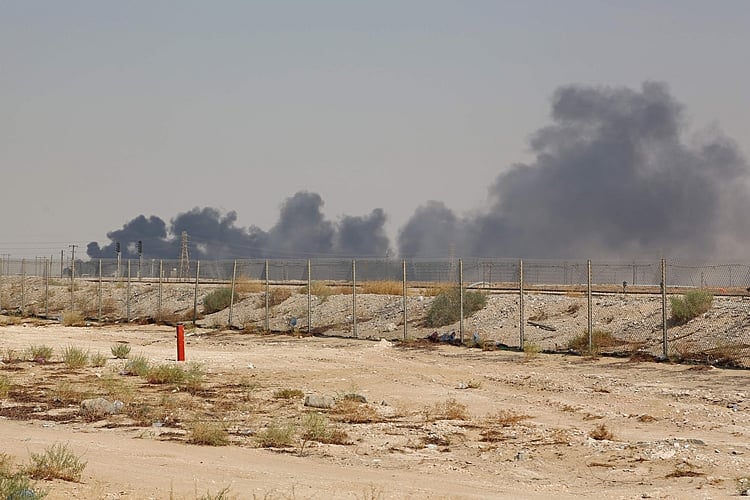
(File) Smoke billows from an Aramco oil facility in Abqaiq about 60km (37 miles) southwest of Dhahran in Saudi Arabia's eastern province. | AFP Photo
Iran’s decision to target Gulf Cooperation Council (GCC) nations is a calculated move based on the perception that these countries are "soft targets" compared to the more heavily fortified Israel.
Click Here For US-Iran-Israel War Live Updates
By striking five-star resorts in Dubai, residential towers in Bahrain and international airports across the region, Tehran aims to impose a direct and immediate cost on US allies.
This strategy is designed to exploit the lower "appetite for a fight" among Gulf states, banking on the hope that civilian casualties and the disruption of glitzy tourist hubs will create internal and external pressure for an immediate ceasefire.
If these initial warnings go unheeded, Iran has signalled that residential areas across the GCC will increasingly "feel the heat" as they are moved further up the target list to maximise domestic political pressure.
Diluting US defence capabilities through asymmetry
From a military standpoint, Iran is utilising asymmetrical methods to stretch and dilute the effectiveness of US defence systems. By widening the range of targets to include civilian infrastructure and diverse geographical locations—such as the Burj Al Arab and various international airports—Iran forces the US to spread its protective resources thin.
This tactic is intended to create gaps in the defensive umbrella, making it easier for Iranian munitions to successfully strike high-value American military assets and Israeli interests embedded within the region.
Weaponising economic and energy lifelines
The strikes on critical hubs like Saudi Aramco and major ports are intended to generate intense financial pressure on the United States and its allies by hitting the region's primary revenue sources.
Petroleum and natural gas serve as the economic lifeline of the Gulf and Iran is systematically targeting this juggernaut. In Qatar, the Ministry of Defence confirmed missile attacks on a water storage tank at the Mesaieed Power plant and energy facilities in Ras Laffan.
Simultaneously, regional instability has forced a retreat in production. Chevron was recently instructed by Israel’s Energy Ministry to temporarily shut the giant Leviathan gas field, jeopardising a $35 billion export deal. Beyond energy, Iran is placing the region’s basic survival at risk by eyeing food and water depots in GCC countries, threatening to strike these vital reserves if US-Israeli military operations do not cease.
Choking the global supply chain
Central to Iran’s leverage is its ability to disrupt the Strait of Hormuz, the world’s most significant maritime chokepoint. Approximately 22 per cent of the world’s oil flows through this narrow passage, making it a critical artery for the global economy.
By demonstrating its willingness to strike nearby targets and harassing shipping, Tehran is effectively holding a fifth of the world’s energy supply hostage. The goal is to prove that any conflict with Iran will not be contained but will instead trigger a global economic shock that the US and its allies cannot afford to sustain.
Neutralising Middle East as an offensive platform
Tehran views the presence of US military bases in neighbouring countries not as sovereign guests, but as an integrated "offensive platform" used to facilitate attacks against Iranian soil.
By striking at these locations, Iran sends a clear message: any country allowing its airspace or territory to be used by the US or Israel will be treated as a participant in the conflict.
This puts GCC leaders in a difficult bind, as they are caught between their security alliances and the reality of being at the mercy of Iranian missiles. An official from Saudi Arabia already expressed feelings of abandonment, noting that the US appears prioritised toward protecting Israel while leaving host nations vulnerable.
Testing limits of regional unity
While Gulf states have attempted to project a rhetorical show of force, Iran’s aggression is designed to expose the profound disagreements lurking beneath the surface of the GCC. Tehran is betting that the sustained threat to sovereignty, the risk to basic food and water security and the high cost of energy disruptions will eventually fracture regional cooperation. By making the "nuanced" approach of the Gulf states increasingly difficult to maintain, Iran seeks to force these nations into a corner where they must either advocate for a de-escalation that favors Tehran or face continued, destabilising strikes on their most prized landmarks, energy assets and residential centres.
Published on: Monday, March 02, 2026, 05:39 PM ISTRECENT STORIES
-
-
-
-
-