Nepal Floods Triggered By Massive Ice-Rock Avalanche, Not Heavy Rainfall: Scientists
A preliminary study by Nepalese scientists has found that the devastating Bhotekoshi-Trishuli floods were triggered by a massive ice-rock avalanche from the Langtang-Lirung area, rather than heavy rainfall. The avalanche travelled over 22 km at speeds of up to 167 kmph, causing widespread destruction, killing over 900 people and damaging hydropower projects.

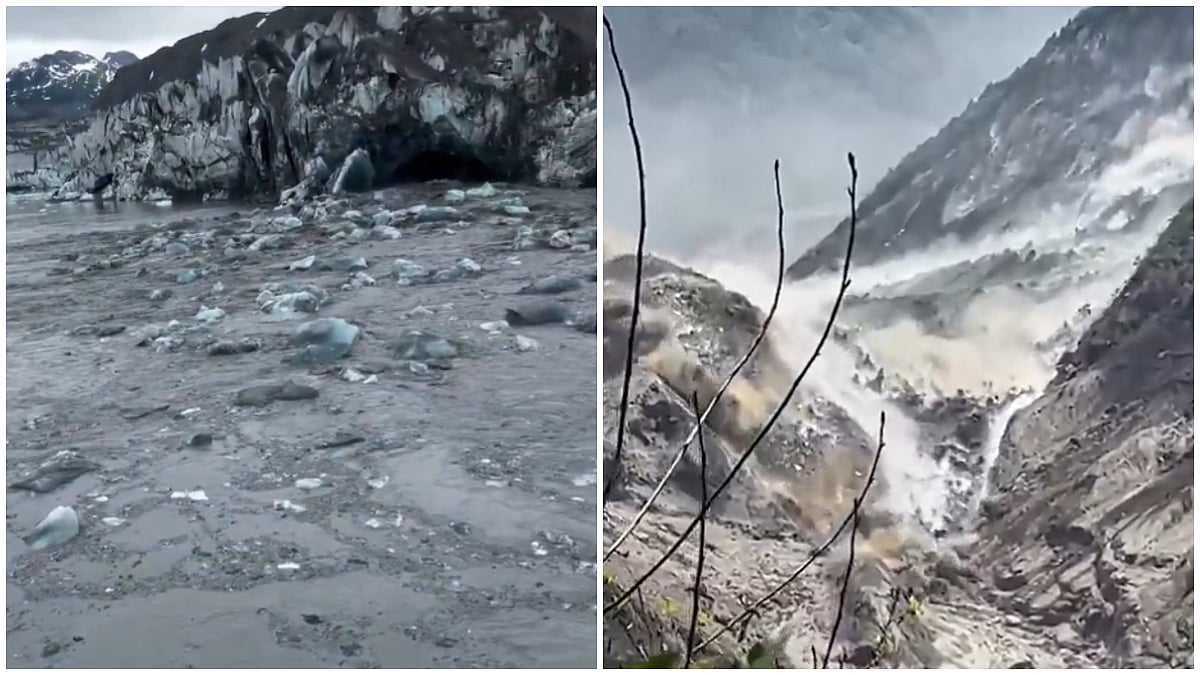
Nepal Floods Triggered By Massive Ice-Rock Avalanche, Not Heavy Rainfall: Scientists | X - METRO_NIDAZOLE
The devastating floods that swept through Nepal's Bhotekoshi-Trishuli corridor were triggered by a massive ice-rock avalanche in the high Himalayas rather than conventional rainfall, according to a preliminary report by Nepalese scientists.
The report, commissioned by the Nepal Environment Society (NES), was released on Sunday. The death toll from the flash floods rose to 903 on Monday as bodies continued to be recovered, authorities said.
Avalanche Originated In Langtang-Lirung Area
The study found that a massive volume of ice, rock and debris fell from an elevation of about 5,200 metres in the Langtang-Lirung area of Rasuwa and entered the Lhende River. The surge travelled downstream through the Bhotekoshi and into the Trishuli, generating a powerful debris-laden flood, My Republica reported.
The floods devastated towns and villages across northern and central Nepal on Aug 26.
Researchers concluded that the disaster was not caused by a glacial lake outburst flood (GLOF). They analysed satellite imagery, hydrological and meteorological data, terrain characteristics and changes in elevation and slope along the river system and found no evidence of a GLOF.
According to the study, the ice-rock mass began falling from the northern part of Langtang-Lirung at around 8.37 am on Wednesday. It descended steep terrain from about 5,200 metres before reaching the Lhende River at an elevation of around 2,930 metres.
Satellite images showed major geographical changes across about 10 sq km, while a section of glacier covering approximately 0.56 sq km had broken away.
Experts, however, said further field investigation was needed to determine the precise geological mechanism, the contribution of melting ice and whether the river was temporarily blocked upstream.
ALSO READ
Ice-Rock Mass Reached Speed Of 167 Kmph
The study found that the ice-rock mass travelled about 22 km to Rasuwagadhi in just over seven minutes, reaching an estimated average speed of 46.3 metres per second, or 167 kmph.
Its speed dropped to around 73 kmph between Rasuwagadhi and Betrabati and to about 22 kmph further downstream. Despite slowing, the flow continued to carry huge quantities of rock, sediment and soil.
The study also found that the river's level and flow in the Rasuwagadhi and Syafrubesi areas declined several hours before the flood arrived.
At Rasuwagadhi, the average water level fell between 5 am and 8 am, while the flow at Syafrubesi began declining at around 7 am.
Researchers found no evidence of exceptionally heavy rainfall in the upper watershed that day, weakening the assumption that the disaster was caused solely by extreme rainfall or a cloudburst.
Also Watch:
Hydropower Projects Hit, Losses Estimated At Rs 3 Trillion
The disaster caused extensive damage to hydropower infrastructure. Citing preliminary Nepal Electricity Authority data, the study said 13 hydropower projects and one solar project were affected, taking around 431 MW of generation capacity out of the system.
Citing a preliminary government assessment, the study estimated economic losses at around Rs 3 trillion, although detailed sector-wise assessments are still underway.
RECENT STORIES
-
-
-
-
-