Israel Builds Massive Earthen Barrier Across Gaza, Raising Fears of Permanent Division
Israel has built more than 23 km of earth barriers across Gaza, according to satellite imagery, reinforcing control over large parts of the territory. The construction along the disputed yellow line has raised Palestinian fears of permanent partition as ceasefire talks remain stalled. Israel says the barrier is for security purposes.

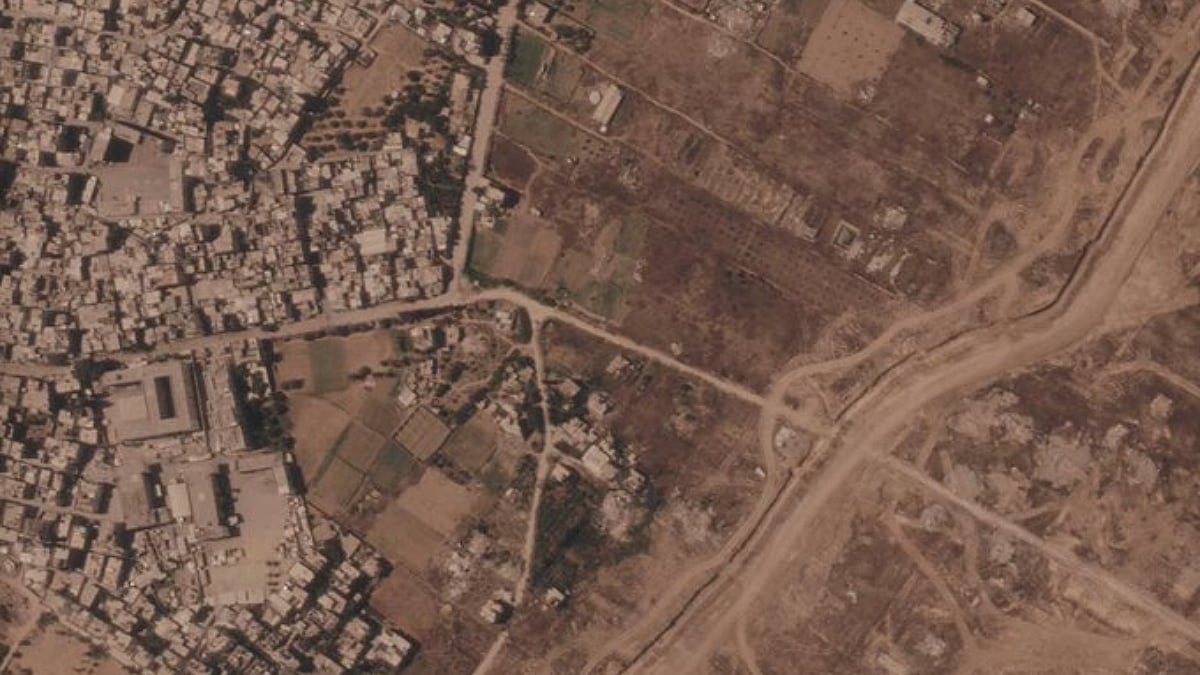
Israel Builds Massive Earthen Barrier Across Gaza, Raising Fears of Permanent Division | X - @ShropshireStar
Israel has been rapidly constructing a massive earthen barrier across the Gaza Strip, further consolidating control over more than half of the territory, according to satellite imagery. More than 23km (14 miles) of berms have been built in recent months through Palestinian communities that were demolished during military operations. The barrier stretches across a significant portion of Gaza, which measures about 40km in length and 11km at its widest point and is home to more than two million Palestinians.
The Israeli military confirmed to The Associated Press that it has erected a physical barrier along the so-called yellow line, the boundary where Israeli troops withdrew under the October ceasefire agreement with Hamas. The line was intended under the US-backed deal to serve as a temporary division until a broader Israeli withdrawal.
ALSO READ
Barrier fuels fears of permanent partition
With the ceasefire process stalled, the expanding barrier has intensified Palestinian concerns that the temporary boundary could become a permanent border. Neither US Central Command, responsible for monitoring the ceasefire, nor the Board of Peace, the body headed by US President Donald Trump expected to oversee Gaza in the future, commented on the construction.
The Israeli military informed AP that it has also created a "security zone" along the line, equipped with intelligence and technological assets. It declined to specify how far the barrier would extend but said it was intended to prevent infiltration and protect Israeli troops as well as Israeli communities bordering Gaza.
Satellite images show rapid expansion
Satellite imagery from Planet Labs PBC indicates that sections of the barrier continue to grow quickly. In southern Gaza, one segment expanded by more than 2km in just two weeks this month. Measuring about 500 metres on July 1, the berm had grown to roughly 2.4km by July 15, separating the Israeli-controlled ruins of Rafah from Muwasi, where some of Gaza's largest tent camps are located.
If construction continues along its current path, this section is expected to connect to the longest continuous stretch of the barrier, which extends nearly 17km from Khan Younis towards Gaza City. Work on this segment began in February and remains ongoing, with more than a kilometre added between June 21 and July 7 near an Israeli military base built on the ruins of Bani Suheila. Additional disconnected berms have also appeared near Beit Lahia in northern Gaza. The exact height of the barriers remains unknown, and in some places they appear to extend beyond the yellow line.
Large parts of Israeli-controlled Gaza reduced to rubble
Most of Gaza's population has been pushed into the coastal areas west of the yellow line, where many are living in overcrowded tent camps and relying on humanitarian aid. Satellite imagery shows that Israeli forces have demolished most buildings in the territory under their control, flattening entire towns, including Rafah, once home to more than 250,000 residents. New military bases and roads have been built across the cleared areas, while large stretches of farmland have also been destroyed. Israel maintains that the demolitions target Hamas infrastructure.
The military said it is working to clearly mark the yellow line to "reduce friction and prevent harm to uninvolved individuals."
Also Watch:
Ceasefire remains stalled as conflict continues
The yellow line has never been clearly defined in the ceasefire agreement or by Israeli and US officials, resulting in confusion on the ground. Israeli forces have killed Palestinians approaching or crossing the line, saying they target militants threatening troops. However, those killed have also included children and other civilians who appeared unaware of the boundary. Some Israeli soldiers have said they did not always know who they were firing at and had orders to kill anyone crossing the line.
Since the ceasefire took effect, Israeli forces have killed more than 1,100 Palestinians, mainly in air and drone strikes, while militant attacks have killed five Israeli soldiers. Under the ceasefire agreement, Israeli troops are eventually expected to withdraw to Gaza's outer edges, where an international security force would take over. However, implementation has remained stalled for months.
A former UN diplomat overseeing ceasefire coordination has blamed Hamas' failure to disarm for the delay. Talks on decommissioning Hamas' weapons have made little progress, while Hamas accuses Israel of violating the ceasefire.
The war began after Hamas-led militants attacked Israeli communities on Oct 7, 2023, killing around 1,200 people, mostly civilians, and taking 251 hostages. Israel's military response has killed more than 73,000 people, according to the Gaza Health Ministry. The ministry, which was part of the recently dissolved Hamas-run government, keeps detailed records that are generally considered reliable by UN agencies and international organisations. It does not distinguish between civilians and militants but says women and children account for around half of all fatalities.
RECENT STORIES
-
-
-
-
-