105 Years of Communist Party of China: Five Pillars Behind China's Development Story
Qin Jie, Consul General of the People’s Republic of China in Mumbai, offers a peek into the Communist Party of China's people-first approach, governance, reforms, self-correction and technological self-sufficiency that continue to define the nation's progress

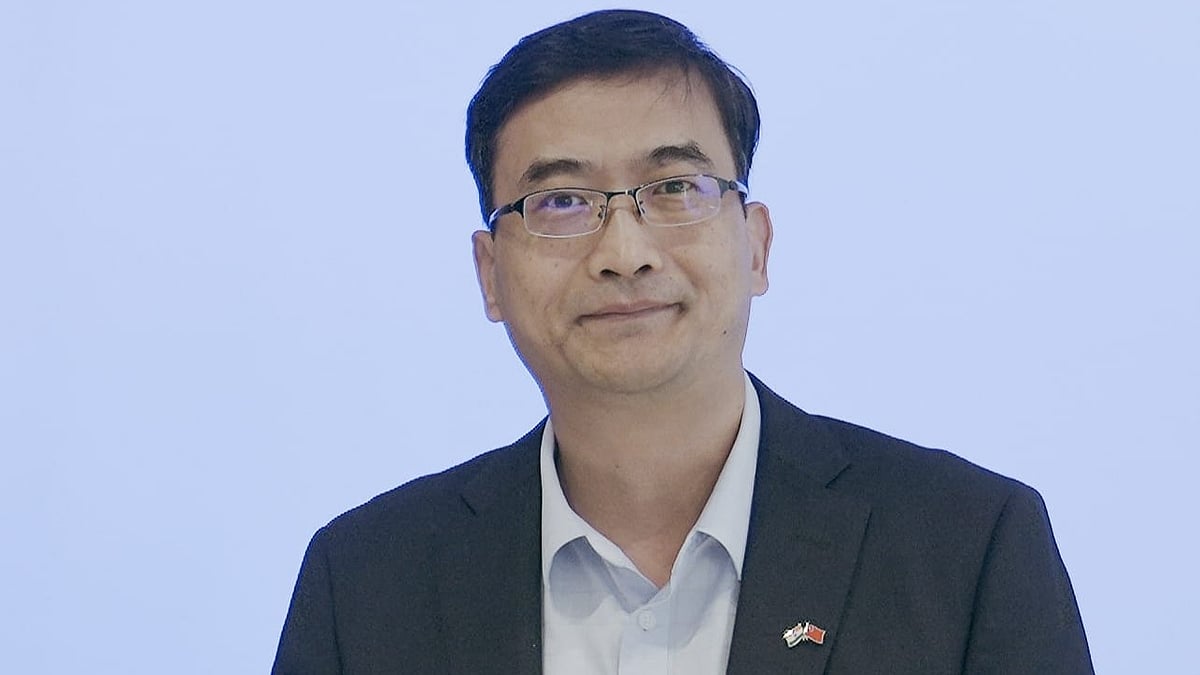
Qin Jie, Consul General of the People’s Republic of China in Mumbai |
July 1, 2026, marks the 105th anniversary of the founding of the Communist Party of China (CPC or the Party). Since its foundation in 1921, the CPC has evolved from a small Marxist party with only 58 members to a major political party with over 100 million members.
From 1921 to 1949, the Party led the Chinese people, through arduous struggles, to successfully overthrow the rule of imperialism, feudalism and bureaucrat-capitalism and establish the People’s Republic of China (PRC). And with another 77 years of hard work, the CPC has led the Chinese people in transforming China from an impoverished agriculture country into a super-size economy, with its overall national strength increasing substantially. The success of the CPC lies in multiple factors.
Being rooted in the people
As a party born in China’s peasant-worker movement in the early part of the 20th century, the CPC has set “to pursue happiness for the Chinese people and realize rejuvenation of the Chinese nation” as its founding mission. The Party has no special interests of its own, and works as the vanguard of Chinese people of all ethnic groups. In the past 105 years, members of the CPC have played a pioneering role in keeping empowering China - winning independence, constructing industries, building the world’s largest education and social security systems, etc. Of course, a most remarkable feat is by 2020, China has lifted over 800 million people out of poverty, achieving the poverty reduction goals of the UN’s 2030 Agenda for Sustainable Development 10 years ahead of schedule. In such endeavors, the Party won the hearts of the people by demonstrating it is truly a party coming out of, working for, and depending on the people.
A report released by Harvard University in 2020 based on its survey in China spanning 13 years shows that the Chinese people’s overall satisfaction toward the central government exceeds 93%.
Effective governance
In its long theoretical probing and concrete practice, the CPC has formed an effective governance system for China. For instance, making five-year plans (FYPs) plays an instrumental role in boosting China’s economy to be among the Top two in the world. This system is reliable as it is consistent and combines sound top design with finely sampled experimentation, and in due course necessary adjustments are made to finetune policies. Since the first FYP in 1953, there have been 15 consecutive FYPs, marking steady and significant advances in China’s overall development.
Besides, different from the laissez-faire capitalism adopted in most developed economies, China’s socialist market economy maintains more compelling institutional prowess in optimizing the use of visible and invisible hands. This demands the Party’s strong ability to make strategic planning that weaves short-term plans into medium and long-term ones. Currently, global attention has been on the 15th FYP spanning 2026-2030, which is set to further develop China in politics, economy, culture, society and ecosystem, and prepare China for its second centenary goal, i.e., building a modern socialist country that is prosperous, strong, democratic, culturally advanced, harmonious and beautiful by 2049 when the PRC turns 100.
Rigorous self-improvement
In the CPC’s journey of the past 105 years, there has been no shortage of risks, problems and even mistakes. In the revolutionary period, weak leadership caused the split of the Party. In the reform period, some early decisions and policies were against market rules, and some officials pursued sheer number of GDP growth while ignoring quality development. A more serious problem is the once rampant corruption in the society.
In addressing such problems and mistakes, the CPC has strengthened self-improvement, and cemented effective rules, such as to seek truth from facts, and to enhance the Party’s self-discipline. So far, high-quality growth has been firmly established as a core standard for assessing government performance, with priorities on environment protection, low-carbon economy, and sustainable growth.
Besides, the Party’s rigorous self-demand and self-improvement has promoted administrative efficiency, built clean government, and its persistent efforts in fighting corruption have proven its strong mechanism of self-correction in winning support of the people.
Reform and opening-up
The CPC values opening up and learns extensively from both history and the practices by other countries of the world, inter alia, the culture and literature, the economics and philosophy, natural and social sciences.
The Party’s reform and opening-up policy has fundamentally transformed China. Since the Third Plenary Session of the 11th CPC Central Committee in 1978, China has engaged extensively and deeply with global markets, talents, resources, etc. This not only stimulated massive innovation and strengthened economic robustness in China, but contributed a significant share of global growth over the past decades.
Today, China is a key drive engine and the largest trading partner for more than 120 countries and regions in the world, and promises to push forward institutional reforms and open wider in services, digital economy, green development, and financial sectors in its 15th FYP.
Besides, in response to global challenges including the bloc confrontations, the 2008 sub-mortgage crisis, climate challenge, and the more recent tariff and technology wars, the Party has demonstrated its people-centered approach, open-mindedness, and global vision.
The Party advocates the idea of a Community of Shared Future, encourages cross-cultural dialogues, and international cooperation, and encourages the UN to play a central and fundamental role in resolving disputes.
Self-sufficiency
The CPC leadership has long realized that self-sufficiency in core sectors such as food, energy and technology is of paramount importance, given China’s large population, weak economic foundations, and limited natural resources. China’s persistent investment in education, sci-tech, and talents has not only boosted its own capacity, but lifted China to a global leader in various areas.
According to multiple global innovation trackers, China now leads in 37 out of 44 critical technology areas such as 5G, high speed rail, AI, EVs, advanced batteries, quantum communication, materials science, humanoid robots and space exploration.
China is the world’s largest grain producer, the biggest contributor of high-impact research papers and holds an overwhelming lead in global tech and engineering patent.
The success of the CPC also lies its ability to stand free from prejudice and ideological bias. The Party adopts an independent foreign policy of peace and formally codifies peaceful development into its Party Constitution and the national Constitution.
China’s recently-released white paper titled “More Just and Equitable Global Governance: China’s Principles, Proposals and Actions”, points out that such domains as the deep seas, polar regions, outer space and cyberspace are the common property of humanity and require urgent attention in order to establish rules and close gaps in their governance.
As an international community, all countries should look ahead, jointly reform and improve the existing system to make it more compatible and aligned with the world’s realities.
Qin Jie is Consul General of the People’s Republic of China in Mumbai
RECENT STORIES
-
-
-
-
-