Aishwarya Singh On Collaborating With Friend Aryaan Misra On Desi Crime For Audible & More
The popular true crime podcasters bring 20 gripping South Asian cases to life in a new audiobook, blending storytelling, emotion, and immersive audio experiences

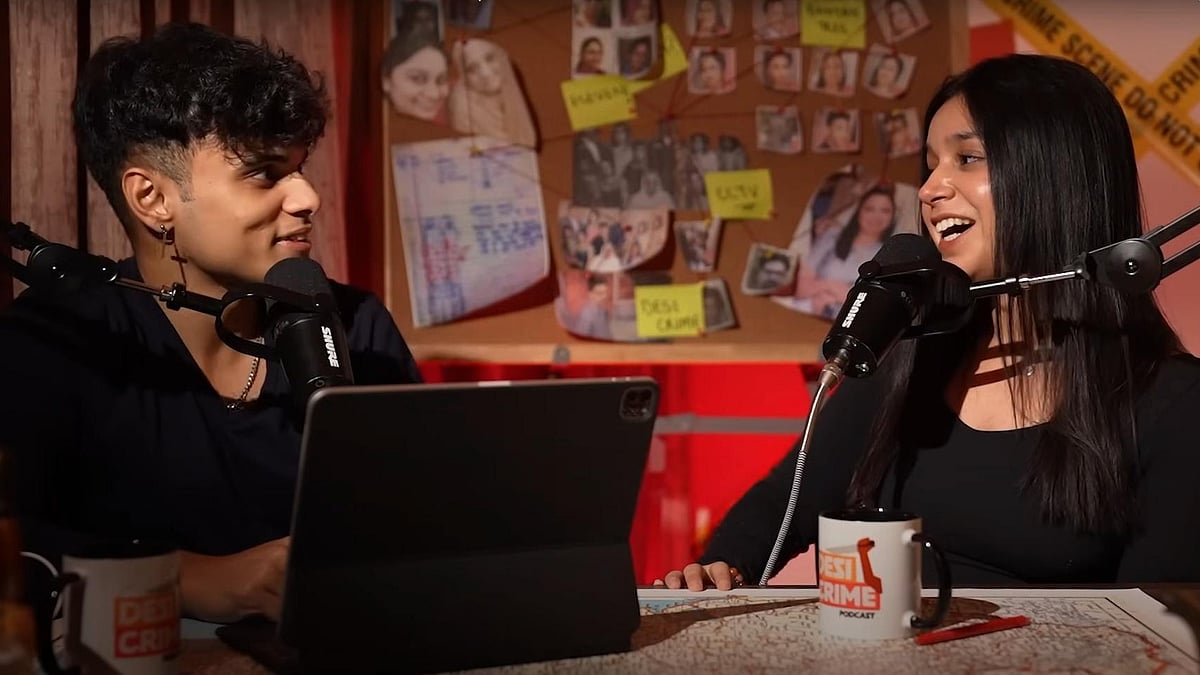
True crime is consistently high in terms of content for movies, books, TV, radio, and audiobooks. Audible has brought out Desi Crime, a gripping new audio book format chronicling South Asia’s most chilling true crime stories. Aishwarya Singh and Aryaan Misra, who co-host the audio book, are popular podcasters who co-host the true crime podcast – Desi Crime.
This chapterised compilation showcases 20 real-life cases from the Indian subcontinent and its diasporas. Created and hosted by Aishwarya Singh and Aryaan Misra, produced by Desi Studios and published by Pan Macmillan, these stories delve into some of South Asia’s twisted and haunting criminal cases, from honour killing to espionage and even cannibalism.
Singh speaks about this crime audio book offering on Audible with Misra, the stories, working with Audible, and more.
Excerpts from the interview:
What is it about Desi Crime that might excite the listeners?
I think this is a very novel format for written material in India, specifically, the way we’ve constructed the audiobook. The podcast is an interlaced narrative mixed with thoughts from the other co-host, which was the first time I experienced a book like that. It’s a book called The Book of Joy, which is a conversation between the Dalai Lama and Archbishop Desmond Tutu. I remember finding it such a jarring format because it’s not normal to have someone else’s thoughts interlaced in a book that you’re reading.
We've tried to pay homage to our own format using that. It’s 20 really gut-wrenching stories, moving tales of the subcontinent. Two are stories that have never been heard on the podcast or on our channel before. When these stories are converted into this audio format, I think they bring that impact that audio does bring with our voice modulation and the emotion with which we narrate.
How have you shown the 20 chilling true crime stories, from the writing to the narration?
This reflects the storytelling style Aryaan and I use. We focus on vivid details in each scene and try to convey the emotions that should be felt in those moments. While video can show a lot, audio lets your imagination fill in the gaps. Nothing is as powerful as what your own mind can create.
And true crime stories don’t necessarily need an infusion of emotion in general or an infusion of mystery. We’ve let the tales take that forward. Obviously, the writing had to be changed from the way it’s done for a narrative podcast versus an audiobook. So, we made it a little more formal in its conversation style. However, we’ve allowed the mystery, intrigue, and emotion to run through those stories by setting vivid scenes. I think it depends on the listener because one’s imagination is what brings out the stories.
How was the experience of bringing the true stories into audio format? Any memorable stories?
There are so many stories out of these that stay with us for such a long time. Aryaan and I often discuss this, that sometimes when we’re researching any one of these stories or working on them for the purpose of this audio book, any music that we’re listening to in general while we’re writing these chapters, that music then begins to remind us of the victims in those stories.
For me, it's Sneha Phillips’ story. She was an Indian doctor in New York who vanished a day before 9/11. The possibilities in this story are endless for what could have happened to this young woman in a new marriage, in a new city, working as an incredibly successful doctor. Her parents are still figuring out whether or not she vanished a day before and was a victim of a different kind of attack, and her story just got overtaken by 9/11. For Aryaan, that story is the Kohistan video murders because he ended up getting in touch with a Reuters journalist who worked very closely with the main victim in the story, Afzal, who was shot in, I think, Kabul.
Certain stories stay with us for different reasons. Sometimes, we see ourselves in them. Aryaan and I both have younger brothers, so stories about young male victims feel especially personal. Other times, hearing a story firsthand from someone close to the case makes it even more powerful.
How was it working with Audible?
Audible is the torchbearer, the frontrunner of audiobooks. My first introduction to audiobooks has always been Audible. I find the user interface so incredible to use. I remember traveling in Greece, and I really wanted to read Stephen Fry’s ‘Mythos’. I wanted to learn about Greek history while traveling. I didn’t want to travel around with a book in this foreign country. So, I have my headphones on and listening to Greek history while walking down the streets of Greece. I can see those chapters there. So, for those reasons, Audible is the first choice for anyone in this space.
Working with Audible has been a great experience. It was easy to adapt our content to audio with a team that understands storytelling in this format. Turning written material into audio is tricky, since podcasts and audiobooks have different tones, but the Audible team made the transition smooth.
How different is the audio format from the visual one when it comes to storytelling?
I’ve always been an audio consumer. It goes back to something I said before, that there are emotions that strike deeply into each of us differently. Someone might feel jarred by a different kind of detail; a different person might be jarred by a different kind of detail. Those are all so deeply rooted in our own individual experience and our lived life stories that no video I can find can do justice to that. It’ll do justice most to my own version of it or my editor’s version of what is the most striking detail in the story.
An audiobook lets you determine that for yourself. To me, that’s exactly why true crime has always been something I’ve consumed on audio. Nothing, for me, can replace what my brain will create of a visual because that’s so deeply rooted in my life story. I think that’s true for listeners across the world. I think people’s adoration for true crime in the audio format is true for the visual format. But the way true crime blew up in the podcasting world is unparalleled.
How do you see the audio medium thriving in a country where the visual medium is popular?
I think we’re so new to podcasting. But we’re not new to audio as a form of storytelling. We’ve all heard those radio shows. I remember this was about 10 years ago, when ‘Ek Kahani Aisi Bhi’ used to be like an FM show late at night when you were driving. Those were horror tales told. So, I don’t think we’re necessarily new to audio in terms of true crime, lore, and horror. Also, any community sitting together and discussing historic lore, discussing crime, it’s all audio narration of crime. So, we’ve had it culturally for a long time. What is new for us is podcasts.
Many of our listeners tell us we’re their first introduction to podcasts. Maybe it’ll take people time to get used to it. I think audio is the same way, but we’re seeing a growing rise. We’re seeing many podcasts in so many mediums across the country. We’re seeing a rise in people listening to audiobooks with the way we consume media. People have less time. They don’t want to have physical books with them. There is an upward trend, and genres like true crime make that transition easier. People listen to them for entertainment. Fortunately, or unfortunately, they’re easier transitions into an audiobook as opposed to deeper textual material.
What more projects can we expect from you?
We have another book from us in the works. And if that is to get converted into an audiobook, Audible will always be option one!
RECENT STORIES
-
-
-
-
-