NASA’s James Webb Telescope Captures Stunning ‘Cosmic Brain’ Nebula Around A Dying Star
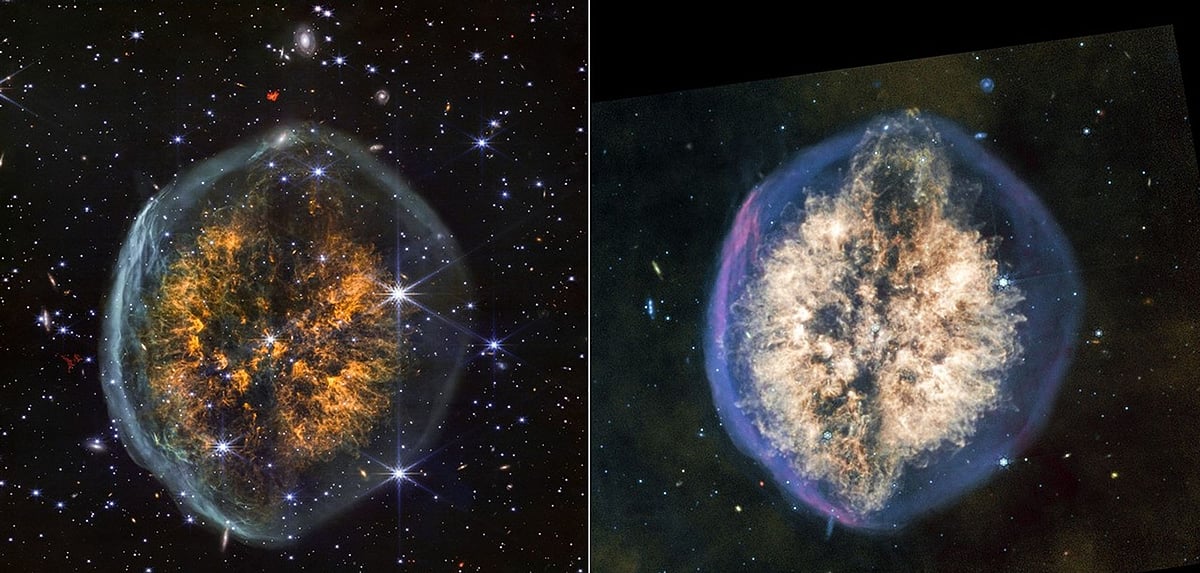
The James Webb Space Telescope captured striking images of the PMR 1 Nebula, a gas cloud formed by a dying star. Nicknamed the “Exposed Cranium” for its brain-like appearance, the nebula reveals intricate dust and gas structures. The observation offers new insights into how Sun-like stars shed their outer layers and evolve into white dwarfs

NASA website
Astronomers have revealed striking new images of a mysterious nebula that appears to resemble a giant brain floating in space. The detailed observations were captured by the powerful James Webb Space Telescope, offering an unprecedented look at a cosmic structure formed during the final stages of a star’s life.
The unusual nebula, officially known as PMR 1 Nebula, has intrigued scientists for years because of its eerie appearance that resembles a brain inside a translucent skull. Due to this distinctive shape, researchers often refer to it as the “Exposed Cranium” nebula.
A rare look at a star’s final moments
The nebula is created by a star nearing the end of its life cycle. As stars run out of nuclear fuel, they begin shedding their outer layers into space. These expanding shells of gas and dust form glowing clouds known as planetary nebulae.
In this particular case, the Webb telescope managed to capture the star during a relatively brief phase of this transformation. While such events take thousands of years to unfold, they are considered rapid on a cosmic timescale.
The detailed imagery highlights intricate patterns of gas, glowing filaments, and dust structures that contribute to the nebula’s brain-like appearance.
Earlier discovery by spitzer
The nebula was initially detected in infrared light by the Spitzer Space Telescope more than a decade ago. However, its structure appeared far less defined at the time.
With Webb’s far more advanced infrared instruments, astronomers can now observe finer textures and internal structures that were previously impossible to see. These improvements make the nebula’s striking resemblance to a brain even clearer.
ALSO READ
What happens when stars die
The final fate of a star depends largely on its mass. Massive stars can end their lives in spectacular explosions known as supernovae. Smaller stars, similar to the Sun, follow a quieter path.
Such stars slowly eject their outer layers, forming colourful nebulae like PMR 1. What remains at the centre is a dense stellar core called a white dwarf, which gradually cools over billions of years.
RECENT STORIES
-
-
-
-
-